
 •
Versione 1
Rating:
•
Versione 1
Rating:
THE REVIEW
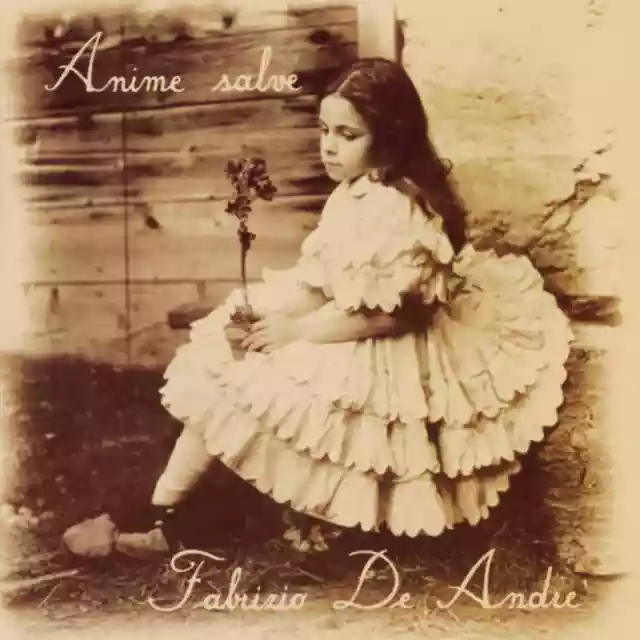
[In this review, I will only talk about the song Anime salve]
I have read several comments about the album Anime salve, all quite accurate. But throughout these years, now more than ten since I discovered De André, there's always been some skepticism lingering. I wasn't convinced that the common interpretation was the most accurate, or simply the only possible one.
I listened to the tracks on this album and couldn't understand; my understanding was lacking. And so, I avoided this album for quite some time. Too enigmatic, too cryptic. In particular, the song that gives the title remained incomprehensible to me. Therefore, I let experiences, readings, my understanding capabilities settle.
Then last night, before sleeping, I felt a need, the necessity to listen to a song that was a source of knowledge, a consoling yet disillusioned spark in the middle of the night. I don't know why, but I put on Anime salve. Not the whole album, just a couple of songs. After years, I confronted the song in question. And maybe I understood it.
The «anime salve» that Faber talks about are not those who go in obstinate and contrary directions, not the Romani, not the excluded, the prostitutes, the dwarfs. He already spoke about that in the Sixties; it wouldn't have been a further development of his poetry. The anime salve are all the souls of men because the soul is a «beautiful deception», i.e., it doesn't exist, it's an illusion.
The vision of De André and Fossati is profoundly metaphysical, from an external perspective on life. And then everything becomes a game, a frin frin, good and evil disappear, they blur until they become identical. They are all «just passages and passages / passages of time». Man's life is this: «a thousand years in the world, a thousand more». A tiny thing, killing time, a year more, a year less.
Good and evil no longer disturb: «They were furious days / without acts of love / without the calm of the wind», but there will also be «future encounters of beautiful, wicked lovers». It doesn't matter much: they will be worries for another thousand years, but this is life, «infinite hours like constellations and waves».
There is an a priori acceptance of existence because it's the only thing we have, and everything gets mixed up. Time flattens: memory is relentless, and yet it's never enough; we continue to face life and its harshness. And then the future, which is beautiful only before it arrives, but it doesn't matter. Another thousand years, we endure a little longer.
The assessment of one's time cannot be clear: «and how great this time / what loneliness / what beautiful company». Apparently a paradox, but not in the depersonalized vision of this song. Life is companionship, but it's also great loneliness. De André sees himself from outside: «I watched myself cry in a snow mirror / I saw myself laughing / I saw myself leaving with my back turned».
The things in life, the failures and tragedies, are ground to dust by time. The value scale is lost: «I spied on myself deceiving and failing / aborting children like dreams». A child, the most carnal and concrete thing that exists, is likened to a dream, clouds of thoughts. Because life and dream overlap, everything aligns in a radically different and detached knowledge horizon.
This is the lyrical surplus of the song, incredibly difficult to understand (I have read other reviews and found no analysis on this single track). And so here is the final poetic step of Fabrizio: after elevating the last, after dismantling bourgeois canonical thoughts, after loving the prostitutes, he arrives at the final vision, summing up his existence: a deception, many passages of time, illusions and failures, wicked lovers, children, and dreams. But it was beautiful, a great company. And so, let it continue (hurting ourselves a bit): the future, another thousand years.
The words come out slowly, deliberate, grained. The melody almost disappears because these are visions to be solemnly recited. And the English horn frames the verses in a sacred way, while still maintaining a lively and almost festive tone. That sacred, tragic, and joyous feast that is life.
Loading comments slowly
Summary by Bot
The reviewer shares a deep, personal journey to understand the enigmatic song Anime Salve by Fabrizio De André. Highlighting its metaphysical vision, the song transcends common interpretations, presenting life as a blur of illusions, time, and companionship imbued with both loneliness and beauty. The poetic, solemn delivery elevates the eternal human experience with rich symbolism and profound acceptance.Tracklist Lyrics Videos
Fabrizio De André
Italian singer-songwriter (cantautore) Fabrizio De André (18 Feb 1940 – 11 Jan 1999) is known for poetic lyrics, narrative songs about marginalized people, and landmark albums including Creuza de mä and La buona novella.92 Reviews
Other reviews
By Grasshopper
De André is primarily a poet, Fossati an already refined musician.
'Smisurata preghiera' is a hymn to 'those who travel obstinately and contrary to the direction,' embodying De André’s entire artistic journey.
By Poletti
Fabrizio De Andrè... one who went beyond any pleonastic reasoning, one who knew how to reconcile Present and Future, one who distinguished the boundaries of divine greatness.
Enormous prayers... we, with all the love and goodwill, could never be enormous: we are Men, therefore, we are Normal. In fact, Extremely Normal.
By hypnosphere boy
This Work is a grandiose and poetically suggestive 'structure' within which poetry unfolds in dramatic, sad, joyful, amusing, epic, and elegiac registers.
'Smisurata Preghiera' ends with an invocation to a divine justice, traversing infinite nuances between tragedy and comedy without touching either limit.
By enbar77
One of the most touching, profound, introspective musical expressions existing on the face of the earth.
Deus ti salve...Fabrizio.
By jubilasiatikusu
Mi dispiace, sembra che non hai incluso una recensione nel tuo messaggio.
Per favore, invia nuovamente il testo HTML della recensione e sarò felice di aiutarti con la traduzione mantenendo il formato HTML.
