
 •
Rating:
•
Rating:
THE REVIEW
The ancient dilemma between believing and not believing, blindly following eternal myths or comfortably defiling oneself, places man before two great themes: the grandeur of the Universe, the wretched nature of Man.
Man (purposely analyzed with an uppercase initial, making it as philosophical as possible) travels between the members and fringes of a very flat existence, which could also be majestic if he only managed to reconcile Present and Future. Meanwhile, the Universe spins, among millions of planets and black holes of epic proportions, between a lunar phase and a principle of ectoplasmic conservation, myths, and perhaps too tenuous boundaries pass from Him. Or perhaps too complex for human nature.
What save our lives are emotions and virtues, but also those flaws we so deeply despise. One is born with flaws, one dies of vices. And we take refuge in secret hideouts, in crazy crevices, which perhaps until a little before we despised (or, more simply, did not know). Some are much less complex, open a book or hear a musical score fly high above the sky. Certainly, they do not listen, at most they hear it. Absent-mindedly, and if they try to understand something more, they end up drowning in it. In the mire, which is mire of gold: but it is still mire.
And to think that all it would take is a gesture, a word, maybe a poem. Because sometimes, to save our existence, it is precisely the poets, whether they are Great or Poor (still philosophically speaking, the sports discipline does not come into play here) that do not matter. Baudelaire, Verlaine, Carducci, the poets of the infinite, from school books, from our darkest thoughts. It is therefore useless to speak to you of Fabrizio De André, one who is in the Olympus of music, but is not even mentioned in a mere school book (blessed studies! blessed school reform!). One of those poets, indeed, one of those people (hence Man) who knew how to align with the Universe, one who went beyond any pleonastic reasoning, one who knew how to reconcile Present and Future, one who distinguished the boundaries of divine greatness. A character desperate in his own lucid intelligence: traveled here and there among eternal space-time suspensions and analyzed society without frills or petty poetic whims. A poet aligned with time, capable of distinguishing between Good and Evil, True and False, and then spitting it in our face, with all the anger and love (and a subtle pain typical of poets): so much so that, like all the greats, he knew how to tell us, at the turn of the millennium and the century, how to save our soul. Or rather, that our soul was not so secure. He was a saved soul, we were not, and we have never been, "Saved Souls".
Because out of time, in the unexplored territories of Creation that only poets know how to traverse with extreme clarity, reside, live and lodge characters who are vile and sneaky, wonderful and astonishing, atypical but not stereotyped: there is a man, now a woman, with essential and cursed contours, who calls themselves "Princesa" and captures the moods of the world. Society changes (our way of seeing things, therefore) because it comes from the Universe, and it is not a Man, it is a superior being. Like the so-called wretched lives of gypsies, who "by being wind" become enormous, larger than us, more bourgeois than the bourgeois, more normal than the normal. Parallel universes that we Men cannot understand: our wretchedness is proportional to the humanoid beauty transfigured in poets. So much so that we, little men, do not even know how to pray. Or rather, we think we know how to do it. Hands joined to invoke a most holy pity (and we return to the principle: to believe or not to believe) only to see ourselves rot in the flames of a Metropolitan Hell, in which Monsieur El Diablo takes forms and styles of a piece of scrap metal beneath the ground. Because we believe that the Universe listens to our supplications, but the Universe listens only to "Enormous prayers".
And we, with all the love and goodwill, could never be enormous: we are Men, therefore, we are Normal. In fact, Extremely Normal.
Loading comments slowly
Summary by Bot
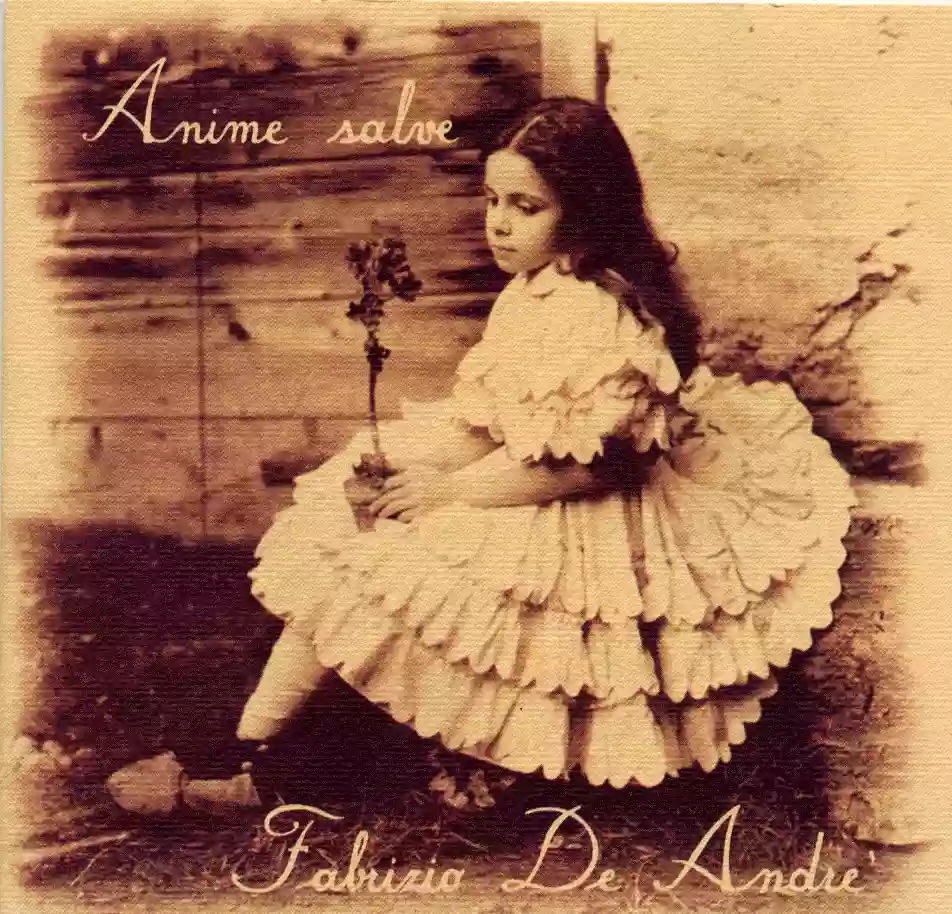
This review praises Fabrizio De André's album Anime Salve as a profound exploration of the human condition against the vastness of the universe. De André is lauded as a poet of timeless clarity who reconciles present and future. The review reflects on themes like flaws, virtues, and existential dilemmas through his music. It highlights the poetic depth and societal insight present in the album, positioning De André as a lasting figure in music and poetry.Tracklist Lyrics Videos
Fabrizio De André
Italian singer-songwriter (cantautore) Fabrizio De André (18 Feb 1940 – 11 Jan 1999) is known for poetic lyrics, narrative songs about marginalized people, and landmark albums including Creuza de mä and La buona novella.92 Reviews
Other reviews
By Grasshopper
De André is primarily a poet, Fossati an already refined musician.
'Smisurata preghiera' is a hymn to 'those who travel obstinately and contrary to the direction,' embodying De André’s entire artistic journey.
By hypnosphere boy
This Work is a grandiose and poetically suggestive 'structure' within which poetry unfolds in dramatic, sad, joyful, amusing, epic, and elegiac registers.
'Smisurata Preghiera' ends with an invocation to a divine justice, traversing infinite nuances between tragedy and comedy without touching either limit.
By enbar77
One of the most touching, profound, introspective musical expressions existing on the face of the earth.
Deus ti salve...Fabrizio.
By jubilasiatikusu
Mi dispiace, sembra che non hai incluso una recensione nel tuo messaggio.
Per favore, invia nuovamente il testo HTML della recensione e sarò felice di aiutarti con la traduzione mantenendo il formato HTML.
By joe strummer
The «anime salve» that Faber talks about are all the souls of men because the soul is a «beautiful deception», i.e., it doesn’t exist, it’s an illusion.
Life is companionship, but it’s also great loneliness. De André sees himself from outside: «I watched myself cry in a snow mirror / I saw myself laughing / I saw myself leaving with my back turned».
