
 •
Rating:
•
Rating:
THE REVIEW
Label: Volcano / Sony BMG
Year: 2006
Duration: 75:52
Genre: Progressive Rock
1. Vicarious
2. Jambi
3. Wings for Marie
4. 10000 Days (Wings for Marie Pt.2)
5. The Pot
6. Lipan Conjuring
7. Blame Hoffman
8. Rosetta Stoned
9. Intension
10. Right in two
11. Viginti Tres
Maynard James Keenan - vocals
Adam Jones - guitars
Justin Chancellor - bass
Danny Carey - drums
Introduction
Some records, after just a couple of listens, run out of steam, their vitality evaporating from the stereo speakers after their simple tricks are unveiled.
However, there are others for which not even a double-digit number of listens allows total comprehension, and the insistence with which the CD passes and repasses in the room, in the car, in the headphones on the way to work or before falling asleep is nothing more than an eternal attempt to unravel the mystery, whose undecipherability is the very reason for the genius's allure; even when resolved, there remains an unconscious reverence for an entity superior to mechanical materialistic consumerism, and even when, long after the first approach, every tiny passage peeks into the brain a moment before hearing it again, it is precisely this memory that soothes the thirst for emotion of those who listen: "10,000 Days" belongs, thank heavens, to this category.
In a temporal perspective, Tool's new LP is more offspring of its predecessors than they were of each other, and compared to them there is already upon first listen a certain attenuation of the surprise effect: the Los Angeles band resumes with the alien, icy, and tribal sounds of "Lateralus" but partly recovers the sonic armageddon of "Aenima" and more unexpectedly the direct and tearing metallic structures of "Undertow" and "Opiate", with open and decidedly heavy sounds, seemingly simple but the fruit of hours spent on arrangements.
In short, just as the previous works differed from each other, this one approaches them all and the hunt for references to past tracks appears long: there are often references to the title track of "Aenima", but also to the bastard riffing of "Prison Sex" or the icy and futuristic sounds of "The Grudge", in addition to some ensemble solutions (the miraculous - and long-lasting - groove of "Schism") that manifest as small déjà-vus.
Naturally, the overall picture does not stop here, because there is novelty even among these tracks, and it is a growing propensity for the dynamism of structures, with an expansion of the sonic range comparable to the psychedelia of acid rock (Grateful Dead) and the delirious modal music, the effect of the further dilation of the pieces' performance times that, combining the various tracks ("Wings for Marie Pt. 1 and Pt. 2", "Lost Keys" and "Rosetta Stoned", "Intension" and "Right in Two"), exceed a quarter-hour duration repeatedly.
The individual action of the four Californians also allows these elements to emerge: Adam's sound seems the least progressed of the collective, but even though the heavier chords and other personal solutions have been familiar for several years, the syncretism infused in the LP inflates the more hedonistic side of listening, sending auditory channels adrift in the wake of his sly hands: educated hands cooking Zeppelin-inspired first courses (with a touch of Soundgarden's nouvelle cuisine) and foul-smelling Sabbathian soups, remembering old traveling companions Life of Agony, Alice In Chains and especially the archaic post-punk of Black Flag (or the Rollins Band) which, born already tired, had been rather stimulatingly revisited by the debutant Tool. Above all, a progressive flavor, an evil child of King Crimson.
Maynard shines, as always, in each composition: a chameleon of Malibu beach, Zelig of modern rock. With obsessive punctuality, he continuously changes guises, flaunting his tonal and interpretative skills: he whispers, urges the instruments, is moved, screams angrily, soothes the listeners' eardrums with characteristic harmonies but continues to remain unrecognizable, now with vocal cords of a child, old man, eunuch, woman, androgyne. There is a not remote possibility that he is the true architect of "10,000 Days"' success, compensating with refined talent for some excessively monotonous moments and illuminating the right path to avoid getting lost among the long compositions, as if the others were constructing a completely dark corridor where his voice is the lantern leading to the exit. A rather stark change of direction from "Lateralus", where his robotic interpretation contributed to swelling the strong psychic unease that emanated from those tracks.
One might think Danny, after his last effort, had completed his evolutionary journey, but reality is entirely different: perhaps the wonderful drummer has become black, painted his body and made huge holes in his lobes, because he plays as if he had been teleported from a tribal bonfire in Uganda; at times instead, here's him with a beard, long hair, transforming into a dirty, technical Meshuggah drummer who beats as an obsessed...but always in front of a fire in the desert! It's simply incredible to observe the evolution of this musician's style starting from the performance of "Opiate", where - as an excellent heavy metal drummer he is - he kept time with expertise and taste, shining with the use of all the typical solutions of the genre (dizzying Lombardo-style rolls, frantic use of open sounds, and truckload double pedal), up to the - so odd they're evenly electronic and percussive patterns he unleashes in the concluding moments of this "10000 Days", and the arrival at a personal and indisputably hermetic technique.
A tough job for Justin to stay on the heels of such a monster of skins, but the newcomer (so to speak, after ten years) does not shirk his responsibilities, even striving to appear and achieving dominance of the record in some memorable passages - above all the title track - where the mark of his instrument is indelibly imprinted: not a single second passes without the bass reminding of its importance which, if in most groups is systematically overlooked, is instead fundamental for the definitive achievement of the Tool sound, profoundly dark.
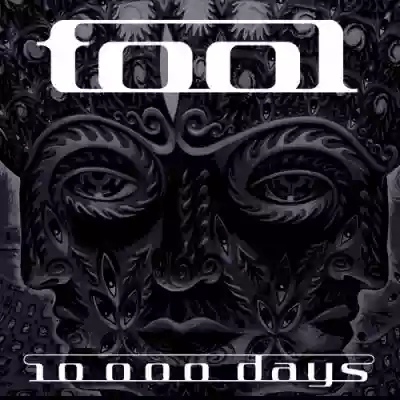
A small parenthesis regarding the artwork: the packaging is a very rigid and practically indestructible digipack; the booklet - on glossy, thick paper - is vertically divided into two parts for each page with the same images (photos and graphic art) reproduced on the right and left: these can best be enjoyed with the attached stereoscopic lenses, taking a trip with both eyes and mind. The most recurring design is that of the cover, a sort of two-faced Janus with eyes scattered everywhere, a mixture of the symbolism of "Lateralus" and Aenima, which - perhaps is a must - seems to recall the theme of duplicity and hypocrisy, recurring in some moments, but also - when in the interior's colored figure reproduced infinitely like a gallery - the divine.
It would be an absolute injustice to stop here, after a superficial and general examination, without recognizing to each song its imposing redundancy, almost as if each wanted to outshine the brightness of the others in a fratricidal struggle between vain pieces of art.
I
The guitar at the beginning of the first track "Vicarious" is light - but creeping and resentful - but the rising trill of the alarm clock (if desired, a nod to Pink Floyd's "Time"), as one would hear progressively emerging from sleep, provokes a clamorous explosion of consciousness, and for all the inept whose neurons drowse impatiently to genius, the moment to choose arrives in mere seconds: listen or judge, nap with indolence or live this new experience? The purportedly flowing melody streams fluidly, luminously amidst the steel flows of the bass, and a timid little voice passed through sandpaper, totally devoid of harmony, follows it, darting here and there - "I need to watch things die" - only to return composed on the staff. Only a few minutes, it's already over... no, the river narrows but the flow increases, with small gusts the drums mark a new march, breathless, the words shatter and reassemble, regressing to the carefree and desperate syllable - "lalalalalalalalalai" - a secure rest in the chaos' ongoing maelstrom. Among confused voices, the airy guitar reappears for a while: the alarm rings again, the last 100 seconds progress on a path already clear to us but which we wish to tread anew under a fresh light, and while the vocal flickers reach magnificent and distant heights, a rhythmic delirium unwinds every impression, resets everything, and digs the furrow to welcome the following word.
A manifesto of hypocrisy - if not contemptible satisfaction - that permeates us in front of others' tragedies, "Vicarious" has lyrics that Silvia Vada and the Studio Aperto editorial board could adopt as a Statute, and with them all those who, like vampires, feed on humanity's misfortunes. Direct verses with no need for interpretation, as have never been written since "Hush", impactful phrases, reflective invitations ("Why can't we just admit it?"), ironic pathos crescendos ("Cause I need to watch things die... from a distance" - "I need to watch things die... from a good safe distance") and cantilenas of indifference unfold in the final revelation of "Much better you than I". The annoying question, settling in the conscience, is: do we really enjoy living seated on a couch, relegating the world's and human life's fate to TV (hence, indeed, "Vicarious") while we head towards self-destruction?
II
"Jambi" attacks forcefully (perfectly transitioning with the conclusion of "Vicarious"), the six strings vibrating irregularly and distorted; then, with a bit of hesitation, the ticking percussion steps in and while whispering of gentle words evaporates, proclaims the sensation - prophetic - of an impending abrupt storm; just a brief pause and there it is, no, it's just a vague clouding over, but the weather is changing.
The voice insists - "wish it away, wish it away, wish it away, wish it all away", distracts for a moment but immediately, with an indescribably lyrical magic, resumes authoritatively (and with immeasurable splendor) the letters and meaning of the previous verses - "if I could I wish it all away" (a passage to bequeath to posterity) - and there they are, the lightning and thunder slicing through the atmosphere - "Dim my eyes" - paving the road to heaven for a vocally modulating solo. A new hiatus? No, it’s progression, baby, pressing on the loins and lifting the body now captive of a musical infatuation until the climactic ending.
If the previous was easy to decipher, trying with this one is tough: however, it's worth spending a little time pondering it.
"Jambi" is a genius from a lamp (in this sense, the recurring theme of "wish it all away" could be understood), but it’s also a region in Indonesia ("Feast like a sultan I do"); there's talk of a deal with the devil - "Tempted the devil with my song and got what I wanted all along" - but with regret ("if I could I wish it away") for which to thank son Devo or the mother ("You're my peace of mind, my home, my center (I said) I'm just trying to hold on. One more day"). The theme of the Two becoming One appears - "Shine until the two become one" - traces from "Schism" and recurring in "Right in two". All things considered, it would seem a positive track, almost narrating a religious conversion... or is there a key that reverses the meaning and returns the usual acidic and anti-Christian Maynard?
III
"Wings for Marie" is an infinite ecstasy: sixteen anguishing minutes of hope, illusion, simple memories, and sweet recollections, moments of sincere humanity overflowing from a sonic magma of unexpected, psychedelic, acid grandeur but tragically real. Engaging in it one accepts to participate in a ceremony that awaited nothing but our consent: "Pt.1" takes flight with a simple electronic pulse, a heart destroyed but beating preparing for an immersion in a new reality, to sublimate fears and life's tragedies; an obsessive, visionary arpeggio, broad visionary and, little droplets of lyricism distilled by each of the four priests in the act of lifting the devotee with exhausting slowness, up, ever higher, only to release them in a blow, like this, letting them fall into the sacred bath of art that purifies and elevates the spirit, in a perfectly muted thud of electric chords and skins that shakes, fears drowning, until the wise acting of the druids brings the initiate back to air, to listen to the next "Pt.2".
It's the divine Adam and Justin (as-ton-ish-ing) officiating the rite under a whirlwind of thunder and drizzling rain, while Maynard insistently drags the adept hand-in-hand on a familiar path, where to the preconciliar psalms of father Roger Waters and the mastodontic heresy of the Neurosis sect, the new tools of rock add a modernist sensitivity (and perfect sound), where the lack of great harmonic variations is a very slow but constant levitation towards a world of chasing percussions and stealing the scene from the lone verses of the phenomenal guitarist, until the novice is ejected with more force into the tub, in an anti-symmetric retrograde journey that decays into a sad and melancholic poetry ("Allheluja, it's time for you to pull me home"), closing the word circle from which the rite started.
It's not strange - on the contrary, it would be the opposite - if (after several listens) after "Wings for marie" you want to stop the stereo: it’s necessary to reflect, to let new layers of (ir)reality thoughts form, or simply realize we've been holding our breath, need to swallow the saliva that's remained motionless between cheeks and gums and feel the air that gives us life, regenerating into a new existence after this exhausting ritual.
Small enigmatic parenthesis: the guitar riff of "Pt.1" fits perfectly with the bass riff of "Pt.2", and indeed returns in the second half of this; it is said - to verify the validity for yourselves - that the two tracks can be listened overlayed with excellent results and that, ended the Pt.1, on the continuation of Pt.2 "Viginti Tres" can be added and indeed the timing matches: summing "Pt.1" and "Viginti Tres" (6:10 + 5:03) you get 11:13, which is exactly the duration of "Pt.2".
We’re not at the Fibonacci sequence of Lateralus levels, but maybe it's more than a coincidence, try it to believe it...
"Wings for Marie" is a declaration of a child's love for a mother (Judith Marie Keenan) who, after 10000 days of paralysis due to an accident, left this world a few months earlier: an epigraph that Maynard writes with all the words of love he possesses, as if to prove his controversial affection, perhaps repentant of not having done it before.
In "Judith" by A Perfect Circle, Maynard attacked the mother and - above all - her religious faith: now he whispers sweet words of angels, light, prayers, with the gratitude of someone who knows the woman for thirty years had no life of her own ("Didn't have a life, didnt have a life") but, with faith, example, mere presence, saved ("but surely saved one") his.
It's not a religious conversion, though with some verses - "This little light of mine, the gift you passed onto me, I'll let it shine, to guide you safely on your way. Your way home." - it comes very close: it seems more an affectionate adoption of the feelings of a beloved person, whose life of dedication and suffering - overcoming the initial rejection for the destined fate - appears to the son as a hell ("Ten thousand days in the fire is long enough. You're going home."); it's for this reason that with one last affectionate wish, it's hoped that after death that person has the awaited reward, and they're even encouraged to claim their wings. Precisely on such a claim (crafted in a family empathy of incommensurable beauty) the interaction between music and words is sensational (with double voice): "Shake your fist at the gates saying. I have come home now. Fetch me the spirit, the son, and the father. Tell them, their pillar of faith has ascended. It's time now, my time now. Give me my, give me my, wings.", an inspiring progression (mandatory thrill), a prayer wishing paradise to Marie (and with a bit of benign emotion we imagine her waving the fist asking for what she's due), offering us a piece of earthly paradise with a musical climax that smacks of art.
For my funeral soundtrack, I used to think until recently of a modest Mozart Requiem Mass: the release of this piece has shaken the certainty of my choice...
IV
Like a detonation, the words (the vocal track in the background is extremely precious, almost inaudible, anticipating the next verse) of MJK in an intense high tone shake the room dust, marking the pace of the new fresco "The Pot". Supported first by tribal percussion and then by a bubbling bass, the chant grows conceitedly almost irritated while the guitar languishes and intervenes languidly but insistently: in the third verse though, precisely the strumming (after much sonic acrobatics, with great class Adam extracts from his Gibson-cylinder a true white rabbit riff) becomes the protagonist and the piece morphs into a great choral test, perfectly written and arranged, without particular changes or oddities but compact and sure on its path: it's pleasant to chase it in the final passages between abrupt halts - "Liar, lawyer, mirror show me / What's the difference?" - and robust recharges until the powerful closure.
Various moments of nostalgia are evident, and the assonance with little gems from the past, particularly "Opiate" (and something from "Dirt" by AIC) is very apparent, along with the will to strike with simply "beautiful" song after so much grandeur.
It doesn't necessarily talk about drug use and abuse in this song, and weed appears as a ploy to talk about hypocrisy. With metaphors and aphorisms, Maynard paints the picture of a hypocrite waving a finger at others ("Who are you to wave your finger?"), even though guilty of reprehensible acts ("Rob the grave to snow the cradle / Then burn the evidence down") for which he doesn't hesitate to cover his ass. Only in front of the mirror ("Mirror, for you what's the difference?") does the hypocrite realize his faults, the dark swamp he’s submerged his life into, and cries remembering the criticisms of people close to him about his false and self-referential behavior, realizing that perhaps he's the one truly high ("You must have been high").
V
The break we weren't granted earlier arrives at this point while the hunger for expanding knowledge grows: here then is a very strange dialectal chant, very vocalic, probably in Enochian language, preparing the stream of consciousness to which we are about to bear witness; a filler, but if there were always so pregnant.
Suddenly we're catapulted into a hospital, at the bedside of a man in total mental disarray, reluctant to answer medical personnel's questions: in the background, ambient noises of the ward, and the excruciating guitar feedback - overlaid with an electric arpeggio - proceeds to wipe clean the ton of input received so far, while the doctor asks the patient about the reason for this state: the answer comes with that "Picture this if you will" raising the curtain on "Rosetta Stoned". A disorderly stream of consciousness, seemingly a copy and paste without head or tail; in reality, a complex set of very different scores, amalgamated only by the guitarist's fingers weaving an elusive thread that only by miracle does not lose unity. Indeed there are in the order of two-digit variations where the other three Tools indulge, from the hoarse and nervous vocal affected by multiple overdubs (remarkable in reproducing the protagonist's discombobulation for what happened), stripping every certainty off the listening, through ungraceful screams, hallucinogenic chants - "He looked right through me[...]Cause this shit never happens to me", cold repetitions ("Shit the bed") and a single, big, high-tension melodic part; needless to underline again Danny's laborious rhythm, managing to stand out even amid this mathematical entropy thanks to what I guess to be the major part of his drum-kit.
The story is a mix of narrative planes, better avoid giving an immediate explanation to its sense: "Rosetta Stones" is however an anagram for "Alien OR ExTraterrestrial TESTS ON Dave". The Maynardian stream of consciousness is indeed the tale of a fifth kind encounter with extradimensional intelligences, which the Angelinos do not miss to pepper with irony - "They chose me, and I didn't even graduate from fucking high school" - reaching comedic peaks in the musical climax where MJK shouts "Overwhelmed as one would be, placed in my position. Such a heavy burden now to be, the one. Born to bear and write you all the details of our ending. To write it down for all the world to see. But I forgot my pen! Shit the bed again... typical.". Could it hide something else? It isn’t excluded, but for now let's be satisfied with the deadly trip we can undertake just by listening.
VI
When "Intension" arrives, you realize the preparation for the grand finale. It's a piece similar to a disease, hard to let penetrate into the blood: the immune system wanting easy entertainment music, all choruses and polite sounds, conditions even the most trained ears and before the infection invades body and mind more meditated listens are necessary. The key to interpretation is the relentless "Pure as we begin" recited like a mantra, almost starting the - long - process of exiting the record: several minutes of sound carpet with a constant weave are nothing but a long preparation-purification for the next track, and when at the end the electronic drum patterns slide harmonically out of rhythm until they fade, something great is expected to conclude this artistic experience with a magic touch.
The notes literally bloom from Adam's guitar when "Right in two" reveals itself: a mix of metal and vocal chords (in some way assonant to the title track of "Lateralus") of precious melodic finesse, which in a single round masterfully condenses a whirlwind of emotions, further enlarged by a Maynard's entry in A Perfect Circle version; what was the electronic part in "Intension", here is an uncertain beating of woods in a bewildered time that disorients, until overwhelmed by the progressive entrance of electric instruments, leading to the long-awaited definitive detonation: it is a single, simple, odd riff that in two strokes seems to sum up the whole kaleidoscopic range of sounds of "10000 Days" from "Vicarious", and from this point in a few minutes, distorted images of the entire journey undertaken parade like slides until the final bang, similar to the sudden and instantaneous opening of a thousand-petal flower that then withers slowly, leaving Justin's strings' tears the honor to lower the curtain.
This final chapter, unless later revelations (the invitation to reflect personally is always valid), seems to deal rather clearly with human evolution - "Spark becomes a flame. Flame becomes a fire. Forge a blade to slay the stranger. Take whatever we desire": light, chaos, return to the initial purity, and in between the man's acting, with his progress, without forgetting a note of pessimism, foreseeing the eternal war of possession littering humanity's history. In the second part, the theme is deepened, discussing human ability to split even what's unique into two ("Cut it all right in two" or "Where there's One you're bound to divide it Right in Two": a poorly veiled reference to religions?), spending time on earth to kill each other (the verse "Monkey killing monkey killing monkey over pieces of the ground." seems original and also quite suitable to me) for anything ("Fight over the clouds, over wind, over sky. Fight over life, over blood, over air. Fight over love, over sun, over another. Fight over.. "); the viewpoint is that of angels, shocked by this vision.
Curious also the idea of placing in the background a subliminal message reproduced in reverse which instead of spreading evil recites in loop: "Work hard, Stay in school, Listen to your mother, your father is right/rising/right, son... Jesus loves you... Work hard, Stay in school, Listen to your mother, your father is right/rising/right son...".
Even among such disillusion and profound significance, the Tools haven't lost their playful spirit.
VII
"Viginti Tres" is the sound of mechanical, deep breathing, on which to coordinate systole, diastole, and breathing, a sort of re-education to life preparing for the best for that screeching little noise the stereo produces at the CD's end and which, after 75:52 of upheavals, can cause serious imbalances...
Epilogue
Whenever talking about masterpieces there is always someone cutting in off-pitch saying how much they dislike that certain painting, that band's second album, or even the model raging in the media at the moment: "it’s not my genre, my ideal type is different, de gustibus..." and many more predictable stances appearing mainly as attempts to assert one's uncertain identity. It's clear that the very goal of Tool's avant-garde rock is to exalt the person's intimacy and the mediation each one's feeling exerts on the music absorbed, making it by definition an intimate and individual experience: exactly this means "10,000 Days" is objectively an excellent disc as it succeeds in stimulating a range of emotional reactions thanks to its authors' skill. It's also clear by now that the Tools look down on the whole rock world.
Is there still room then, amid this modern triumph of subjectivity, to recognize the Beautiful? I am deeply convinced yes, and as long as I can lay small works of art like "10,000 Days" on the hi-fi set tray, far be it from me to doubt it.
Drink from its source too.
Loading comments slowly
Summary by Bot
This detailed review praises Tool's 10,000 Days for its complex and evolving progressive rock sound, highlighting the individual musicianship of the band members. The album is viewed as a mature blend of their past works with fresh dynamism and emotional depth. Standout tracks such as "Vicarious," "Jambi," and "Wings for Marie" convey profound lyrical themes and sonic innovation. The reviewer regards the album as a masterpiece that demands repeated listens to unlock its layered mysteries.
Tool
Tool is an American rock band from Los Angeles known for long, complex compositions, dense production and striking visuals; their albums (Ænima, Lateralus, Undertow among others) are central to modern progressive/alternative metal.53 Reviews
Other reviews
By Adil
The eleven tracks of 10,000 Days... represent the most vital and dynamic rock music one can find today.
The only criticism one might level at Tool is perhaps an excessive awareness of their own abilities.
By pops
The artwork is something amazing, meticulously crafted with holographic 3D images... AMAZING!
This will be an album that will certainly provoke extensive discussion but we need bands like them!
By Stoopid
The rhythm proceeds regular and aseptic, regular even in irregularity. An artificial heart, not a spasm, not a jolt, not a leap into the void.
The album flows without any meaning, leaving only the froth at the mouth of those who were waiting for something juicy.
By coolmoon1987
If it had been the same as the previous albums, I would have given a bad review.
An album to savor and listen to billions and billions of times from start to finish.
By DreaminGorilla
It is certainly one of the best albums of the last 5 years.
Pink Floyd are one thing, Tool are another.
