
 •
Rating:
•
Rating:
THE REVIEW
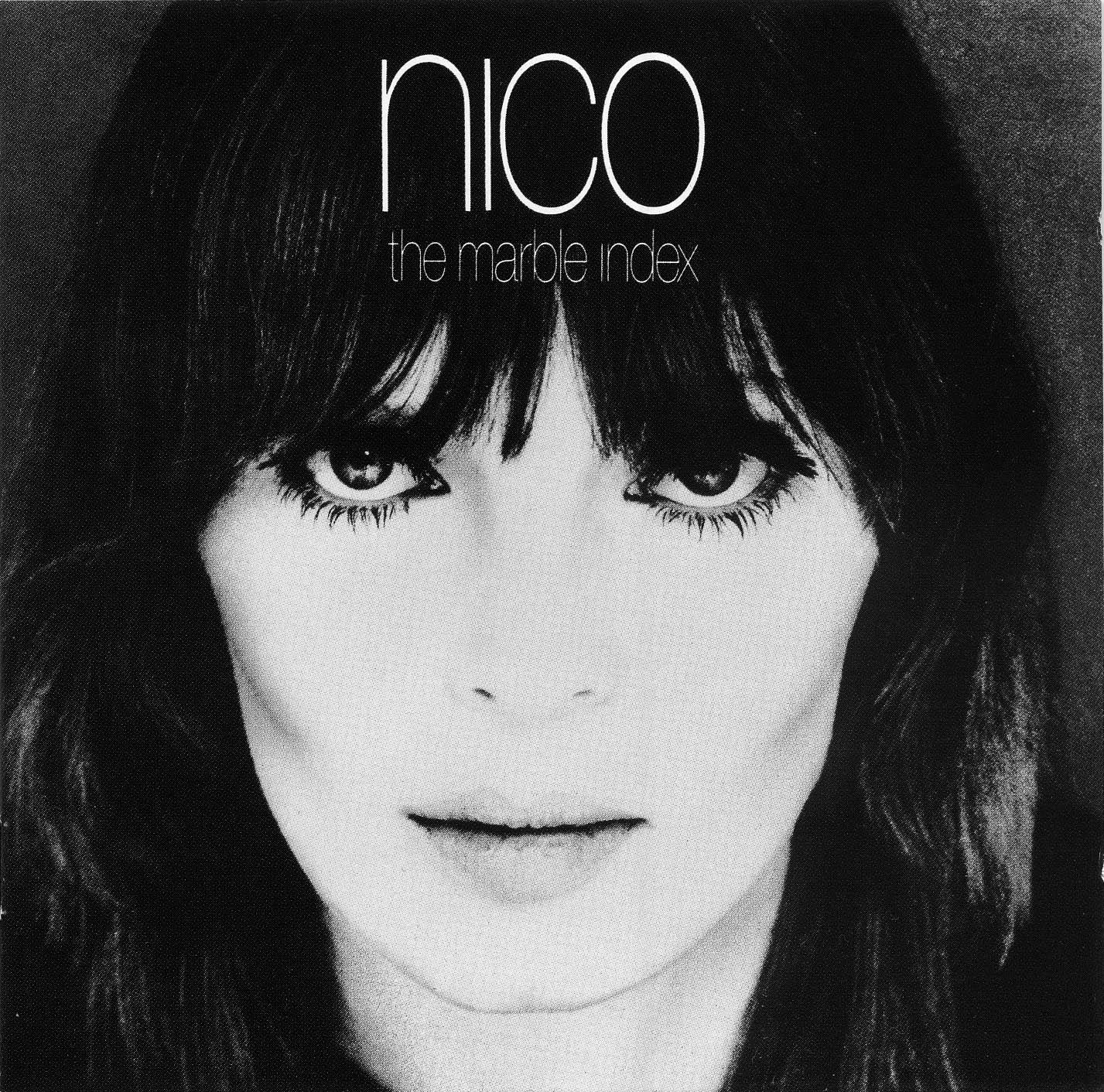
The cover shows a woman now mature, far from the smiling Nico from "La Dolce Vita" with a helmet on her head and a candelabrum in her hand, distant from Andy Warhol's Factory, from the Velvet Underground. With a serious, thin face. A chanteuse, a priestess of music. Immersed in a world that will reveal itself to us gradually as we dive track by track into her heart.
"The Marble Index" is Nico's return to the Europe of her childhood. Even if the melodies are not folk from the Mittel-European tradition, something beyond physical perceptions takes us exactly to those hills far from the sea, full of immense and unfathomable forests. Among the medieval castles of various princes, to their courts, wrapped in the melodic stories of minstrels.
This album is of a genre that is impossible to define. It is so avant-garde, that even now it is beyond every traditional and non-traditional structure. It is an absolute innovation, born from the fusion of two very close sensibilities: Nico and Cale. And the latter certainly played a part in the end result of the entire work.
The constant of every single song on "The Marble Index" is that the music accompanying Nico's pure voice is like the wind. An inconstant wind, that torments and unsettles. The beautiful effect is achieved thanks to Cale's oscillating strings and Nico's Indian harmonium, then mixed in a particular way. The poetic lyrics, made of words that freeze the soul, the music like a distant echo, recall some of Bruegel's paintings. The winter day that doesn't even have time to be born and is already preparing to die, in pale red and yellow. Eternal melancholy of landscapes of leafless trees, spotting the horizon with black, lifeless patches. It is in this setting that Nico chants her sparse and beautiful laments, in complete solitude, in the fairytale and legendary atmospheres, centuries away from our world.
The first version lacked "Roses In The Snow" and "Nibelungen", the latter performed by Nico without any accompaniment. "Ari's Song" is dedicated to the son born from the liaison with Alain Delon.
"The Marble Index" is somewhat a prelude to Nico's masterpiece: "Desertshore", with which she will reach the apotheosis of her musical career.
Loading comments slowly
Summary by Bot
The review praises Nico's The Marble Index as an avant-garde, genre-defying album that transports listeners to a mystical Europe of ancient forests and castles. John Cale's instrumental contributions and Nico's haunting vocals create an unsettling yet beautiful soundscape. The album is seen as a precursor to Nico's peak work, Desertshore. It captures eternal melancholy through its sparse arrangements and poetic lyrics.Tracklist Lyrics Videos
Nico
Nico (born Christa Päffgen) was a German singer and songwriter, also known for her association with the Velvet Underground and for a stark solo catalog built around harmonium, austere vocals, and collaborations with arranger John Cale.16 Reviews
Other reviews
By Joe Vanny 78
The disoriented voice, used itself as an independent instrument, seems to be in the grip of a hallucination.
Recommended for nighttime listening, for particularly dark and restless souls.
By Alvo23
Nico makes her TRUE debut... it seems that the music she has participated in until now never existed.
The emotion unleashed in these grooves can poison you and make you dependent on the darkness surrounding it.
By paolofreddie
Christa’s lyrics and music convey anguish, profound sadness, annihilate the listener with their spontaneity, with their lack of inhibition.
With 'Marble Index,' Nico introduces for the first time a genre that will have a wide echo in the '80s and '90s, the gothic genre.
