
 •
Rating:
•
Rating:
THE REVIEW
Introduction:
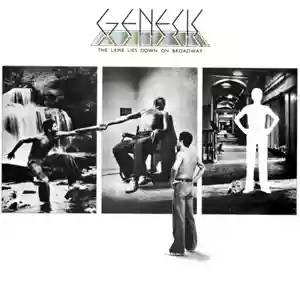
Let’s assume that in 1974, Genesis singer Peter Gabriel wasn’t exactly what he was, that is, an artist brimming with talent (as were many of his bandmates) but with ambitions, desires, and doubts that were much more complex and problematic than the others. In short, that about his future and the group’s, he still thought more or less in the same simple way as his partners, which was: go for the Music with a capital M, everything else follows.
In that case, it would never have occurred to him to temporarily leave them for a soon-aborted cinematic career, nor, once returned to the fold, to ask/impose to be the only lyricist of the next album, shaping and adapting it around a single, elaborated sci-fi story set in New York, filling it with lyrics at the expense of the instrumental portions (vital for that ensemble equipped with a couple of excellent soloists, supported by a sharp and agile rhythm section).
This artifice of subtracting Gabriel's artist unrest, his courage, his priorities of the time, his presumption from the panorama of his group's evolution/involution clearly shifts this discourse into the field of fiction, gratuitous fantasy, what could be called “progressive self-indulgence,” but what else is there to say about this famous album, epochal for many, that hasn't already been said and emphasized? Since the real facts and the relative, actual architecture of the album have already been described in detail in so many reviews, biographies, and interviews, let’s try to play by altering the context of that 1974 genesis, deforming the... genesis of the work to view it from an unprecedented perspective.
Context:
So, in the (un)reality that is fun to sketch here, we aim to return to that phase of the group's existence, removing much of its cruciality, forcing the framing of Genesis in the 1974 period as an even more cohesive and loaded progressive quintet, each musician well-aligned and covered towards the goal of continuing to improve their musical production, and by reflection, their own careers, insisting and refining further what had been achieved by that point, or at least hinted at. In this fiction, there are no reasons or resentments to hinder the happy continuation of the path outlined by previous works, increasingly elaborate and fascinating, filled with satisfying ideas, poignant melodies, compelling rhythms, and surprising dynamics.
As one single entity, the five dive into compositions, sounds, arrangements, and lyrics; then, diligently setting aside the less successful efforts to prioritize quality and effectiveness, they release about forty-five minutes packed with fresh and excellent music, divided into ten varied and fascinating compositions, articulated as follows to sketch the hypothetical tracklist of the sixth career album (and single!):
Side A:
- “The Lamb Lies Down on Broadway” – 4’52”
- “Fly on a Windshield” – 2’47”
- “Broadway Melody of 1974” – 2’11”
- “In the Cage” – 8’15”
- “Back in N.Y.C.” – 5’49”
Side B:
- “Carpet Crawlers” – 5’16”
- “Lilywhite Lilith” – 2’40”
- “Anyway” – 3’18”
- “The Lamia” – 6’57”
- “The Light Dies Down on Broadway” – 3’32”
Strengths and Shortcomings:
The ten tracks listed are the best of the album, purged of all fillers, lesser intuitions, those not well developed not due to haste but rather due to the frustration of some of the instrumentalists; and then there are hints of concrete music, hyper-Beatlesque sketches... all this may be good but not memorable.
Personal opinion, of course... everyone may find omissions, oversights, or overestimates. The actual work is divided into twenty-three titles over ninety-four minutes: in this context, some might find the vaudeville skits “Chukoo Cocoon” and “Counting Out Time” irresistible, while others might consider the reprise of “The Light Dies Down on Broadway” superfluous in this context and perhaps opt for something extracted from “The Colony of Slippermen” (“The Raven?”) instead. Etc., etc.: but for my tastes, the sweetest and most savory essence of ‘The Lamb’ is contained in these ten pages.
Certainly, in this way, the work loses the guiding thread and the appeal of the Concept, the grandeur of the Sum Opera, but it recomposes for the good of Music through the definitive highlighting of its many thematic pearls, its authentically inspired moments that in this compacted form follow in quick succession, qualifying the record as the best of their career (indeed, many people think it is regardless, including its verbosity and fillers).
Album Peaks:
Structured and compressed like this, the album is almost entirely at its peak... each episode contains remarkable and engaging pages of peculiar Genesis talent beginning with the scholarly, brilliant overlapping and alternating pianistic cadence, engaged in playing very tight double chords, which inaugurates the incipit “The Lamb…”. Legions of budding pianists have practiced replicating it, discovering that, as is usually the case for Tony Banks' musical inventions, the technical difficulties are present but not insurmountable... nothing insurmountable, even at an amateur level, and even non-existent in cases of academic preparation, or any consistent background.
The genius of this grumpy, yet invaluable rock keyboardist is different from that of Emerson and Wakeman: what elevates him to the highest merits is his compositional talent and his ability to create strong romantic suggestions, especially through inspired pianistic pages like this one, replicated later with equal if not greater charm on “Anyway,” “The Lamia,” “Carpet Crawlers,” themselves intuitions of heartbreaking effectiveness on the grand piano.
Regarding Banks as an organist and synthesist, as known, “In the Cage” is a real festival of his, filled with overflowing solos of his priceless monophonic synthesizer ARP Pro Soloist, alternating with the tight gallop of an old and unrivalled Hammond organ, in the accompaniment portions to the harrowing invocations of a wildly engaging Gabriel.
The latter sings beautifully, nothing to say: great performer, beautiful timbre, tremendous variety, and admirable conviction. He was already singing well at twenty in the band’s first album, here he is exceptional.
The Rest:
In the authentic “The Lamb…,” the absolute quality of many of its passages is partially compromised, primarily by the excessive burden brought by the verbose, abstruse adventure of Rael, but also by the evident step back in quality (compared to the previous “Selling England by the Pound”) in terms of tracking, sound, and production, and finally by the decent absence of a guitarist who seems not entirely in tune with the project.
Genesis records are certainly not known for their sound qualities: both “Nursery Crime” and “Foxtrot,” though with all their merits, had shown limited clarity and intelligibility between the various instruments. Hackett’s guitar in particular, was sacrificed and suffocated due to its boxed and not very resonant sound. On “Selling…,” magically everything had fallen into place, and Steve emerged as divine with his array of distortion units, volume pedals, flangers, echoes, and reverbs to render his instrument’s solo flashes in the most sublime manner.
Here it’s different: his ideas, although generally used as a complement to those of the others, lose almost entirely the icing on the cake effect they had in the previous occasion: the sound is no longer so clear and round, but above all, there are recording deficiencies... the one in “In the Cage” may be the best guitar solo of the album, but at a certain point, it gets marred and due to a gross production error, it’s left as is, unprofessionally. On the other hand, the much-acclaimed final solo on “The Lamia” has never really impressed me: the guitar is mixed poorly (too high), its cadence is too mechanical, without style, and the melodies it creates are evocative more for the admirable harmonic base on which they rest rather than their own merits.
Final Judgment:
I have my thoughts on Genesis: the actual double album “The Lamb…” I regard as slightly, but certainly inferior to the other classics of the Gabriel period, except for “Trespass.” I also find it inferior to “A Trick of the Tail,” for me one of the absolute best, endowed with great consistency and thematic variety.
In this hypothetical “Best of” single version, The Lamb, as already hinted, would shoot to the top of my list... and to hell with Rael’s story, as it’s not very enjoyable and if you trim it a bit here and there, the entertainment is enhanced with few damages to the lyrics.
I also have my opinions on Gabriel: enormous frontman and singer, perfect (or almost… a bit too verbose and intrusive) with Genesis, but his solo career doesn’t intrigue me. I find it a bit depressing from 1977 (the start of his solo discography) onwards, but mainly with insufficient melodic abilities to make me love him. He’s truly a missed drummer... much of his solo repertoire consists of grooves that stretch cyclically for several minutes, without much happening, without a decisive shift in musical key, a genius resolution, an exciting chorus. Great man, no doubt, but I go by taste, as it should be, and therefore I have always cordially ignored him (also comforted by my son, who one evening when he came to visit me and after dinner I put on a DVD of Gabriel in concert, open-air in a French square, after a while exclaimed laconically: “Dad, what a drag!”).
Nothing personal anyway: I’m not much interested in the solo careers of Banks (my only deep love towards him is for “A Curious Feeling,” very charming), Hackett (well, I viscerally love only “Spectral Mornings,” the song), Rutherford, and Collins (for heaven's sake the latter… even disastrous for how he guided 1980s international taste towards... bad taste).
I apologize for these last digressions... they were meant to say something not obvious about these five gentlemen and this famous work of theirs. Thank you for your attention.
Loading comments slowly
Summary by Bot
This review reimagines Genesis's 'The Lamb Lies Down on Broadway' as a more cohesive and concise album, emphasizing its strongest musical moments. While recognizing the original’s conceptual verbosity and some production flaws, it praises the instrumental skill and songwriting, particularly Tony Banks’ keyboards and Peter Gabriel’s vocal performance. The review also shares personal views on the band members’ solo careers, contextualizing the album within their broader discography.Tracklist Lyrics Videos
Genesis
English rock band formed in 1967, celebrated for landmark early-1970s progressive albums (Foxtrot, Selling England by the Pound, The Lamb) and a later, more pop-oriented phase led commercially by Phil Collins.116 Reviews
Other reviews
By Mr_Iko
I love to call it 'Music-All': a watershed between a rock opera and a musical to be performed on a Broadway stage.
Should you not like this album, I recommend consulting a good doctor for an otoscopy.
By Mariaelena
"This double album is astonishingly difficult, progressively dilatable and becomes unique because it is full of merits, flaws and double meanings both for the lyrics and the music."
"Rael and John dissolve because maturity will have been reached due to a fundamental choice transforming them into a single complete man... You are free to interpret, and this is what Peter Gabriel wanted to convey to us."
By Old King Cole
"The Lamb is something more... too varied, containing too many different elements to be classified in a genre that is undoubtedly open but still has boundaries that delimit it."
"The main instrument in 'The Lamb' is [Peter Gabriel's] voice, which finally reaches its peak of technique and, above all, of expressiveness."
By STIPE
"Gabriel was Genesis and Genesis was Gabriel."
"A courageous work, completely different from their discography and also the last one by Gabriel with his old companions."
By paolofreddie
The album ranks among the most interesting in progressive and rock music in general.
The Lamb is one of the most complex and difficult to analyze albums in the history of prog and that is what enhances its intriguing nature.
