 •
Rating:
•
Rating:
THE REVIEW
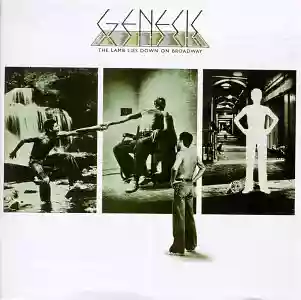
The story of this album begins right with the title track that Peter Gabriel wrote during the band's American tour at the end of 1973: "I am impressed by New York at dawn, sleepy people coming out on the street after spending the night at the cinema. Shops are beginning to open, the first taxis are running, and our hero, Rael, is slipping out from the subway underpass. There's a lamb on the sidewalk of Broadway and many people are wondering who or what this lamb is, but it's just a lamb, from the sheep family. I liked seeing it there, on the sidewalk, among the steam of the heating systems coming up from below...".
The poetic-musical subject of The Lamb Lies On Broadway begins to take shape in Gabriel's mind: melodies, ideas, scenographies. For months, he works alone on this project, but there's a problem to solve: getting the other band members to accept this "ego trip," especially Banks and Collins, who absolutely don't want to play the part of simple supporting players, even if it will be the latter who delays Peter's departure. Collins would say some time later: "During the recordings, my participation wasn't as decisive as other times; I had other things on my mind and spent a lot of time talking with Brian Eno, who occasionally came to give us a hand. But on that record, there were some beautiful things and especially that opportunity to dissapear into improvisation that was the thing that interested me most back then". So, while Gabriel continues describing the music of The Lamb as a tremendous big jump for the group, the others see it all as a too risky change of course.
Genesis is already a band gratified by the success of Selling England By The Pound, which has definitively imposed them on international attention, and by the enthusiastic responses of their live act (the Los Angeles Times described it as the "best example of theater ever offered by rock, a collage between fairy tale and science fiction lived in a mythical key"). And then why abandon finally victorious choices, in a moment of such great popularity, in favor of an originality perhaps difficult and ungrateful? It is precisely the miraculous sales of Selling England that act as a glue within the group because if it's true that Banks and Rutherford created Genesis expressing their musical style, it's equally true that Gabriel's admirable visual-theatrical art has "saved" the group from oblivion in the challenging years preceding the commercial breakthrough.
So, retiring to the tranquil Welsh countryside with Island's mobile studio, the five begin to record what will be one of the wonders of rock; a courageous work, completely different from their discography and also the last one by Gabriel with his old companions. For three weeks, working sometimes up to twenty hours a day, the artistic divergences between Gabriel and the others emerge sharply: on one side the frontman who sees music as an element not an end in itself, but in function of an ever more scenographic-spectacular role, almost like a soundtrack, on the other four musicians increasingly striving towards refinement, especially stylistic-musical. In the end, a sort of coup that Gabriel imposes on his companions, for the first time almost entirely responsible on a compositional level for the whole album. Particularly struck by the film El Topo, Gabriel gives free rein to his creative selfishness by overturning the band's classical and folk roots in favor of a new more rhythmically concise sound sometimes close to funk-soul, other times imbued with strong electronic echoes with meticulously arranged arrangements and great synthesizer work. A true sonic adventure with free instrumental research far removed from the "progressive" rock that at that time was moving towards a slow decline.
Gabriel finds the right pace even in the lyrics, bypassing the old stylistic elements of the epic novel and symbolist fairy tales linked to that English literary avant-garde that refers to writers like Eliot, Dylan Thomas, and Barker, adopting a visionary poetics, a demystifying surrealism where a world dehumanized by progress and full of false heroes is exposed in a irreverent and clear way as happens in Broadway Melody 1974. The unease of man imprisoned in a consumerist and value-arid society wandering in search of itself and its illusions: "They say the lights are bright on Broadway, they say there's always magic in the air". After four months a atypical concept double-album comes out: four sides, all linked to each other, by a kind of "musical scheming", as Rutherford said at the time, and not a true suite, as for example was the second part of Foxtrot. The compositions, despite having a unitary story, can equally free themselves from the original context and assume a well-defined autonomous form. In 36 episodes is narrated the story of a young Puerto Rican thug named Rael who travels between dreams-nightmares of his subconscious in the meanders of an unsettling New York. The music moves in step with the images evoked by the lyrics that develop through a series of oppositions of archetypes full of allegories, dark symbols as in the desolation of "The Light Dies Down On Broadway" and in the visions of "Carpet Crawlers". Genesis broadens and diversifies in various facets the area of expressive possibilities of rock in conjunction with a whole collateral development of harmonies, of rhythmic solutions. The strength of The Lamb lies precisely in this emotional and aesthetic perfection derived from a new sound, in the ability to appropriate the rock idiom to later refine it, elaborate it, and find new suggestions. Here's the importance of this album: to deeply change musical matrices that now stagnate in sound rhetoric as an end in themselves and renew them with surprising eclecticism. In a crescendo of musical chiaroscuros, soul, the avant-garde, pop melody are reviewed, and above all rises Gabriel's voice, with that astonishing expressive charge, that chromatic richness, and that extreme versatility. English critics wrote: "The sound achieved in this album represents the best that music has offered to date". But it's not only the sound of The Lamb that is perfect; it is a masterpiece of musicality that closes, summarizes, and overturns all the sonic contributions from Foxtrot onwards. The meticulous work of choice and selection produces extraordinary effects. The rock of The Lamb Lies Down On Broadway with its insistently heavy guitar riff prepares "Fly On A Windshield", where the destructive cloud descending on Broadway is described with black key rhythm and a great work by Collins and Rutherford. An old Hackett melody, expertly played on guitar picks, creates the suspended atmosphere of "Cockoo Cocoon", while right after Banks' ARP is a sound carpet crescendo for "In The Cage".
In Rael, there are a thousand cells of a hypersensitive and hypercomplexioned creature, which is why the moods unfold in a thousand directions, now on the strange "march" of "The Grand Parade Of Lifeless Packaging" where we find very special voice effects cared by Brian Eno, now in the hypnotic aggression of the urban nightmare "Back In N.Y.C."; it is unpredictable music that bends on itself, returns to its principle to snap towards the future as in the splendid instrumental "Hairless Heart" or in the poignant melodies that blossom like memories and advance inexorably through the notes of "Counting On Time". "Carpet Crawlers" is a moving ballad that Gabriel describes as "a Leonard Cohen song arranged by Phil Spector" and the enchanting "The Lamia" with piano and bass that take over everything. Everything is perfect: the country of "The Chamber Of 32 Doors" and two old songs written four years earlier reunited and completely rearranged in jam sessions titled "Lilywhite Lilith". The Latin American rhythms of "Here Comes The Supernatural Anaesthetist", "Anyway" are fragments of another piece dated 1968 and faithfully reproduced on a record with no retouching. "Silent Sorrow In Empty Boats" instead prepares the flashes of psychedelia that break into the formidable pop structures of "The Colony Of Slippermen". The anguish, the search for a way out, the remedy of Doktor Dyper and again the curse of the thieving crow, the rescue of John (Rael's brother) are the descriptive musical drawing of "Ravine", the piece closest to the old Genesis style, and of "The Light Lies Down On Broadway" which resumes the title track theme. Then comes "Riding the Scree" and "In The Rapids" where Rael looking at John's face sees himself. "It" is the end of the journey, but the end is merely another beginning: "It is the spirit inside everyone of us, with that much force to survive. If you think It is pretentious you have been fooled: look through the mirror before you decide".
With this visual-musical treatise that crosses the history of Genesis like lightning, ends the cycle of romantic-impressionist rock opened by King Crimson. At the end of a mega tour of 102 dates in just four months, in May 1975, the Archangel leaves the band after a memorable concert in St. Etienne. Gabriel will explain the reasons for his farewell in a long open letter: "I had a dream, a dream with eyes wide open. Then I had another dream, with body and soul of a rockstar. When it became unpleasant I packed it up and threw it away. Examining its reasons, musical and otherwise, these are the conclusions. The vehicle we had built as a cooperative to serve our music had become our master, had trapped us in the success we wanted, influenced the attitude and spirit of the whole group. The music had not dried up yet and I respect the other musicians, but our roles had stiffened. I believe that the use of sound and visual image can be developed to achieve much more than we have done".
Time will confirm an undeniable truth that escaped contemporaries: Gabriel was Genesis and Genesis was Gabriel.
Loading comments slowly
Summary by Bot
This review praises Genesis' 1974 album The Lamb Lies Down On Broadway as a bold and transformative work in progressive rock. It highlights Peter Gabriel's visionary storytelling, the band's musical experimentation, and the album's complex narrative about Rael, a Puerto Rican youth navigating a surreal New York. The tension between Gabriel and band members during recording is explored, alongside the album's lasting influence and Gabriel's eventual departure. It concludes the album is a masterpiece blending artistry and innovation.Tracklist Lyrics Videos
Genesis
English rock band formed in 1967, celebrated for landmark early-1970s progressive albums (Foxtrot, Selling England by the Pound, The Lamb) and a later, more pop-oriented phase led commercially by Phil Collins.116 Reviews
Other reviews
By Mr_Iko
I love to call it 'Music-All': a watershed between a rock opera and a musical to be performed on a Broadway stage.
Should you not like this album, I recommend consulting a good doctor for an otoscopy.
By Mariaelena
"This double album is astonishingly difficult, progressively dilatable and becomes unique because it is full of merits, flaws and double meanings both for the lyrics and the music."
"Rael and John dissolve because maturity will have been reached due to a fundamental choice transforming them into a single complete man... You are free to interpret, and this is what Peter Gabriel wanted to convey to us."
By Old King Cole
"The Lamb is something more... too varied, containing too many different elements to be classified in a genre that is undoubtedly open but still has boundaries that delimit it."
"The main instrument in 'The Lamb' is [Peter Gabriel's] voice, which finally reaches its peak of technique and, above all, of expressiveness."
By paolofreddie
The album ranks among the most interesting in progressive and rock music in general.
The Lamb is one of the most complex and difficult to analyze albums in the history of prog and that is what enhances its intriguing nature.
By EverardBereguad
"The result was a carpet of 'pure anxiety' on which all the songs were built."
"It is a mistake to look for what Genesis had to say with this album in the moral of the story or the meaning of the lyrics."
