
 •
Rating:
•
Rating:
THE REVIEW
Following the release of Selling England by the Pound and the subsequent tour where Peter Gabriel showcases all his theatricality to the detriment of other band members who are overshadowed, Genesis return to the studio to prepare for the creation of a new album. They choose to compose music for a concept album that develops a story within itself. Consequently, they record more tracks to work on. The task of writing the lyrics is entrusted to the eccentric Peter Gabriel, who flaunts all his culture and knowledge to compose the lyrics, while the other members of the group focus more on the music.
Situations of conflict begin to arise, as the singer, Gabriel, often arrives late to the studio due to his task of drafting the extremely complex lyrics, which contains a large number of literary citations and mythological references. As Steve Hackett, the band’s guitarist, would declare, Peter was very behind with the lyrics, so he arrived later and sang over everything, even over what were supposed to be instrumental passages. This behavior is so brash and disrespectful towards the other band members and the work itself that, once again, Steve Hackett would say it was as if Peter had taken a painting he just finished and smeared it all over with red paint. The group’s frustration towards the leader was also caused by the fact that the music and lyrics were attributed almost entirely to Peter Gabriel alone.
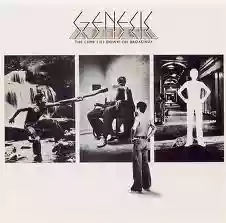
The album that emerges shows no flaws in its composition. Thanks to the very cultured lyrics and a story written exclusively by Gabriel, the album ranks among the most interesting in progressive and rock music in general. The character of the concept album is Rael, a Puerto Rican boy, who lives his life in a sleepy, smoke-filled Broadway, which will serve as the backdrop for his adventures. He always carries a spray can with him to write his name on walls and affirm his identity. The adventure of Rael, his ordeals, and his growth are described in 23 songs. The double album is divided into 4 sides, 2 per disc.
Side A opens with the title track, introducing us to Rael's world, the sleepy, smoke-filled Broadway, minutely described like a painting of a civilization. This is followed by two songs of about 2 minutes each; the first has a very gentle beginning but then explodes with a rock-style instrumental section. This brief final piece acts as a bridge to the next song, Broadway Melody of 1974, a predominantly rock piece with a dominant electric guitar. The fourth song on side A is titled Cuckoo Cocoon; it is also short and more pop-oriented. The highlight comes with the penultimate song on side A, In the Cage, an 8-minute piece in which keyboardist Tony Banks showcases all his synthesizer skills. At this point in the concept, Rael awakens in a cave while stalactites and stalagmites progressively form a cage around his body. At a certain point, he sees his brother John outside the cage and cries for help, but John ignores him and walks away. At the end of the song, the cage dissolves and Rael’s body begins to spin on its own. Side A closes with The Grand Parade of Lifeless Packaging, a very light song with a comedic vein that initially evokes laughter due to the initial train whistle and Peter's filtered voice.
Side B opens with a predominantly rock piece, Back in NYC, where Peter’s voice is aggressively at its peak; this is followed by a sublime instrumental of wonderful craftsmanship, Hairless Heart, where Steve builds a poignant guitar solo. This piece opens the doors to Counting Out Time, a song in which Peter has Rael speak in the first person. It talks about Rael facing his first amorous experience; he approaches it by reading a book that contains helpful advice on how to make love. Naturally, Rael’s date with the girl goes poorly. The penultimate song on side B is an absolute masterpiece, a strong concert piece with and without Peter, Carpet Crawlers, which literally translates to "the crawling creatures of the carpet." The text is complicated and full of uncommon words. The music is very sweet, with the guitar as the main instrument. The chorus is very catchy. The song that concludes side B and, consequently, the first disc, is a magnificent piece, with a wonderful guitar introduction accompanied by Tony Banks' mellotron. The song, The Chamber of 32 Doors, lasts almost 6 minutes and develops dramatic music that reflects Rael's feeling of disorientation, the concept’s protagonist, when he faces the 32 doors (32 doors) of the mysterious room in which he finds himself with other mysterious characters he'd like to ask for help, but he doesn’t know whom he can truly trust. In this piece, Gabriel’s voice reaches its peak. So, disc one ends on a high note.
The second disc of "The Lamb" and, consequently, Side C opens with a short song, Lilywhite Lilith, a piece with a very rock air, starting with the combination of distorted guitar and bass and drums predominantly, followed by Peter Gabriel's voice. The second piece of side C is a very particular instrumental: various sounds and effects are present, including the sound of something breaking. It is followed by a song with a very poignant atmosphere. Introduced by a touching piano followed by Peter Gabriel’s voice perfectly in tune with the music, Anyway speaks of the moment when Rael, the concept’s character, feels the approach of death with resignation. Here Comes the Supernatural Anaesthetist is mostly an instrumental piece in which a single phrase is sung. The fifth song of the album is rich in pathos and very poignant; it develops a particular story experienced by Rael, told through mythological references (the Lamia are mythological creatures, with a snake’s face and a woman's breast, subjects of many poets). Silent Sorrow in Empty Boats is a brief instrumental in which a single series of orchestral notes is repeated insistently. The seventh song of the album, lasting 8 minutes, The Colony of Slippermen, unfolds in three parts. In the first, an instrumental develops over about a minute and a half, followed by Gabriel’s singing, which also ventures into rather hoarse and impressive verses. The instrument predominantly featured in the song are Banks’ keyboards, and the track presents a very electronic atmosphere. Ravine follows the lead of The Waiting Room; in this instrumental piece, the sound of synths producing the sound of wind is present. We've reached the only song on the album to which, in addition to Peter, the other band members have also contributed, The Light Dies Down Broadway, which echoes the title track. The chorus line of this song is characterized by the same music as the chorus line of the track opening the entire album. Riding the Scree is a very particular piece featuring a unique synthesizer solo by Tony, developing with an improbable tempo, reaching the height of complexity. This piece is followed by In the Rapids, a piece where Peter’s voice is very poignant, as is the text in which Rael, the concept’s character, realizes that John, his supposed brother, is just a projection of himself. The album closes magnificently with It, a song that conceptually gathers the entire story of The Lamb, in which Peter shouts the phrase "It is real, it is Rael," to affirm the character's identity.
The Lamb is one of the most complex and difficult to analyze albums in the history of prog and that is what enhances its intriguing nature, drawing attention to it. A milestone in the genre and music in general, a double album that could not have been better.
Loading comments slowly
Summary by Bot
This detailed review examines Genesis' 1974 double album The Lamb Lies Down On Broadway, highlighting the complex concept, theatrical lyrics by Peter Gabriel, and rich musical composition. It discusses the internal band tensions during production and breaks down notable tracks across all four sides. The album is praised as a milestone in progressive rock, anchored by its intricate storytelling about the character Rael. Despite some conflicts, the double album is recognized as a masterpiece in prog history.Tracklist Lyrics Videos
Genesis
English rock band formed in 1967, celebrated for landmark early-1970s progressive albums (Foxtrot, Selling England by the Pound, The Lamb) and a later, more pop-oriented phase led commercially by Phil Collins.116 Reviews
Other reviews
By Mr_Iko
I love to call it 'Music-All': a watershed between a rock opera and a musical to be performed on a Broadway stage.
Should you not like this album, I recommend consulting a good doctor for an otoscopy.
By Mariaelena
"This double album is astonishingly difficult, progressively dilatable and becomes unique because it is full of merits, flaws and double meanings both for the lyrics and the music."
"Rael and John dissolve because maturity will have been reached due to a fundamental choice transforming them into a single complete man... You are free to interpret, and this is what Peter Gabriel wanted to convey to us."
By Old King Cole
"The Lamb is something more... too varied, containing too many different elements to be classified in a genre that is undoubtedly open but still has boundaries that delimit it."
"The main instrument in 'The Lamb' is [Peter Gabriel's] voice, which finally reaches its peak of technique and, above all, of expressiveness."
By STIPE
"Gabriel was Genesis and Genesis was Gabriel."
"A courageous work, completely different from their discography and also the last one by Gabriel with his old companions."
By EverardBereguad
"The result was a carpet of 'pure anxiety' on which all the songs were built."
"It is a mistake to look for what Genesis had to say with this album in the moral of the story or the meaning of the lyrics."
