
 •
Rating:
•
Rating:
THE REVIEW
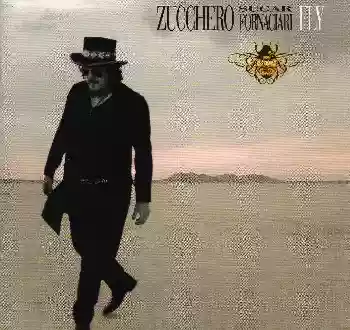
After the "Shake" (shaking, shiver, but also a meeting and blending of very different languages, styles, and codes), now the angel's flight and the view from above of "Fly": it's difficult to determine where the "unbearable lightness of being" of the musical/metaphorical citation game ends and the more "sustainable," concrete and solid "ground" of confrontation with the current context begins, the main measure for evaluating the meaning of a work, to (try, as always) define the lyrical, poetic, and purely musical value of the album in question: "Fly," indeed: the risk is too high of being caught offside with "hot" comments that would sound contrasting and misleading, partly due to the (too many) "background noises" that have accompanied the release of this record.
However, one can try to delineate a sort of "no fly zone," (for now) devoid of references to the various peripheral comments that disturb its focus and instead start from the (numerous) fixed points.
Adelmo Fornaciari, known as Zucchero (a nickname that, according to an anecdote, seems to have been attributed to him for his sweet nature) Sugar (for the potential opening in the Anglo-Saxon market) is objectively a composer of music and lyrics, with a world-level talent and competence in the field; after his very initial beginnings (more "traditional"), he has progressively more assertively focused on the concept and practice of "contamination," understood as a blend of different languages and cultures, from an almost casual encounter (in the manner of improvised "jam sessions" for example) to the higher level of accomplished syncretism of languages that manage to "speak to each other," giving rise to indefinable and unusual hybrids. In some cases, the most intimate essence of soul-blues has been captured ("Come il Sole All'Improvviso" is and remains one of the most precious jewels of his entire collection), at other times, a certain "form" (Hammond organs, saxophones, gospel choirs, etc.) seems to predominate over a certain "substance" ("Senza Una Donna" is a splendid Italian song, adorned with refined "garments" but is not an original soul or blues piece), yet other times, the creative genius fully manifests, achieving something that "doesn't exist yet": here, a suggestive dreamlike vision of Arctic landscapes, ("Iruben Me," spectacular intersection of pure and sublime melodies, extraordinarily poetic verses, and distant echoes of electronics à la Art of Noise), here a (dream)-pop-song ("Pure Love") that, enriched by the voice of Dolores O'Riordan, manages to genuinely sound better than the best Brit-pop or Brit-rock; perhaps, however, it is "Miserere," a lyrical and desperate profane prayer, with a broad orchestral arrangement, slide guitar, and blues accents, as well as the appearance of one of the world's greatest tenors, that more than others conveys the idea of such poetics.
From here, I believe one must begin to delimit sound and stylistic boundaries (the border), and recount the emotions this new album provokes (what goes beyond the border). The first impression is that of a work (once again) perfectly executed, with great skill and a sense of balance between freshness of new ideas and various recollections of the recent and distant past.
The present is the predominance of slowness over speed, as happens in ballads: "Occhi," somewhat a "Masterplan" with the melancholic hues of "Blue," a refined and poetic songwriting ("then I saw her eyes, like wheat in the wind"), a falsetto chorus "in steps" that sticks in the mind; "Quanti anni ho," starts almost in medley with the previous one (one barely notices the second and a half of interval), with a Hammond organ like "Il Cielo In Una Stanza," again in the style of John Lennon/Liam Gallagher, a more majestic and orchestral arrangement, in perfect continuity with the previous one for the theme dealt with, almost two consecutive pages of an inner emotional diary, where the sentimental geography of "Un Piccolo Aiuto" merges with the angelic perspective on existence of "Miserere" ("I need you, to wake up in the sun").
Where the recent past echoes in "Cuba libre" (it seems like a flamenco divertissement closer to certain exoticisms of Smoke City rather than the past in Mano Negra of which its ex-leader is cited) and "Un kilo," more than for the possible similarity with "Nietzsche (che dice)?" or "OLSM," has an impact due to the bass line and the rhythmic section (strangely monochromatic and more "rock" than the rest of the album), the distant past perhaps is the territory where the best inspiration seems to be found: "L'amore è nell'aria," one of the two gems of the entire work, delicately arpeggiated, whispered, and subtly bitter yet at the same time growing like an anthem, and finally perhaps (and hopefully so), the most remote past illuminates from the distance of the poetic memories of "Dune Mosse" and "Madre Dolcissima" a glimpse of the future: "Let it Shine," beautiful, incredibly modern as while perfectly played like the best episodes ever, it has something more: that is, the whole piece seems to play as if it were put on loop, thus giving a sense of "cultured updating" to the tribute, of high lyricism, austere and almost "in mourning" to that New Orleans to which Zucchero owes much, and from which it all began.
Mixing "high and low," good taste, and bad taste (which according to Pablo Picasso "is the main limitation to creativity") manages to sound at the same time like the possible closure of a cycle, like a "work in progress," and perhaps as the opening of a new (further) creative phase. The rest, is indeed emotion. Which, as is known, "has no voice." Nor words. Least of all those of the writer.
Loading comments slowly
Summary by Bot
Zucchero's 'Fly' showcases his world-class talent through a blend of soul, blues, and diverse musical styles. The album expertly balances new ideas with references to his past work, featuring standout tracks like 'Miserere' and collaborations such as Dolores O'Riordan's. Rich orchestration, poetic lyrics, and emotional depth define this album as both a potential closing of a creative cycle and a fresh beginning.Tracklist Lyrics Videos
Zucchero
Adelmo Fornaciari (born 1955, Roncocesi) is an Italian singer-songwriter known by his stage name Zucchero. He rose to prominence in the 1980s with blues‑influenced pop, major albums such as Blue's and Oro, incenso & birra, and numerous international collaborations.35 Reviews
Other reviews
By Emiliano
“Fly has the sweet taste of maturity, perhaps finally reached.”
“The album globally struggles to find its identity, suspended between the glories of the past and the normality of the present.”
By livecity.it
Fly is indeed pure poetry, a continuous 'soaring above the clouds,' with the absolute value of love and faith as the true leading theme of the album.
Zucchero rediscovers his true Italian roots in songs filled with previously veiled feelings, now revealed in a harmonic framework typical of European musical tradition.
By Birbabirba
Every single rhyme, verse, and chord is an anthem to joy.
A record full of love is the most appropriate definition for this work with a pinch of Zucchero’s typical glee and irony.
