
 •
Rating:
•
Rating:
THE REVIEW
1981: Vasco Rossi is on everyone's lips, fresh from "Colpa d'Alfredo", an album that achieved modest success, though far from being considered the persona he has crafted for himself today. Back then, Vasco was seen as a burnout, one of those young rebels who would die young, yet today he's probably the only true rock "icon" in the Italian panorama who has transcended decades of music, filling stadiums and attracting everyone from those who love him wildly to those who hate him out of sympathy, always staying true to himself despite struggling with some future works. For better or worse, his standing remains undeniably meritorious.
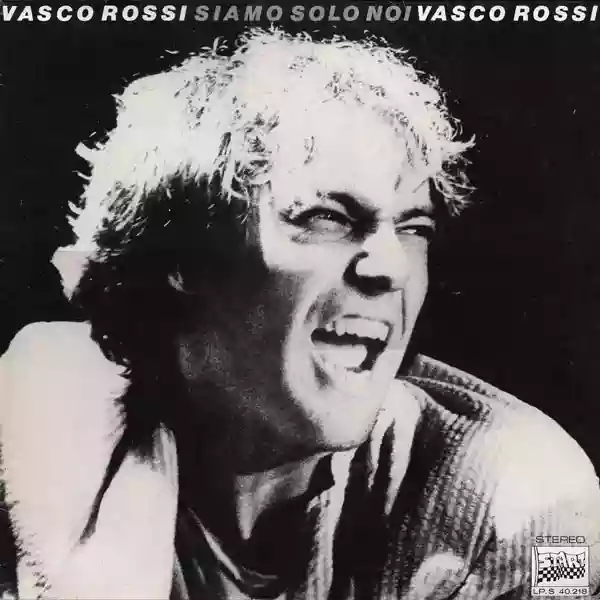
"Siamo solo noi" is the album that represents Vasco's rock phase more than the previous ones: just 8 tracks in the album, none of which you skip due to the fast and calculated rhythm. Inside, we have everything: the angry, romantic, sick, drug-addicted, and even party-goer Vasco; it's the album from the first part of his career that clarified his intent: the transgression of a 29-year-old from a 4,000-resident province, with anger between his teeth and the sensitivity of an eternal good guy. The album presents a rich and fresh rock sound, albeit from a purely Italian perspective, an important consideration. Vasco is an authentic artist, his music is communication, from nonsensical language to real love poems, and "Siamo solo noi" has what it takes to be one of his best works, less "experimental" than "Non siamo mica gli americani", but in my opinion qualitatively superior.
The album opens with what is one of the anthems par excellence of Italian rock: "Siamo solo noi", indeed. This track is legendary, the anthem of a generation of "disrupted without saints or heroes". A lot has been said about this song, but the fact that it still unites millions of people at concerts all over Italy is no small thing, on the contrary. A nearly hungover Vasco in the verses until the explosion of the chorus, with an absolutely stadium-worthy finale, followed by Maurizio Solieri's wild solo. Next is "Ieri ho sgozzato mio figlio", one of the most controversial episodes of the album, with its ingenious irony in its grotesque language, similar to "Fegato, fegato spappolato" or "Alibi", to understand us. A rock track in a hard & heavy key, balanced with the sounds of those years: incorrect and absolutely delightful. Following is "Che ironia", a lighter and more carefree track, although the title itself refers to heroin addiction (what irony... this disease...). A fun track that gives a proper breather to the previous pieces, although that sense of bitterness is always present. "Voglio andare al mare" is a Police-esque reggae with an "ignorant" text, in which Vasco makes it clear his desire to experiment with women on the beach. The empty chorus opens into energetic and neurotic rock, almost punk in some respects.
We've arrived at one of the Blasco's most loved songs: "Brava", where the singer lashes out at a girl (presumably an ex) venting that she treated him like a puppet with "her logic of black stockings." Musically, the track is a bomb, a spirited rock inspired (so to speak) by "Baba O'Riley" by The Who. It's one of the episodes where Vasco vocally gave his best, and overall, it works brilliantly, rightly becoming a cult in his career. We continue with "Dimentichiamoci questa città", the most rock episode of the album, where this time the main theme revolves around the desire for sex directed towards a particular girl. Once again, there are references, starting from the riff of "Vicious" by Lou to the inevitable plagiarism of "Living after midnight" by Judas Priest. A matter I personally find pointless to paraphrase, as Vasco merely "steals" those riffs and makes them his own, staying faithful to his style, both in singing and writing. The strongest track musically on the album, it's a real shame it ended up almost forgotten, though Vasco fans occasionally resurrect it at concerts. After so much anger and healthy ignorance, we've arrived at the ballad of the album, in my opinion one of Vasco Rossi's most beautiful songs: "Incredibile romantica", sweet and warm, a simple text that seems to flirt with Battisti/Mogol (Vasco explicitly mentioned being a great fan of the artist from Poggio Bustone), which finds a moment of explosion in the chorus, among guitar choirs that seem straight out of a Queen album (it personally reminded me of "Save me") and a powerful drum that lays down the law until Salieri's final solo, as usual, in excellent form. A gem. The album closes with the epitome of its sickest track, the acid blues of "Valium", a descent into Vasco's drug-ridden mind, a song that treads like an elephant as intended, though over the years it has been re-proposed in versions that I believe have stripped it of the madness that characterized it. A nice closure for an album that remains consistent from start to finish without any dips in tone.
"Siamo solo noi" is one of Vasco Rossi's most fundamental albums; easy to listen to, albeit much rawer than many future works, without particular pretensions and with strong and clear messages this time, a bit like Vasco has always wanted to represent in his genuineness. Sanremo would soon arrive, consequently even more power, which over time would lead him to a slow artistic decline; but until then, Vasco was that singer considered without hope, to look at him today almost impresses when thinking about the journey he has made. Despite the excesses, the reckless life, and the criticisms from a certain type of bourgeois public at the time, Vasco in the end pretended, whether liked or not it remains an undeniable truth.
Loading comments slowly
Summary by Bot
The review highlights Vasco Rossi's 1981 album 'Siamo solo noi' as a defining moment in Italian rock, showcasing the artist's raw energy and authentic expression. It praises the album's consistency, memorable tracks, and cultural significance, while noting Vasco's evolving career and unique style. The album mixes anger, irony, and romance with a fresh rock sound rooted in Italy's music scene.Tracklist Lyrics Videos
Vasco Rossi
Vasco Rossi is an Italian rock singer‑songwriter from Zocca (Modena), active since the late 1970s. Known as “Blasco,” he’s a central figure of Italian rock with enduring anthems and massive live shows.91 Reviews
Other reviews
By AR (Anonima Recensori)
"One of the angriest and damned albums of the 'Blasco,' and therefore also the most genuine!"
"'Siamo solo noi' has become an anthem and a cornerstone piece in live performances."
By DonSanfelice
"Siamo solo noi" is an immortal track, often described as a generational anthem.
"Try listening to 'Valium' as a lullaby, I assure you the effect is excellent!"
By yorke75
"Vasco is a man with the soul and impulses of a child... endowed with great sensitivity and poetry."
"'Siamo solo noi': this track is history, if it had been born outside of Italy... it would be considered a classic of world rock music."
