
 •
Rating:
•
Rating:
THE REVIEW
On April 26, 1969, sessions officially began for the Beatles' new work, replacing the now-abandoned "Get Back" project. In reality, none of the group is very eager to return to the studio; only McCartney and George Martin show the intention to work together again to give a worthy follow-up to "The Beatles." In particular, the producer agrees to work again with his protégés on the condition that the quarrels marking the previous sessions of early '69 are set aside.
The new LP is put into production amid great difficulties, the recordings will stretch throughout the summer and will see the four of them in the studio together only a few times. In particular, Lennon will always try to slip away, provoking McCartney's ire. Side A of "Everest," the first title assigned to the new LP, is composed during this period. However, given the lack of commitment from Lennon and partly from Harrison, the group finds itself with a handful of sketched and disconnected songs. As autumn '69 approaches, none of the Beatles are inclined to complete the songs, but there is an entire Side B to piece together by September, and EMI is pressing for the "Get Back" material to be used as an alternative to the incomplete song fragments. McCartney and Lennon object; Paul comes up with the idea of uniting the remaining songs into one great piece. George Martin is pleasantly impressed by the idea and convinces Harrison and Starr, while Lennon is now disinterested and detaches himself from it.
The famous "The Long One" is the last great testament to the four's artistry, or perhaps it is yet another proof of the absolute talent of McCartney and Martin, who, starting from bits of ideas, construct the group's final masterpiece. "You Never Give Me Your Money/Sun King/Mean Mr Mustard/Polythene Pam/She Came In Through The Bathroom Window/Golden Slumbers/Carry That Weight/The End", the sequence of tracks, only the central part is recorded in a single session. In the middle of this medley, a world inhabited by the "girl hidden behind a silver spoon" of Paul, Mr. Mustard, stingy, and his sister Pam, dressed in polythene, by the odious Alan Klein, who will force McCartney to "carry that weight" for a long time. An incredible sonic experience, with a blend never heard before, an absolute pinnacle put together out of necessity that will lead to Ringo Starr's only drum solo, perfect, clean, which will open up the finale of "The End" with that bouncing note serving as an incipit to cosmic equality, "and in the end the love you take is equal to the love you make."
Loading comments slowly
Summary by Bot
Abbey Road was created amid internal struggles and low enthusiasm from some Beatles members, especially Lennon. Paul McCartney and George Martin pushed forward, crafting a brilliant album. The iconic medley 'The Long One' stands as a pinnacle of the group's artistry and collaboration. Despite difficulties, Abbey Road remains a sonic masterpiece and final testament to the Beatles' legacy.Tracklist Lyrics Videos
The Beatles
The Beatles were a British band formed in Liverpool in 1960 by John Lennon, Paul McCartney, George Harrison and, from 1962, Ringo Starr. They revolutionized popular music through songwriting, studio innovation and cultural impact, releasing landmark albums from Rubber Soul and Revolver to Sgt. Pepper’s, the White Album and Abbey Road before disbanding in 1970.173 Reviews
Other reviews
By rob
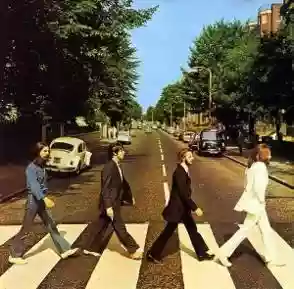
Paul is the only one differing from the other FAB 4, walking barefoot with the right foot leading—clues to his alleged death.
Abbey Road is dominated by Paul’s particular state of grace, especially in the final majestic medley that builds a sober but flashy mosaic.
By pinkoSpallino
This album is mainly famous for its cover, which portrays the 4 boys from Liverpool as they were heading towards their futures.
In short, a great album that demonstrates how this group created unforgettable things.
By Jack Darko
"Abbey Road is the true masterpiece of rock music, it is certainly the album that has influenced rock music the most."
"The track 'The End' is of astonishing beauty because it mixes a sort of primitive punk, rock, and a beautiful slow bit at the end. Absolute masterpiece."
By Braindamaged
Abbey Road was released, the last (but not last) of the 12 albums published by the Beatles.
Come Together has become a generational anthem and is electrifyingly beautiful.
By enbar77
"Abbey Road, despite everything, is a work of overwhelming charm, rich with exceptional pieces of pure rock."
"In the end the love you take is equal to the love you make."
