
 •
Rating:
•
Rating:
THE REVIEW
And in the end...
September 26, 1969, is a historic date in the world of music. Abbey Road was released, the last (but not last) of the 12 albums published by the Beatles (13 if you include Magical Mystery Tour). And what better farewell could there have been than such an album? On the way to disbanding due to internal disagreements and the economic difficulties of Apple that had been weighing on the group for some time (rather than Lennon - McCartney, one might write alongside the lyrics Lennon vs. McCartney), the four now mature Liverpool boys managed to put together a unique and incredibly homogeneous album (unlike the White Album) that nods towards the imminent '70s (here and there you can hear the sound of the Moog synthesizer, recently introduced). The album flows beautifully from beginning to end.
The two most prolific members who penned the best songs are Lennon and Harrison. John writes gems like Come Together and I Want You (She's so Heavy). The first has become a generational anthem and is electrifyingly beautiful. Masterful. The second is a sort of blues/rock lasting a good 7 minutes and 48 seconds, during which the last 3 minutes reprise the initial guitar and bass riff and repeat it endlessly, creating a dark and dreamy atmosphere... but it will be a rude awakening because the song abruptly cuts off, giving the impression our stereo has gone.
George, on the other hand, proves himself a great songwriter with two splendid songs, Something and Here Comes the Sun, absolutely two of the most beautiful he composed. Even Ringo, until now always more than a bit in the background, pulls out of his hat the most successful piece of his entire career with the Beatles, Octopus's Garden, and will also give us his only drum solo in The End. McCartney is the usual melodist of the group and the most attached to the patterns of the song that features fictional characters. Some songs he wrote include Golden Slumbers, Maxwell's Silver Hammer (in my opinion, the most pointless song on the album), and She Came in Through the Bathroom Window.
The B-side of the album is characterized by the presence of a long and expertly arranged medley of which McCartney's You Never Give Me Your Money (which talks about the financial difficulties of Apple) and Lennon's Sun King, where he enjoys singing nonsensical Italo-Spanish phrases (Quando paramucho mi amore de felice corazon, Mundo paparazzi mi amore chicka ferdy parasol, Presto abrigado tantamucho cake and eat it carousel), stand out. Still on side B, we find Because composed on the chords of Beethoven's "Moonlight Sonata" played backward.
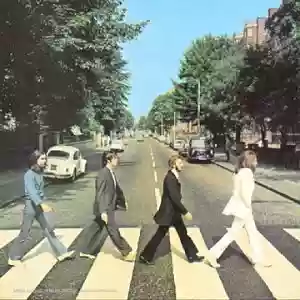
But it's not only the songs contained within the album grooves that make it a milestone of pop/rock music. Just looking at it from the outside, you immediately understand that it's not just any album. The cover photo is very simple but impressive. It was taken on the morning of August 8, 1969, on the pedestrian crossing in front of the Abbey Studios and will go down in history, like so many other Beatles icons, to the point where the Beetle parked on the sidewalk was sold at a Sotheby's auction in 1986. Who among you, being a great Beatles fan, has never dreamed of getting photographed while crossing that crosswalk? No special title, just Abbey Road (The album was initially going to be titled Everest, but due to record company needs, there was not enough time to head to the Himalayas to take the photos that would appear on the cover).
Abbey Road also contains the first ghost track in history, although this happened due to a mistake by the technician who cut the tape incorrectly. Her Majesty (only 23 seconds long) dedicated to Queen Elizabeth, was moved at Paul's request from its original position (between Mean Mr. Mustard and Polythene Pam) and placed at the end of the master, waiting to be deleted; but it remained there. In fact, Her Majesty lacks the final chord, which remained at the beginning of Polythene Pam. The result is a suspended, unfinished ending, not without unusual suggestion. The Beatles were this too.
Loading comments slowly
Summary by Bot
Released in 1969 amidst the Beatles' internal tensions, Abbey Road stands as a unique, cohesive landmark album. Showcasing Lennon's electrifying anthems and Harrison's beautiful compositions, combined with McCartney's melodies and Ringo's standout drumming, the album flows seamlessly. The iconic cover and innovative tracks like the medley and ghost track 'Her Majesty' add to its lasting impact. Abbey Road remains a defining moment in pop/rock history and the Beatles' final artistic statement.Tracklist Lyrics Videos
The Beatles
English rock band formed in Liverpool, active 1960–1970. Core members: John Lennon, Paul McCartney, George Harrison, Ringo Starr. Renowned for songwriting, studio experimentation and broad cultural impact.172 Reviews
Other reviews
By rob
Paul is the only one differing from the other FAB 4, walking barefoot with the right foot leading—clues to his alleged death.
Abbey Road is dominated by Paul’s particular state of grace, especially in the final majestic medley that builds a sober but flashy mosaic.
By pinkoSpallino
This album is mainly famous for its cover, which portrays the 4 boys from Liverpool as they were heading towards their futures.
In short, a great album that demonstrates how this group created unforgettable things.
By Jack Darko
"Abbey Road is the true masterpiece of rock music, it is certainly the album that has influenced rock music the most."
"The track 'The End' is of astonishing beauty because it mixes a sort of primitive punk, rock, and a beautiful slow bit at the end. Absolute masterpiece."
By enbar77
"Abbey Road, despite everything, is a work of overwhelming charm, rich with exceptional pieces of pure rock."
"In the end the love you take is equal to the love you make."
By whereismymind
Between this record and any other, there is a chasm not to be found in the individual songs but in the magic and surreal balance of the whole.
With side B of Abbey Road, music reaches the top and from that moment on, it can only descend.
