
 •
Rating:
•
Rating:
THE REVIEW
I, too, had listened to Pink Floyd as a child, but with the indifference and ignorance that plagues today's youth, I hadn't gone any further.
I remember that autumn evening from my window, you could see the sun setting and the air was crisp: I decided in complete tranquility to lay down for an hour and relax in the company of music, and so far, everything was still normal; I was completely unaware that I was about to embark on a unique journey, perhaps never even dreamed of, which would open my eyes to the music (and not only) that matters.
Oh yes, because the first time you listen to “The Dark Side Of The Moon” you never forget, the mark it leaves is indelible, like the lingering echoes of a trip that presents visions even long afterward, so that “Ticking away…” can still engulf you with prisms and beams of light even after the millionth listen.
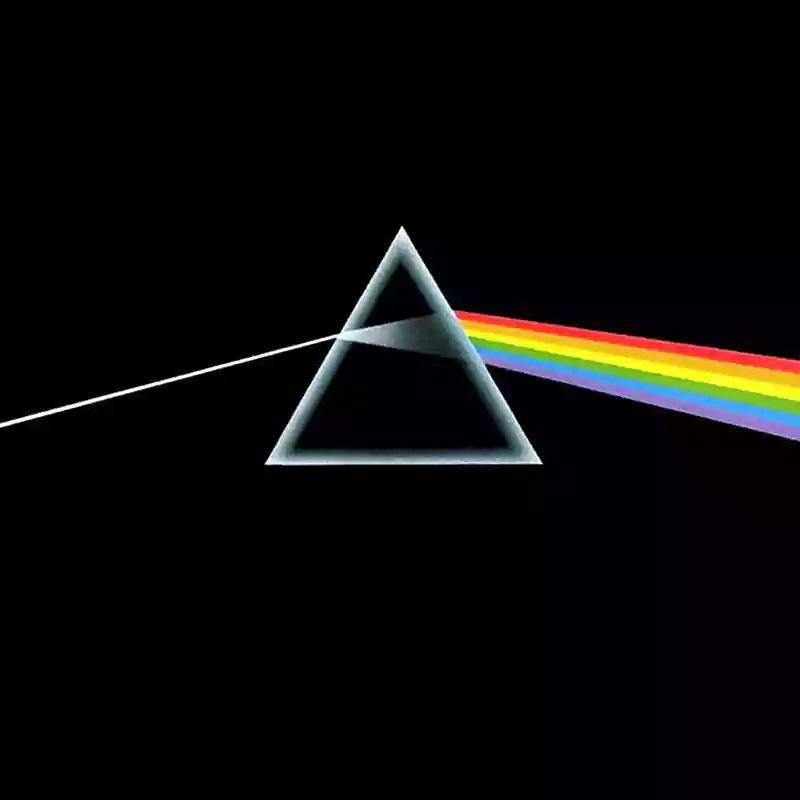
But, back in my room, the choice of CD was completely random: perhaps it was that cover with the triangle on a black background that magnetically took hold of me. Anyway, I inserted that disc, and since then... well, I can definitely say that since then my life has changed.
I was reborn like a phoenix and took flight.
I had just entered the “Pink Floyd” system, or rather, I had been captured by it.
I listened to the CD three times in a row, lyrics in hand, and from there, I would listen to it every day for I don't know how many months, meanwhile striving to obtain the entire discography to try to understand who Pink Floyd really were, these “evanescent embryos of cosmic fires to come, chromatic arabesques for the fresco of the universal sabbath,” as the well-known music historian Scaruffi calls them.
In hindsight, I have understood that with this album the artistic maturity of Pink Floyd had been realized, achieving a very fine polish of their sound, thanks also to the young but highly skilled sound engineer Alan Parsons, who had also worked with the Beatles on “Abbey Road” in '69.
“The Dark Side Of The Moon” was released by EMI on February 24, 1973. The creative mind of Roger Waters knows no bounds, and the realization of this apocalyptic concept album is largely due to him (it's hard for me to admit this as a “Gilmourian”).
The common thread is recognizable from the song titles: voice, breath, the race against time, music, money, illness, the end—the human life's path, made of fears and madness.
The velvety sound mantle that envelops the nine tracks is something alluring, also thanks to the sound effects inserted with surgical mastery, as is evident from the start of the album with the opening ballad “Speak to Me-Breathe in the Air”.
Mason’s gallop in “On the Run” introduces the most beautiful moments of the record: first, the bells of “Time” burst in to anticipate Gilmour’s resolute singing and overwhelming solo that can leave one breathless, then the sonic backdrop woven by Richard Wright accompanies Clare Torry’s superb vocal flight in “The Great Gig in the Sky”, inevitably recalling Gilmour’s dreamlike cry at the end of “A Saucerful of Secrets”.
Next comes the Waters-influenced “Money”, noteworthy if only for the most famous bass line in rock and for the riveting sax intervention by Dick Parry, although the piece, composed by Waters in just one day, suffers from repetitiveness and overall is the least successful on the album.
“Us and Them” and the apt continuation “Any Color You Like” instead highlight Wright’s perfect compositional balance, finding their place in a bidimensional space-time context, inseparable from the paranoia pervading them.
“Brain Damage”, loaded with references to Barrett, is instead proof of how a piece that repeats the same tempo can be (at the same time) touching, if of Floydian brand.
The concluding “Eclipse” appears as an outburst, hitting us in the face with the fleetingness of real moments and the substrate of difficulties to which our life is anchored, all pessimistically accentuated by the final comment: “There is no dark side of the moon, really; matter of fact, it’s all dark”; finally, the heartbeat, reconnecting to the initial track as in any respectable concept.
Summing up, “The Dark Side Of The Moon” is not the best album in the Pink Floyd discography, yet certainly the most compact and refined, to the point of redefining the artistic concept of “aesthetics.” Essential stages for the final definition of such an unmistakable sound were the previous albums “Ummagumma” and “Atom Heart Mother”, predominant demonstrations of inventiveness more than innovation, fruits of a truly well-cohesive band’s creativity, which provided appropriate bases for creating an album of such completeness.
At the beginning of the third millennium, “The Dark Side Of The Moon” enjoys astounding freshness and relevance, even though its release dates back 33 years, and it has all the credentials to be considered the greatest rock masterpiece, even if to call this album rock would be reductive, for with the innovations it brought to classical music, the futuristic visions contained within, the utterly perfect collage of music-sound effects-lyrics, for being a source of inspiration for an innumerable quantity of artists and, if you will, for the immense number of copies sold, it inevitably places itself among the major works of 20th-century art.
Loading comments slowly
Summary by Bot
The review reflects a deeply emotional journey sparked by Pink Floyd's The Dark Side Of The Moon. It praises the album's refined sound, masterful production by Alan Parsons, and timeless themes revolving around life and human experience. Highlighting key songs and the band's creative evolution, the reviewer views the album as a seminal artistic achievement that remains profoundly relevant decades later.Tracklist Lyrics Videos
Pink Floyd
Pink Floyd formed in London in 1965 and became a defining force in psychedelic and progressive rock. The classic lineage spans Syd Barrett’s founding vision, Roger Waters’ conceptual leadership, Richard Wright’s harmonic textures, Nick Mason’s pulse, and David Gilmour’s arrival in 1968, shaping their signature sound.237 Reviews
Other reviews
By claudio12
THE DARK SIDE OF THE MOON is one of the top 5 most important albums in rock history.
An album that, more than an album, is undoubtedly a work of art in rock.
By AngeloLecce87
Madness, suffocation, excitement, fear, relaxation, adrenaline, and pleasure blend almost imperceptibly in this thing called an "album".
I gave this album 0 because 5 is too little.
By UcCaBaRuCcA
It would be a crime to listen to the album in pieces.
The texture of the music is rich in detail, and at the same time light, smooth, and it creates an environment, an atmosphere around you.
By Pepperism
I take my mind to distant places. And I feel the madness, finally.
Don’t tell me anymore that I am sane, the dark side of the moon changes everyone.
By AR (Anonima Recensori)
An album is great when it belongs to Led Zeppelin or Pink Floyd, or the Doors.
Amidst soft and unsettling tones, the journey unfolds of The Dark Side Of The Moon, which still ranks among the best-selling albums, 33 years later.
