 •
Rating:
•
Rating: THE REVIEW
When music becomes poetry, this is the case of Queen II (1974).
It's not the first case nor the last, but such a high and technically perfect level was perhaps never reached, except in “A Night at the Opera”, either by Queen or other groups. We ask ourselves: How is it possible that from the first to the second album there is such maturity? The fifth place in the charts is just a confirmation. The Queen have understood which path to follow, but it is the Mercury/May duo that reaches and will surpass that of Plant/Page.
1) “Procession”. If the debut album opened with a very lively curtain, we are now completely in the dark. An almost funeral march will only give a “hint” of a dark atmosphere, but May’s skillful instrumental play, shifting from minor to major chords with a low accompaniment and a high overdub, will make it clear that that little march is instead indicative of the album’s “White” side, all its own but… let’s count to 3 before saying it will be a sunny album!
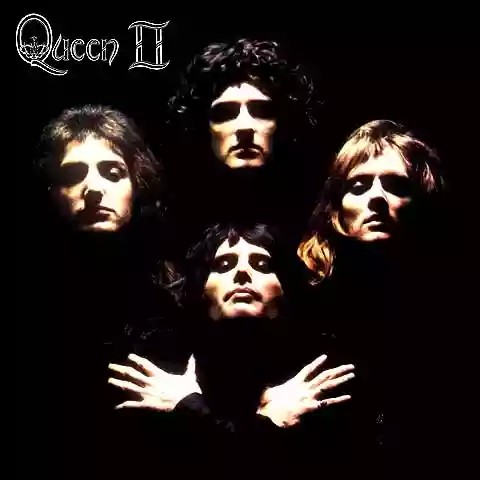
2) “Father and Son”. The curtain opens: The Queen on stage. Those 4 dark characters on the cover materialize. It is a triumphant start and also a hymn to the father/son relationship that has always meant a lot to Brian. May himself, in a not-so-famous interview in 1986, declared that his father was an example of composure for him, who, despite never having taken drugs or indulged in alcohol, was adrift. Choirs and overdubs dominate the scene, accelerations with returns to hard rock to soften into almost paradisiacal slowness. When a piece is long, it can’t be otherwise. May learns it from Wordsworth’s “long poem” theory which argued that poetry is physiology and that if short it can be the maximum, if long it must have high and low moments. Throughout Queen’s discography, there will be constant references to the literary world. The closure of the piece is faded and triumphant. Perfect.
3) “White Queen (as it began)”. After Bohemian Rhapsody, the most beautiful song by Queen in the '70s. Once again, a stunning May imagines a gothic landscape in the era when imagination was still carried only by audio and not by video clip. Good times. Brian's guitar weeps, a mournful Mercury accompanies this sadness, and one walks as if in a dark valley imploring the White Queen who with her power is capable of enchanting the poet and of making the night pale. May can only wait in vain, giving vent to a classical arpeggio followed by unknown rustles that, at the appearance of the Queen in the darkness, GIVE BIRTH TO ONE OF THE MOST INTENSE MOMENTS IN MUSIC HISTORY. Explosion of guitar, explosion of voice, triumph of choruses. The closure is melancholy “as it began”. Goosebump-inducing song, excellent piece.
4) “Some day, one day”. May is still dealing with the white side but evidently tired of the hard work, gives birth to a “bucolic” song in the non-negative sense of the term but with little grip. Despite the fascinating gothic themes contained in it and a not bad variation in the chorus, it does not captivate. It is also the first piece he sings, and his singing abilities are very limited. Weak.
5) “The Loser in the End”. Finished with the sunny side, where do we put this track? Who knows! Just because Taylor wrote it and wanted to sing it! It does not match the rest of the album. For this, it would deserve failure, but placed in “solitary confinement”, it is not bad, indeed. The drummer demonstrates a great voice and a track quite similar to “Son and daughter” in terms of rhythm and concept but thematically simpler and more understandable. Obsessive mother-delinquent son relationship. Truth is in-between. And those drum breaks at the end! A nice 6 for encouragement for his first track all his own.
6) “Ogre Battle”. Mercury only the singer so far? No dear boys and girls! From the depths of a rustle that seems to come from lost mountains, horror rises: the ogres are coming. Freddie showcases all his fabled and mythological ability, recalling English late-gothic literature, initiating the dark side of the album. Universal song. Adults and children would dream. These ogres, at nightfall, gather only if “the piper plays and your soup is cold on the table while the raven flies…” , ogres who devour the ocean and often test their strength in mythological battles. The track is at times hard rock, at times a fast march, but never a dull moment. For everyone.
7) “The fairy feller’s master stroke”. Translated it means: the master stroke of the woodcutter. Mercury, a graduate of Ealing College of Art, knew the namesake painting by Richard Dadd. A gushing fairy tale. A circle of creatures from “A Midsummer Night’s Dream” almost gather in the woods to witness the woodcutter who will deliver an ax blow to break the nut. Mercury, with a pressing rhythm and chords that to each other broke many harmonic laws, creates one of the most “naughty” tracks in the entire Queen repertoire, painting all the characters present in Dadd's crowded painting. Great voice then. Collector’s gem.
8) “Nevermore”. Sublime. In every sense. Edgar Allan Poe wrote the famous poem “The Raven” in which he repeated never more to every question of the lover who asked if his beloved was in love or even alive. That haunting answer was a reason for despair. Poe also theorized that poetry had to be, because it is physiological, short, 100 words at most, melancholic because melancholy is the greatest mood and echoing… “the letter r and the vowel o in nevermore”. Mercury composes, only piano and voice, a track with a mark of 10 and praise that everyone loves in all parameters. Undisputed jewel.
9) “The March of the Black Queen”. Like in an ellipse, this is the second focus of the entire album. Still signed by Mercury, it is the sum of the work done so far. Absolute peak for music (march, jumps, crazy drums, very high and always well-organized harmonies, discant, infinite variations, truces, gallops, interruptions, resumptions), voice in which Freddie is in great shape and text. No, not that mysterious queen of the white side anymore, but this is a black queen, ruthless, like in a chess game between whites and blacks (just like the nails of the left hand that May and Mercury will paint from now on), she reigns sovereign and undisputed in the darkness with both hands (totalizing political ideology?), fascinating, mean, who “boils, bakes, and never dots the i’s”. Second only to Bohemian Rhapsody and Stairway to Heaven. Masterpiece.
10) “Funny how love is”. Very much affected by the “Beach Boys” style that Mercury had to do with during the “Larry Lurex” period. Freddie also shows himself tired in this piece. After all, it also seems legitimate to me. Heavy with the spector sound, it’s a continuous plucking of guitar and a tambourine beat to celebrate the beauty and funny innocence of love. A little song that only highlights Freddie Mercury’s huge voice.
11) “Seven Seas of Rhye”. It resumes the main theme of the same piece contained in the first album which I did not mention (see “Queen”). This time, however, Freddie Mercury organizes it again with his poetic taste, imagining himself as a superhuman creature descending from above and claiming his seas of Rhye with a rhythm that is hard not to involve. The only track on the album to be included in the Greatest Hits of 1980. Chosen for its brevity, not certainly for its value. Captivating.
“Queen II” is one of the most well-crafted and creative albums ever and saying it was superior to “A night at the Opera” would be like saying that Maradona was stronger than Pelé. It depends on our users' tastes. On one thing we agree: both albums are excellent.
Loading comments slowly
Summary by Bot
Queen II (1974) is praised for its poetic quality and technical perfection, showcasing the early maturity of Queen's sound. The review dissects each track, highlighting the gothic themes and musical complexity. Standout songs include 'White Queen' and 'The March of the Black Queen,' described as masterful rock compositions. Despite some weaker moments, the album remains a creative triumph and a classic in Queen's discography.Tracklist Lyrics Videos
Queen
British rock band formed in London in 1970. Core classic lineup: Freddie Mercury (lead vocals), Brian May (guitar), Roger Taylor (drums) and John Deacon (bass). Known for genre-crossing albums and stadium anthems such as "Bohemian Rhapsody", and for legendary live performances (notably Live Aid 1985). Freddie Mercury died in 1991.143 Reviews
Other reviews
By 3poundsoflove
Queen II is indeed one of the albums to be rediscovered and considered as a true and legitimate masterpiece of rock with dark and sepulchral tones.
The March of the Black Queen encapsulates all, I say all, the band’s poetics, in a single, elusive, infinite song.
By Peppe Weapon
One of the most underrated rock works in history.
Those who hate Queen should listen to this album.
By CRITIC-MUSIC
Freddie was and still is 90% of the band’s success.
‘The March of the Black Queen’ is, in my opinion, the most beautiful song in the history of rock!
By Starblazer
"'Queen II' is a record full of hard rock and baroque, surreal, and fairy-tale atmospheres."
"I consider it Queen's masterpiece, even more than 'Bohemian Rhapsody.'"
By paolofreddie
"Queen II is an ambiguous masterpiece with multiple nuances, an admirable blend of styles, perfect in arrangements, structure, and the fluid flow of the music."
"'The March of the Black Queen' is superb, a masterpiece within the masterpiece, one of the best compositions by Queen, if not the best."
