
 •
Rating:
•
Rating: THE REVIEW
"Oh no, a review about those commercial sellouts, the Queen!"
I imagine that some of you reacted like this upon finding their name on the list of new reviews.
Well, let me tell you that in that case, you're being superficial and ill-informed. You see, before Mercury's death, there wasn't this media bombardment of their most famous and now popular songs, which are more or less tolerated with resignation. And there wasn’t even the widespread belief that Queen was an easy-listening band, because they actually weren’t, so much so that in Italy, as in the USA or other parts of planet Earth, Freddie Mercury's band was anything but a mainstream high-charting group.
Queen wasn’t well supported by critics who always denigrated them without ever truly understanding them, despite some essential works for every rock lover, interspersed with less important pop-rock albums, which nonetheless are difficult to find comparables to in terms of value in the recent musical scene.
The necessary introduction was meant to make it clear that it's not just Led Zeppelin, The Who, or Deep Purple that hard rock needs to save from the end of the world. In fact, compared to many other names unfortunately, and solely in our parts, underestimated, these mentioned groups are even overrated by the new generations of kids rediscovering the '70s.
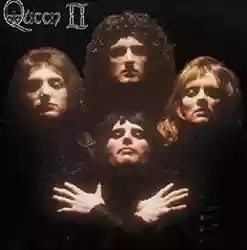
Queen II is indeed one of the albums to be rediscovered and considered as a true and legitimate masterpiece of rock with dark and sepulchral tones, so dear to new wave artists, as well as to '90s rock stars like Billy Corgan, who has honestly declared in unsuspecting times that this album is one of his absolute favorites, fundamental for his artistic formation.
But what could be so valuable in a Queen album? Well, first of all, get rid of the prejudices, and insert the CD into your player: you'll find something to which, if you're not already familiar with the Queen's court, you weren't prepared.
The intro of Procession already suggests that something is amiss, that the cleanly polished sound of the songs from the Greatest Hits is far away, and the guitar arpeggio introducing Father to Son clears any form of doubt: these are not the Queen everyone knows. The aforementioned song is notoriously one of the most underrated in the entire band’s catalog. Epic and melodramatic with perfect moderation, it already lays down the cards that the band will play throughout the album, where, if there was ever the slightest doubt, Bruno Maggio’s guitar overdubs, and Fede Mercurio's sublime, unparalleled voice, dominate.
The first part of the album, named White, is entirely composed by May, who excels in every single intuition, especially in the splendid White Queen (As It Began), which the band itself has surprisingly forgotten in the years to come. It continues with an acoustic song sung by Brian, and the customary primordial punk rock outburst by Taylor, marking the end of the white side, and takes us straight towards the heart of the album, the black side, entirely composed by Freddie Mercury, where you'll journey through stories inherited from Tolkien's Hobbit, high-class progressive hard rock, flourishing piano, pseudo-operatic choirs (which we will find again in a more melodramatic form in the following albums) and many other insights that make this album a gem.
Ogre Battle is hard rock by definition, Nevermore, just voice and piano, is as good as it gets for hearing the clean voice of a young Mercury, applause-worthy for his talent as an interpreter empathizing with the narratives of his own songs. The Fairy Feller Masterstroke is Yes-styled progressive, and I believe Mr. Enrico Ruggieri (yes, him!) should have a bit more to tell us about this song (see Peter Pan).
The March of the Black Queen is then a true journey into the band’s history: it encapsulates all, I say all, the band's poetics, in a single, elusive, infinite song.
It concludes with Funny how Love Is (another surprise hit, a sunny and easy song that contrasts with the dark atmospheres of the album) and the tongue-twister and finger-twister (at the piano it must not be an easy task to play it) of Seven Seas of Rhye, the only song left to posterity from the entire batch.
In conclusion, for those already familiar with the album in question, I would recommend revisiting it for a new interested listen, especially if the tape or CD has been gathering dust. For those who still can't stand them, and hate the image (exploited and raped - only - here by us) that has been made of the band, it's time to be surprised. That is, if one is sufficiently open-minded and patient to see, understand, and bow to the passing of the Black Queen.
Loading comments slowly
Summary by Bot
This review challenges the superficial view of Queen as merely a commercial band, urging listeners to rediscover Queen II as a complex and dark rock masterpiece. It highlights the album's progressive and epic qualities, with special praise for Freddie Mercury's vocals and Brian May's guitar. The album's unique structure and innovative songs set it apart from Queen's more popular hits, offering a rewarding experience for open-minded rock fans.Tracklist Lyrics Videos
Queen
British rock band formed in London in 1970. Core classic lineup: Freddie Mercury (lead vocals), Brian May (guitar), Roger Taylor (drums) and John Deacon (bass). Known for genre-crossing albums and stadium anthems such as "Bohemian Rhapsody", and for legendary live performances (notably Live Aid 1985). Freddie Mercury died in 1991.143 Reviews
Other reviews
By Peppe Weapon
One of the most underrated rock works in history.
Those who hate Queen should listen to this album.
By CRITIC-MUSIC
Freddie was and still is 90% of the band’s success.
‘The March of the Black Queen’ is, in my opinion, the most beautiful song in the history of rock!
By Walterstarman1
Queen II is one of the most well-crafted and creative albums ever.
Explosion of guitar, explosion of voice, triumph of choruses. The closure is melancholy 'As it began'. Goosebump-inducing song, excellent piece.
By Starblazer
"'Queen II' is a record full of hard rock and baroque, surreal, and fairy-tale atmospheres."
"I consider it Queen's masterpiece, even more than 'Bohemian Rhapsody.'"
By paolofreddie
"Queen II is an ambiguous masterpiece with multiple nuances, an admirable blend of styles, perfect in arrangements, structure, and the fluid flow of the music."
"'The March of the Black Queen' is superb, a masterpiece within the masterpiece, one of the best compositions by Queen, if not the best."
