
 •
Rating:
•
Rating:
THE REVIEW
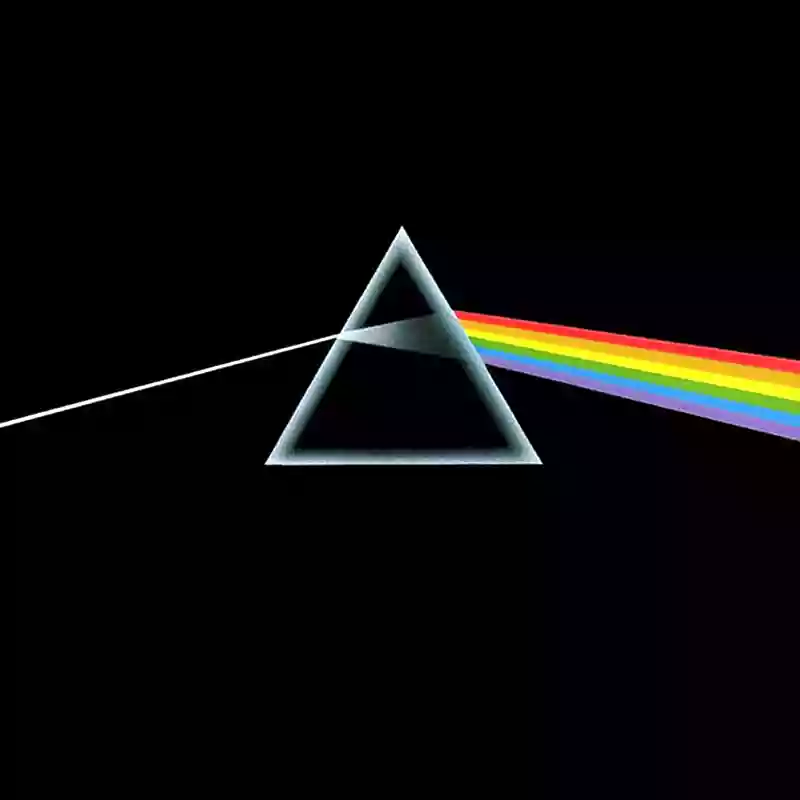
Scientifically, we know that the lunar phases last approximately seven days. Musically, four thirty-year-olds have managed to perform a miracle: they encapsulated everything related to the moon in about 43 minutes, starting from the cover (of Harvest, a record label very dear economically) that depicts a triangular prism intent on slicing through a magnificent rainbow, all against a fantastic black background, giving the idea of suspension in a void. No title on top, only on the thin side strip do we find the necessary information to decode artist and title. On the back, the track titles are absent, available only on the CD-ROM (in reality, in the 30th anniversary edition, the title is directly on the cover, as with the track titles, but this only ruined the fascinating strangeness of the "Dark Side").
Once the case is analyzed in its smallest details, there's nothing else to do but introduce this concept album into the player. Initially, the loudest silence, then slowly, gradually, slow sounds, heartbeats, ticking, cash registers (as analepsis for what will be Money), subdued and hearty laughs, repeating in a deep cycle, simultaneously, a piercing scream growing in progression, crossing the sound barrier. Finally, the start of a brilliant and unpredictable slow: mathematical, precise, pure, pierced by a good dose of serenity, the angelic and sweet sounds of guitar, the soothing voice of David Gilmour that doesn't break this magical harmonic balance, rather it delights it, softening it largely and making this Floydian invention even more danceable. This is "Speak to me/Breathe". One almost doesn't notice that all the tracks (as will be experienced later as well) are connected to each other by the magical thread of lunar psychedelia, reaching the second track, "On the run", completely dependent on the electronic setup regulated by the great bassist Roger Waters (the true soul of the group). However, there are also airport voices accompanied by a presumed takeoff (achieved by varying the effects). Ultimately, it's just a theme that undergoes small variations, but it doesn't arouse monotony, more so it prompts lively participation and a full sense of transport, of movement toward destinations light-years away. The piece finds its conclusion with a tapping noise of footsteps.
Sudden mechanical noise of multiple clocks: it's the genesis of "Time". Bright ringing of alarms and repeated chimes that fade to make room for a deep and consistent ticking, different from the previous ones because it's free of sharp beats. The opening of a strange electric guitar chord hints at a deep alternative-progressive atmosphere, stemming from deep sounds never reproduced as they're devoid of human sense, more so cosmic, almost dating back to the dawn of time, yet so innovative that it's really difficult, if not impossible, to categorize them. The abrupt drum break, after 2 and a half minutes of musically converted unconsciousness, brings back to reality: the first words are indeed pronounced, so charged and energetic, magnificently supported by electric guitar breaks, which then find almost a relaxation that unwinds right within the musical meanders. Temporary end of the spoken part, consisting of phantasmagoric chords, almost angry, prisoners of the dream, such as to imagine great naturalistic and galactic documentaries. Sudden return to musical verses, always characteristically colorful, always then tending towards a state of wellness with oneself. Subsequently, brilliance of brilliance, the return to the danceable melodies of "Speak to me/Breathe", but this time with different lyrics. Thus, this over 7 minutes of deprivation from conscious will conclude.
The sequel is no less: "The great gig in the sky" manages to embody a tranquility sometimes falsified, "disturbed" by veiled and then piercing vocalizations that fit like a glove. The piano is master in this noble composition; it proceeds solemnly, never interrupted, reflecting absolute perfection. Track 5, "Money", recognizes itself by those cash registers that repeatedly ring, producing bright jingles quite different from those in "Time". The ensuing bass line now holds a place in music history. However, it's not the only protagonist: it's followed by the guitar and drums, and naturally, David's vocal emissions, reluctant to stay on the sidelines, always egocentric (not unjustly). The chorus is almost scaling. Incredibly (perhaps it's not so strange since we're now accustomed to channeling oddities into our auricles) we find trumpets, which nonetheless do not clash. But the main feature of the musical track is the incredible guitar outbursts, which, if they could talk, would have much to say. They are expertly and not excessively stirred by great and knowledgeable masters. The return to vocals is mandatory also because it's rightly requested to end gloriously. Gilmour doesn't delay and expresses his great and boundless vocal ability.
Organ sounds mark the prelude of "Us and them". The trumpets make their exquisite appearance. The vocal part comes after almost two minutes, calm and gentle, velvety. The chorus almost depicts an anthem, a liberation from this chain of calmness that inexorably envelops the listener. As in "The great gig in the sky", we pleasantly perceive the piano, maximally diligent. Kaleidoscopic and psychedelic sounds set off "Any colour you like". Followed by guitar tremors masterfully played with care, almost fearing to break the instrument that can do everything, given its infinite possible musical combinations. "Brain damage" couldn't have a more suitable title: its initial gospel-like associations at times, its angelic chorus vividly pronouncing "The dark side of the moon", its tasteful laughter, all these factors cause brain damage, but positively.
Sweetly at the end, the CD fittingly concludes with "Eclipse", which gathers so many emotional states, all in the words, and in its final part revisits that abysmal silence of "Speak to me".
The "record" (but can this agglomerate of musical instruments, voices, effects, electronics be defined as such?) thus comes to its end. However, it's hard to think of it as such, considering everything has forcibly penetrated our soul and it will be difficult to rid ourselves of it. We can truly declare that the dark side of the moon has been explored.
Loading comments slowly
Summary by Bot
This review celebrates Pink Floyd’s The Dark Side of the Moon as a miraculous and timeless concept album. It highlights the detailed packaging, the seamless flow of tracks connected by psychedelic and lunar themes, and praises the masterful instrumentation and vocals. The reviewer appreciates the album's innovative soundscapes and emotional depth, describing it as a journey that penetrates the soul.Tracklist Lyrics Videos
Pink Floyd
Pink Floyd formed in London in 1965 and became a defining force in psychedelic and progressive rock. The classic lineage spans Syd Barrett’s founding vision, Roger Waters’ conceptual leadership, Richard Wright’s harmonic textures, Nick Mason’s pulse, and David Gilmour’s arrival in 1968, shaping their signature sound.237 Reviews
Other reviews
By claudio12
THE DARK SIDE OF THE MOON is one of the top 5 most important albums in rock history.
An album that, more than an album, is undoubtedly a work of art in rock.
By AngeloLecce87
Madness, suffocation, excitement, fear, relaxation, adrenaline, and pleasure blend almost imperceptibly in this thing called an "album".
I gave this album 0 because 5 is too little.
By UcCaBaRuCcA
It would be a crime to listen to the album in pieces.
The texture of the music is rich in detail, and at the same time light, smooth, and it creates an environment, an atmosphere around you.
By Pepperism
I take my mind to distant places. And I feel the madness, finally.
Don’t tell me anymore that I am sane, the dark side of the moon changes everyone.
By AR (Anonima Recensori)
An album is great when it belongs to Led Zeppelin or Pink Floyd, or the Doors.
Amidst soft and unsettling tones, the journey unfolds of The Dark Side Of The Moon, which still ranks among the best-selling albums, 33 years later.
