
 •
Rating:
•
Rating:
THE REVIEW
PINK FLOYD
THE DARK SIDE OF THE MOON
Harvest, 1973
Produced by Pink Floyd
Roger Waters – Bass, VCS3, Sampling, Vocals
David Gilmour – Guitars, VCS3, Synthesizer, Lead Vocals
Rick Wright – Keyboards, VCS3, Vocals
Nick Mason – Drums, Percussion, Sampling
1. SPEAK TO ME / BREATHE
2. ON THE RUN
3. TIME / BREATHE (Reprise)
4. THE GREAT GIG IN THE SKY
5. MONEY
6. US AND THEM
7. ANY COLOUR YOU LIKE
8. BRAIN DAMAGE
9. ECLIPSE
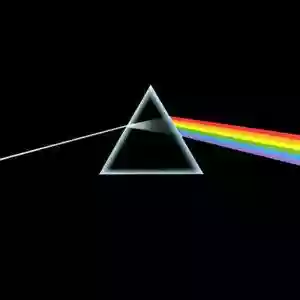
Here we are. After years of attempts, experiments, interstellar journeys, orchestral pomposity, and bucolic minimalism, here is the album that captures the soul of 70s Pink Floyd: "The Dark Side Of The Moon" is not only the compositional and musical climax of the post-Barrett group's experience, but also a compendium of perfectly centered experimentation, thanks to the revolutionary sampling and mixing techniques of the brilliant Alan Parsons. The sound engineer and the four members of the group recorded (and skillfully inserted into the music) sound effects of all kinds and vocal interviews with the most disparate characters (from rock bigwigs to the Abbey Road doorman) on themes such as violence, madness, and death. Dark Side marks the beginning of Roger Waters' era as the sole lyricist for the group and, in fact, the master of the Floydian reins: probably inspired by the experience of his friend Syd, the theme of the masterpiece is madness, the progressive abandonment of psychic faculties in a foamy whirlpool of darkness, condensed for the first time into a concept album.
A crescendoing heartbeat blends with mechanical noises and distant voices, delirious in their snickering; a pneumatic drill rises and is swept away by a desperate scream. "Speak To Me" is the perfect antechamber for the album, seamlessly fitting with the subsequent "Breathe", laid-back and rarefied among guitar slides in the Meddle style. Allegory of creation and birth, it cradles the sweetness of Gilmour's voice in refined piano chords, conveying the peaceful infantile tranquility of unconscious innocence. Mason's drum passages are steps taken crawling by an electric child, smiling and playful, who does not yet know what sad future awaits.
The heart plunges into the chest and begins to race breathlessly together with "On The Run", an expression Waters used several times during his career to indicate madness: a rushing, feverishly, towards the black finish line of oblivion, the erasure of the mind, the hysterical cell of insanity. The frenetic pace is transported by waves of synthesizers, obfuscating and magnetic in their accompaniment and sinking, while obsessive buzzing, mechanical voices, and breathless sighs appear on the mind's screen, synthetic pulses, confessions of sick spirits, air raids, and explosions: the race has reached its full frenzy, leaving behind any real foothold.
In the murky, foggy moor, dozens, hundreds, thousands of clocks and alarms suddenly explode in their stunning and deafening trill: what better opening for "Time"? The mechanical noise slides away, making room for a constant pulsing on which percussion, organs, and guitars appear as menacing beings, now disappearing now reappearing, to come closer and closer to the actual song. David Gilmour pilots Waters' lyrics on the reflection of how time flows differently depending on the ages on a treadmill of a perfect song, in its verse-chorus-breathtaking solo of a moving Stratocaster-verse-chorus structure. The sweetness alternates with more decisive parts, describing a harmonious and magnificent rainbow, flowing again into Breathe, the initial theme, soft and reassuring in its grand simplicity.
It's goosebump-inducing melancholy that is narrated by "The Great Gig In The Sky", a stunning passage signed Rick Wright. The piano guides Clare Torry's majestic vocalizations, warm and heart-wrenching and so communicative despite the absence of words. Mason's perfect drumming marks and accentuates the attacks and ebb of non-verbal poetry. Torry's sighs and full voice explain to everyone the emotional stages of death, the natural continuation of the loss of time, from sadness to resignation to anger, in one of the most exciting compositions ever signed by Pink Floyd: a gloriously alive conclusion for the A-side of the album.
The second side of the album welcomes us with the sound of cash registers overlapping to create the characteristic yet unusual 7/4 time signature, the backbone for one of the most famous bass lines of all time: here's "Money", a chapter reserved for vile money as an actor of alienation and insanity. More radio-friendly than the other pieces included in the concept, with a jaunty sway, it moves away from the dark path to embrace a magnificent sax solo, an antechamber for another masterful exhibition of Gilmour on guitar in a goosebump-inducing variation. Although Dark Side is a single, homogeneous thread, Money stands out as a "song," becoming one of the most loved and requested by fans. The disordered voices also sweep the tail of this piece, descending again into the anesthetizing fogs of the dark side of the Moon.
"Us And Them" is slow and soft, wrapped in spirals of piano and saxophone while Gilmour recites Waters' verses against wars in poor countries with sweet echoes. The anesthetic calm is broken by the inflaming of the tranquilizing potion, a crescendo of tones that brings tears to the eyes shakes the sense of calm to dive into the hot and disturbing waters of sound. The stunning musical space created by the late Rick Wright becomes legendary when Dick Parry's sax rises to the sky to complete the majestic and gentle magnificence of this chapter.
The journey turns sour on vintage psychedelic synthesizers in "Any Colour You Like", an instrumental passage on the illusion of having different choices even when there is only one. Gilmour's guitars scream and screech, knotting with the other instruments for a space ascent in an artificial river, full of cutting-edge electronics, and flowing into that sea in a gentle storm which is "Brain Damage".
What is, in fact, the title track ("dark side of the moon" is repeated several times) is the only entirely Watersian moment: music, words, and voice are in fact his domains. If the composition echoes from afar the simple bucolic structures of Waters' past compositions, with the relatively sparse guitar and the predominance given to the voice, the words break the emotional shell and go straight to the heart of the theme: madness. The brain damage is there, now evident, and the splendor of the chorus cannot hide the subconsciously hysterical laughter hovering around the protagonist's devastated mind, unable to recognize himself in the ocean of madness ("There's someone in my head, but it's not me"). The apparent joyful cheerfulness is nothing but irrational resignation to embrace the dark side of the Moon.
"Eclipse" is the natural continuation and emotional and conclusive peak of the album: the Pink Floyd litany, the magical instruments and choirs mix in a unique vortex of sonic emotions that push the mental spacecraft onto the dark side, happily unaware of having abandoned rationality, and free to abandon itself once again to the primitive and familiar heartbeat with which the journey began.
Loading comments slowly
Summary by Bot
This review praises Pink Floyd's The Dark Side of the Moon as the pinnacle of 70s progressive rock, highlighting its revolutionary production and profound themes of madness, time, and death. It emphasizes the expert blend of musical experimentation, lyrical depth by Roger Waters, and masterful performances. Each track receives thoughtful analysis, revealing how the album creates a cohesive and emotionally powerful journey. The review celebrates the album’s timeless influence and its lasting emotional impact.Tracklist Lyrics Videos
Pink Floyd
Pink Floyd formed in London in 1965 and became a defining force in psychedelic and progressive rock. The classic lineage spans Syd Barrett’s founding vision, Roger Waters’ conceptual leadership, Richard Wright’s harmonic textures, Nick Mason’s pulse, and David Gilmour’s arrival in 1968, shaping their signature sound.237 Reviews
Other reviews
By claudio12
THE DARK SIDE OF THE MOON is one of the top 5 most important albums in rock history.
An album that, more than an album, is undoubtedly a work of art in rock.
By AngeloLecce87
Madness, suffocation, excitement, fear, relaxation, adrenaline, and pleasure blend almost imperceptibly in this thing called an "album".
I gave this album 0 because 5 is too little.
By UcCaBaRuCcA
It would be a crime to listen to the album in pieces.
The texture of the music is rich in detail, and at the same time light, smooth, and it creates an environment, an atmosphere around you.
By Pepperism
I take my mind to distant places. And I feel the madness, finally.
Don’t tell me anymore that I am sane, the dark side of the moon changes everyone.
By AR (Anonima Recensori)
An album is great when it belongs to Led Zeppelin or Pink Floyd, or the Doors.
Amidst soft and unsettling tones, the journey unfolds of The Dark Side Of The Moon, which still ranks among the best-selling albums, 33 years later.
