
 •
Rating:
•
Rating:
THE REVIEW
Many works in the '70s were created with the intent to describe the fears and anxieties of the people of that time in the face of death, madness, and things like that. The Pink Floyd, with all the brightness they had in their souls, didn't miss the chance to do analytical work in this area. They focused on some of the main human fears/obsessions and dedicated a piece of their album 'Dark Side...' to each one. Gabriel himself, later and in his own way, did equally analytical work in III with the various forms of madness and the fear connected to them. There are those who maintain, and they find me on their side, that the Genesis wanted to represent the restlessness of their generation in the face of these fears. They did so with this album, but not through analytical work, rather in the way, let's put it this way, in which impressionists expressed their message through colors (I borrow the comparison from ondarock because it well expresses what I want to say). This hypothesis is the starting point of my very personal discussion about the album.
Having agreed upon the project, the five announcers of false apocalypses must have believed that it was necessary at all costs to take the ground from under the listener's feet. For the cause, the factotum keyboardist provided his nimble fingers and his combat arsenal, and the result was a carpet of "pure anxiety" (and here I steal again, damn me, this time from a very old review, I couldn't come up with a better definition) base on which all the songs were built.
The singer understood that the first thing he needed to do was to bring the other four face to face with reality: only he had a mind adequately sick enough to conceive a story and lyrics worthy of the intent they had in mind, and therefore he had to do it alone. He convinced them and willingly got to work, still alive with the memory of a movie titled 'El Topo', a product of a mind as disturbed as his own. Thus, he conceived the story of a journey (that of the well-known Puerto Rican writer) with an evolution teetering between a storyline and a dream. However, it is not a fairy-tale or romantic dream, but one that is absurd and makes little sense.
The fairy tale tool was once again useful to him, but in a different way than in the past. No more visionary standalone frames, no more battles between good and evil, no more metaphors and word games intending to criticize poor England, he had once threatened to sell it and deemed it sufficient.
In my opinion, it is a mistake to look for what Genesis had to say with this album in the moral of the story or the meaning of the lyrics. I initially suggested thinking of the Lamb as a painting where the representation of the subject occurs through the play of colors. Here the colors used are the suggestions, and the story serves to create more in addition to those created by the music, not to communicate a message. The other hypothesis I start from is that the subject they wanted to represent is the state of mind of their generation, and then the disjointedness of the journey told probably aims to transmit to the listener the restlessness in the face of the unknown and the collapse of certainties, a part of that state of mind.
To the chorus of voices that subsequently defined Gabriel's work as nebulous, the voice of Banks was also added over time. The music, however, shows that during the making of the album he had clear ideas very much in line with his singer. But I am grateful to him for too many things, above all the solo in 'In the Cage,' to give importance to these behaviors of his like a grumpy mother-in-law.
From a strictly musical point of view, I have practically nothing to add to the analyses conducted in other reviews. I will just make an observation about the use of the bass. For once, it proves to be a strongly characterizing element of the sound. There are finally some great bass lines on this album (the one of the title track is my favorite). I must have read somewhere that Rutherford also put quite a few chords into it. The sound is very aggressive, and the use of the Rickenbacker and the pick would explain this fact. What I know for sure is that Pluto did indeed use this bass on tour, along with another double neck, a Micro-Frets, I have no idea what sound it has.
Rutherford is a strange bassist: a great stomper of moog taurus pedals up to the Lamb, with fingers almost always glued to twelve strings, and for the rest of his career a triumph of double necks. The most conventional bass I've seen him hold is the Rick, for the rest models not far from the artisanal: the aforementioned Micro-Frets, the aesthetically valuable Shergold (sonically I have no idea), the plasticky Steinberger, up to that mutant instrument of the 2007 tour fusion of a Gibson guitar and a Yamaha bass. Never a Jazz or a Precision bass as far as I know.
Just in the period when they created what I believe to be their most beautiful work, the Genesis committed a serious sin in the world of music. They gave little space to their very particular guitarist. Few are the gems of his making within the album: Cuckoo Cocoon, the shaved heart, the arrival of the Supernatural Anesthetist, and the Nippon introduction, a bit of a nag to be honest, of Colony of Slippermen. A meager haul, indeed, even though the Anesthetist is among Genesis' most beautiful pieces for me.
The album came out in a period marked by quite a few contrasts within the band. The facts are well-known to those who know Genesis, who may know more than the band members themselves remember. For those who know nothing about it and are interested in shedding light on it, you can find avalanches of information virtually everywhere, on this site and elsewhere, except here.
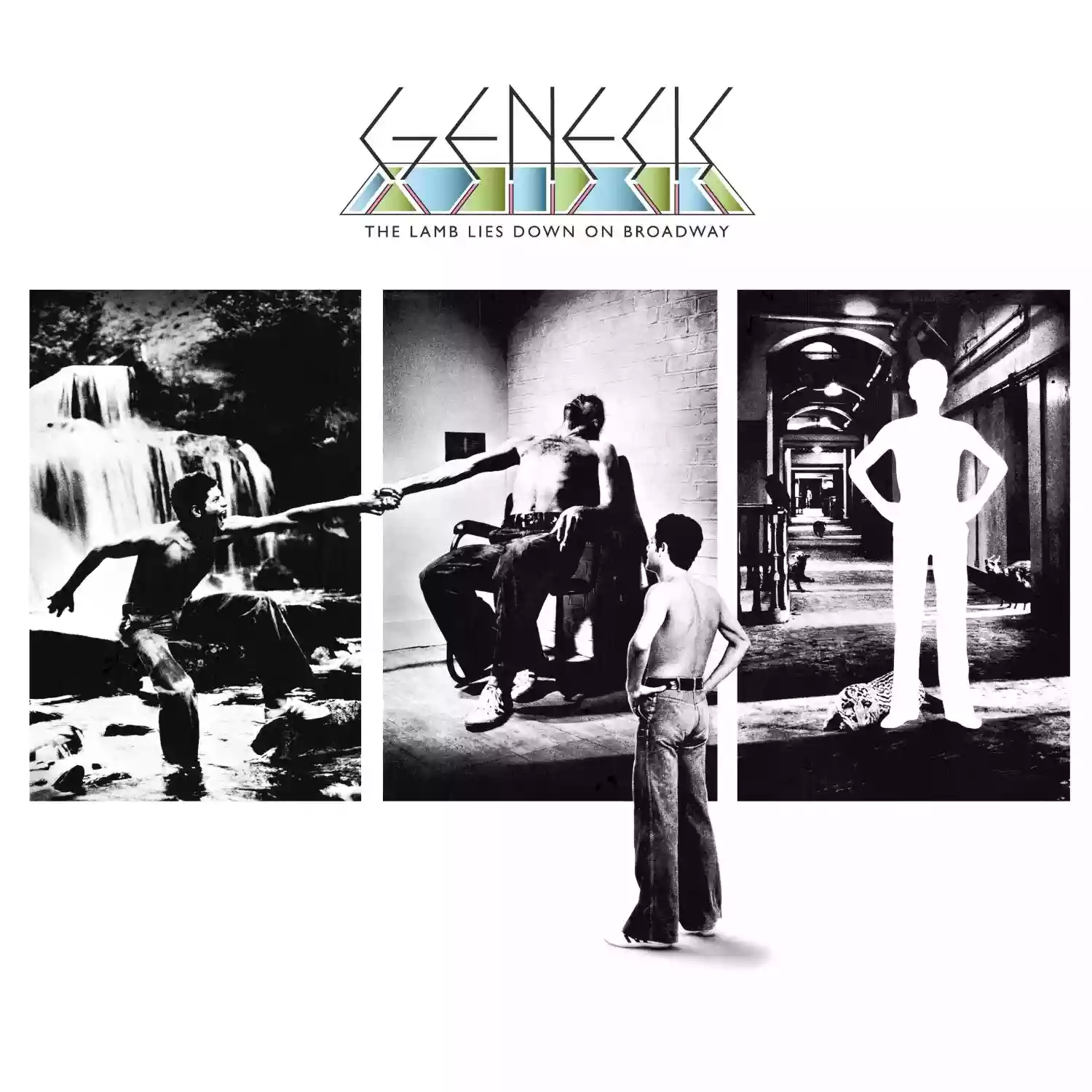
Beautiful cover by Hipgnosis studio.
And after this senseless ramble, I extend a dear salutation to those who have made it this far without giving up on me even once.
Loading comments slowly
Summary by Bot
This review reflects on Genesis' masterpiece 'The Lamb Lies Down On Broadway' as an impressionistic portrayal of 1970s societal fears. The album's music delivers a carpet of anxiety, supported by standout bass lines and vivid storytelling from Peter Gabriel. It emphasizes the emotional state of the generation rather than a linear narrative. The review praises individual musicianship, especially Mike Rutherford's bass playing, and recognizes the album's significant artistic achievement.Tracklist Lyrics Videos
Genesis
English rock band formed in 1967, celebrated for landmark early-1970s progressive albums (Foxtrot, Selling England by the Pound, The Lamb) and a later, more pop-oriented phase led commercially by Phil Collins.116 Reviews
Other reviews
By Mr_Iko
I love to call it 'Music-All': a watershed between a rock opera and a musical to be performed on a Broadway stage.
Should you not like this album, I recommend consulting a good doctor for an otoscopy.
By Mariaelena
"This double album is astonishingly difficult, progressively dilatable and becomes unique because it is full of merits, flaws and double meanings both for the lyrics and the music."
"Rael and John dissolve because maturity will have been reached due to a fundamental choice transforming them into a single complete man... You are free to interpret, and this is what Peter Gabriel wanted to convey to us."
By Old King Cole
"The Lamb is something more... too varied, containing too many different elements to be classified in a genre that is undoubtedly open but still has boundaries that delimit it."
"The main instrument in 'The Lamb' is [Peter Gabriel's] voice, which finally reaches its peak of technique and, above all, of expressiveness."
By STIPE
"Gabriel was Genesis and Genesis was Gabriel."
"A courageous work, completely different from their discography and also the last one by Gabriel with his old companions."
By paolofreddie
The album ranks among the most interesting in progressive and rock music in general.
The Lamb is one of the most complex and difficult to analyze albums in the history of prog and that is what enhances its intriguing nature.
