
 •
Rating:
•
Rating:
THE REVIEW
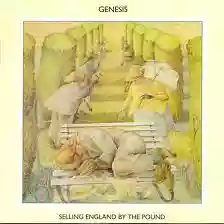
After the great success of the album "Foxtrot," and with the group's fame further enhanced in Europe, Genesis returned to the studio to record a new album of originals. The album was released in September 1973 and was named "Selling England by the Pound," which in Italian can be rendered as "vendesi Inghilterra un tanto al chilo." Although it is not a true concept album, it develops a plot with a political and social background.
Peter Gabriel, the band's eccentric leader, contributed massively to the lyrics, which contain many word plays and many untranslatable points. The first song of the album is a clear example of a text full of word plays and ambiguous words. It is titled Dancing with the Moonlit Knight and the lyrics represent an ironic indictment of England at the time. This is evidenced by the frequent references to English culture scattered throughout: the lyrics mention the Queen of Maybe, which calls into question the Queen of May; moreover, it refers to an American hamburger company, Wimpy. There would be countless terms worthy of attention, but suffice it to say that the song is on the whole a snapshot of English society characterized by a sprinkling of properly English irony. The music lives up to the lyrics. The track begins with Peter Gabriel's a cappella choir followed by a beautiful acoustic guitar solo by Steve Hackett. Meanwhile, the atmosphere intensifies and with a drum roll by Phil Collins, Peter Gabriel's shouted singing, delivering the title line, is introduced. This is followed by a long instrumental solo by the entire band, but especially Tony Banks on the mellotron. Peter resumes singing accompanied by a uniform choir that breaks off with the chorus, introduced again by Phil's roll. The song closes with a long instrumental.
The second song on the album, I Know What I Like (In Your Wardrobe), is a pop-rock vein piece, one of the standout performances in both Genesis Gabriel-era and Collins-era concerts. The lyrics talk about a boy, Jacob, who lives in the countryside, who is daily dominated by his family and those around him: he has no character, is easily influenced, and the only time he feels good about himself is when he is mowing the grass. This pop-rock piece is followed by a true anthem to progressive, a piece of magnificent molding, Firth of Fifth, which already in the title presents a word play that pokes fun at a Scottish river. The song, which lasts about 9 minutes, begins with a superb piano solo by Tony Banks that flows into Peter Gabriel's commanding vocals. In the middle of the song, a long guitar solo by Steve Hackett develops, leading to a finale that reprises the opening notes with Gabriel's commanding vocals. The lyrics are not up to the music, as even the band members, who describe it as trivial, have stated. Side A of the album closes with a piece sung by Phil Collins, the band's drummer. It is negligible compared to the other tracks.
Side B opens with a song of considerable length and a very long, intrinsic, and difficult-to-interpret lyrics, called The Battle of Epping Forest. The lyrics tell of the struggle between two gangs vying for territory near London. Following this mini-suite is an instrumental piece by Steve Hackett, After the Ordeal, dominated by his guitar. Members of the band, especially Peter Gabriel, have expressed opposition to the inclusion of the track on the album, and this disdain for the guitarist's work would, years later, lead to Hackett leaving the band. The third song on Side B is an imposing piece featuring a majestic 7/8 keyboard solo by Tony Banks in the middle. The song is called The Cinema Show. The lyrics combine the story of two new "Romeo & Juliet," anxious to spend an evening at the cinema, with the mythological figure of Tiresias. The album closes with a short piece, Aisle of Plenty, which reprises the theme of Dancing with the Moonlit Knight.
Selling England by the Pound deservedly enters among the milestones of progressive, an album with a very British flavor, an album worthy of praise and that would deserve deeper exploration.
Loading comments slowly
Summary by Bot
Selling England By The Pound is a seminal progressive rock album by Genesis, released in 1973. It blends political and social lyrical themes with complex musical arrangements. Peter Gabriel's clever wordplay and Steve Hackett's guitar work stand out. Although some tracks received mixed opinions from band members, the album remains a milestone of British prog rock. The review highlights key songs and the album's lasting influence.Tracklist Lyrics Videos
Genesis
English rock band formed in 1967, celebrated for landmark early-1970s progressive albums (Foxtrot, Selling England by the Pound, The Lamb) and a later, more pop-oriented phase led commercially by Phil Collins.116 Reviews
Other reviews
By Dario Pierini
The piano intro alone is worth the price of the record.
The unmistakable dreamy and romantic atmosphere, with a medieval and baroque flavor, makes them at once so modern and ancient, so innovative and tied to tradition.
By rebel1
The history of music will never be able to forget pieces like "Dancing With The Moonlit Knight" and "Firth Of Fifth."
Undoubtedly one of the most extraordinary albums of the immense Genesis (clearly, with the presence of Gabriel and Hackett).
By Breus
"Selling England" unfolds like a fable-like and epic fresco between the unifaun and the Queen of May Be, singing the fate of a land that has become prey to commerce and lost its nobler ambitions.
"The Cinema Show" remains the most spontaneous and authentic testament of their original group career, with a succession of phrases that engage all the musicians without ever detaching from the typical style.
By lukather88
"Selling England By The Pound is an extraordinary album that perfectly represents progressive rock alongside King Crimson and Yes."
"Hackett’s guitar solo on 'Firth Of Fifth' is a gem perhaps unparalleled in progressive rock, leaving one enchanted and lulled into a dreamlike dimension."
By XBend
"53 minutes of real delight, of pure art exposed by those who know how to do art well."
"It marks the absolute consecration of the group that had already made waves with monumental works."
