
 •
Rating:
•
Rating:
THE REVIEW
The Genesis have rightfully secured their place in music history after solidifying their lineup in 1971 with the arrivals of guitarist Steve Hackett and drummer Phil Collins, and releasing with the new lineup the album of maturation, "Nursery Crime" (1971), and that of consecration, namely that masterpiece called "Foxtrot" (1972), and the release of "Genesis Live" (1973), which captures the perfection of the group's live performances, although it doesn't capture the atmosphere created by Peter Gabriel's legendary stage antics and costumes.
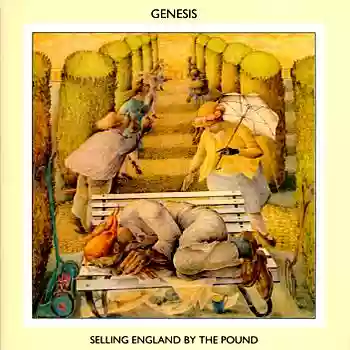
When everyone believes the band has reached its compositional peak, the five wizards of progressive rock, to everyone's surprise, demonstrate that they are a perfectly coordinated and boundless musical machine, bringing forth "Selling England By The Pound," an extraordinary album that perfectly represents progressive rock in an ideal trio along with "In The Court Of The Crimson King" (1969) by King Crimson and "Close To The Edge" (1972) by Yes. Every band aspiring to seriously create progressive rock (and not only...) will certainly have listened to this musical gospel, the product of five genius minds, with Gabriel wild in his wordplay, Banks, Hackett, and Collins in a state of grace, and Rutherford as a worthy accompanist.
The opening is dedicated to the masterpiece that is "Dancing With The Moonlight Knight", which begins the album with Gabriel's delicate and sweet voice singing "Can you tell me where the country lies...", to then introduce in sequence Hackett's guitar, Banks' relentless and then gentle piano, Rutherford's bass and second guitar, and the drums of an extraordinary Collins, for a musical paradise evolving in an almost Rossinian crescendo. The best Genesis articulate this according to the theory that every action corresponds to a reaction, responding for example to the guitar with the snare drum and to the bass with the piano, moving until the voice steps aside to make room for a rapid instrumental ride that proudly showcases the great trio Banks - Hackett - Collins, to then reintroduce Gabriel in an almost biblical atmosphere that oozes omnipotence, with the voice of the showman framing it in a unique and unrepeatable musical setting, before riding again the fantastic trio and surrendering to a calmness and sweetness with Gabriel's beautiful flute melody introducing the "false closure" by Hackett and Rutherford's guitars. "I Know What I Like (In Your Wardrobe)" is the first "pop song" in Genesis' history, in which Gabriel enjoys playing on a rather simple musical plot with his extravagant lyrics.
"Firth Of Fifth" is one of the bibles of progressive rock, with an unforgettable intro by an inspired Banks on the piano, introducing the other instruments and Gabriel's voice that cradles the listener in this forest of extraordinary musical inspiration, only to display an instrumental fugue that is first relaxing, then intensifying and reintroducing the initial theme this time on keyboards, which even manages to be eclipsed by the best Collins ever, transformed into an actual war machine behind his Pearl, culminating in Hackett's solo, a guitar gem perhaps unparalleled in progressive rock, leaving one enchanted listening, praying it never ends, lulled into a dreamlike dimension, until Gabriel reclaims the stage and concludes the piece as he began it, perhaps to the listener's dismay.... "More Fool Me" is Collins' second attempt as a singer, in a piece that exudes calm, gently accompanied by Banks and Hackett, without great pretensions, but perfectly embedded in that list of wonders that is the tracklist.
You are introduced by Collins' roll and Banks' keyboards in "The Battle Of Epping Forest", where Gabriel brings his ravings to life, with one of the most complex and well-articulated musical fabrics in the quintet's history: after the instrumental intro, Gabriel introduces us to a fairy-tale world characterized by rapid instrumental evolutions, with Gabriel flooding them with texts singing the chorus with an almost mad intonation, leaving space for the beautiful inventions of Hackett and Banks, which Rutherford accompanies with a good bass line while Collins delights with inventions first on the hi-hat, then with hi-hat and bass drum, and finally with one of his impossible tempos, for one of the most successful pieces of his career and that of the group, keeping listeners from half the world glued to the stereo, until changing gear with an almost beat influence and reprising their tested and approved crescendo structure, concluding the piece with instruments literally marching like soldiers in battle.
"After The Ordeal" has a warmer and more medieval tone compared to the rest of the work, with a beautiful piano and guitar introduction, with Collins' drums limited to accompaniment and Rutherford following in a hugely successful instrumental piece of the album. "The Cinema Show" is yet another pearl, introduced by a guitar with cold tones, which instill "pessimism," to lead to perhaps the most homogeneous piece on the album, heavily played on Gabriel's text, with the instruments occasionally granting themselves some flashes as shy protagonists, this time leaving room for the showman. The stroke of genius arrives by reprising at the end the theme that closed "Dancing With The Moonlight Knight" and reprising it in the 1:20 of the concluding "Aisle Of Plenty," as if to enclose the album in a magical circle that never breaks, inducing the listener to start listening again, something many probably have done and still do with infinite pleasure and with tears in their eyes, for having just listened to what is undoubtedly one of the greatest masterpieces in music history.
Loading comments slowly
Summary by Bot
This review celebrates Genesis' album Selling England By The Pound as a pinnacle of progressive rock. It highlights the band's evolution, detailed track insights, and superb musicianship. The album is compared to other prog rock classics and praised for its complexity and emotional depth. Overall, it is regarded as one of music history's greatest masterpieces.Tracklist Lyrics Videos
Genesis
English rock band formed in 1967, celebrated for landmark early-1970s progressive albums (Foxtrot, Selling England by the Pound, The Lamb) and a later, more pop-oriented phase led commercially by Phil Collins.116 Reviews
Other reviews
By Dario Pierini
The piano intro alone is worth the price of the record.
The unmistakable dreamy and romantic atmosphere, with a medieval and baroque flavor, makes them at once so modern and ancient, so innovative and tied to tradition.
By rebel1
The history of music will never be able to forget pieces like "Dancing With The Moonlit Knight" and "Firth Of Fifth."
Undoubtedly one of the most extraordinary albums of the immense Genesis (clearly, with the presence of Gabriel and Hackett).
By Breus
"Selling England" unfolds like a fable-like and epic fresco between the unifaun and the Queen of May Be, singing the fate of a land that has become prey to commerce and lost its nobler ambitions.
"The Cinema Show" remains the most spontaneous and authentic testament of their original group career, with a succession of phrases that engage all the musicians without ever detaching from the typical style.
By XBend
"53 minutes of real delight, of pure art exposed by those who know how to do art well."
"It marks the absolute consecration of the group that had already made waves with monumental works."
By SydBarrett96
"Selling England by The Pound remains and will forever remain the Masterpiece."
"Consolidates them as a legendary band in the rock Olympus. Immense, deep, intense."
