
 •
Rating:
•
Rating:
THE REVIEW
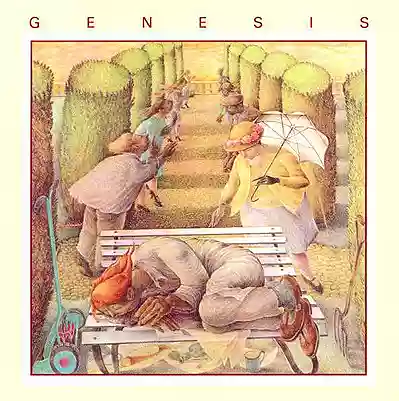
I hope those who have already written about this historic album with critical thoroughness won't hold it against me; and above all, I hope those (many, I believe) who consider "Selling England" the band's absolute masterpiece won't hold it against me, since I only give it 4 ****.
The fact is, I personally adore this work, but I feel compelled to relate it to the others: and since I consider "The Lamb" the absolute pinnacle of Gabriel and company's musical artistry, I can't place "Selling England" on the same level. But everything is relative, and know that my 4 is worth double when compared to many other records of the genre and of that period.
So... right from the start, "Selling England" "betrays" its vocation and nature, which has roots in folk and mythological scents before becoming a metaphor for a sociopolitical and cultural condition that the band's nation of origin seemed to suffer from. The first verses of the splendid "Dancing With The Moonlight Knight" leave no doubt about it, given Gabriel's citations and lyrical inventions that don't disappoint the expectations created by such a narrative and legendary title. The Moonlight Knight unfolds like a fable-like and epic fresco between the unifaun (a Gabriel-created creature that mixes faun and unicorn) and the Queen of May Be, singing the fate of a land that has become prey to commerce and lost its nobler ambitions.
A real ride through misty atmospheres, historical horizons, and moments of pathos that stir strong emotions, this long song immediately puts all five artists' technical abilities to the test and plays its aces fearlessly, celebrating the Genesis-thought with maturity and cohesion that the previous "Foxtrot" lacked. Gabriel performs with heartfelt passion, and the others follow, weaving impressive arpeggios and riffs, with an alternation of lyrical troubadour-like suspensions and impetuous rocking percussion, until the delicate and nebulous closure that drags into a perhaps deluded, but no less incisive dimension.
"I know what I like", following, brings us back to earth for a moment: bizarre and nonsensical lyrics, familiar and playful atmospheres, less drama and more playful citation. A splendid melodic poem whose chorus is one of the peaks of the Genesis career, certainly destined to inspire subsequent similar compositions of a more commercial cut (even in duration and structure). Indeed, "I know what I like" is the only "chart-topping" track on the entire album and remains a classic even outside the fans' culture. Unforgettably presented by Gabriel on stage with a reversed flower crown on his head and long wheat spikes in his mouth.
Then "Firth of Fifth", a cryptic and enigmatic parabolic excursus - in the sense of a parable - with many biblical references and a compensation between classical and choral partitions and more minimal, shadowy passages. Piano takes the spotlight and the flute is still prominent, before the almost definitive sinking of "The Lamb" (where the flute appears minimally). A beautiful manual test by Tony Banks, a beautiful development of the central theme woven on various instruments without being prolix: from solo flute to piano, then opening touchingly on Hackett's strings so poignant it gives the impression that the piece will end in a major tone.
A classic too, although stretched in the vocal parts.
"More Fool Me", which closed side A on vinyl, remains an emblematic episode - for better or worse - of the Genesis evolution, practically years before the band would experience not only the defection of Peter Gabriel and later Steve Hackett but also a decisive shift towards a break with prog-rock canons to embrace Phil Collins' melodically-domesticated cause. The latter, by chance, interprets here for the first time a song as an absolute soloist, meowing words of mournful sentiment on a base of timid acoustic strumming.
A not happy track, although defended by some fans, with more historical than artistic value, certainly not matching the creative depth of the rest of the album. Ultimately ahead of its time, but in my view out of place in that context.
"The Battle Of Epping Forest" is the relentless musical depiction of an episode that at the time interested British news, namely the "organized" clash between two youth gangs in the aforementioned Epping forest. With a highly amused attitude and following a precise narrative schema, Gabriel sings the "heroic" deeds of the event's protagonists, dwelling perhaps dauntingly for those not well-versed in English and forcing the rest of the band to navigate through many inserts and refrains that over the ample 12 minutes of the piece end up slightly weighing the whole down.
It has always seemed to me a kind of divertissement for the enjoyment of the English and a certain typically British cultural approach, since this song does not provide particularly profound evocative thrills. On the one hand, the Genesis trademark is there; on the other, there's the impression that it's someone else's piece reinvented by Banks and Rutherford; with a mood more inclined to "Foxtrot" (especially to "Get'em Out By Friday") than to the more lyrical moments of "Selling England."
"After the Ordeal" is an instrumental written by Hackett that returns to display that epic and madrigal dimension of the album's first part, with a profusion of arpeggios and classical atmospheres closing on respectable writing, from which Gabriel's flute re-emerges. Not a fundamental track, but certainly an emotional reset that acts as a bridge between Epping's excesses and the great work of "The Cinema Show." This latter undoubtedly an important moment not only of the album but of the entire period with Peter Gabriel.
Beginning with a sentimental delicacy typical of certain ballads of theirs and immediately playing with elements and characters that become symbols and metaphors (Romeo and Juliet) of a time - ours - where lovers are no less tormented than those from many centuries ago, the piece then develops on a significant intertwining of arpeggios that recall a fabulous and epic dimension. Bringing Tiresias into play and playing on sharp literary and mythological ambiguities that take sexuality to a probably almost cryptic level for those not deeply familiar with Gabriel's writing.
Prolonging seamlessly with "Aisle Of Plenty" which closes the album, "The Cinema Show" touches chords that even the Genesis of "The Lamb" could no longer graze, whether constrained by the emotional state of Rael's story or progressively distanced from their internal balances. And so, the long instrumental that preludes the sad announcement of England sold to gold remains the most spontaneous and authentic testament of their original group career, with a succession of phrases that engage all the musicians without ever detaching from the typical style of the sound they had forged and chiseled from '69 onwards. Great Banks, great Collins, great Hackett, great Rutherford: succeeding in not being prolix and self-citing in a score that could have become a real trap.
The sad closure of the record hears Gabriel's choked voice reprising the opening Knight melodies, while ominous clouds gather over England's skies and the characters who populated the story dissipate like ghosts among the mists, leaving room for the market's logic, consumerism, and politics that no longer have anything epic and glorious.
Loading comments slowly
Summary by Bot
This review praises Genesis' Selling England By The Pound as a standout progressive rock album, rich in folklore, myth, and social commentary. While the reviewer ranks The Lamb Lies Down on Broadway higher, they emphasize the album's technical skill, evocative tracks like "Dancing With The Moonlight Knight," and memorable classics such as "I Know What I Like." Some tracks like "More Fool Me" are noted as less fitting but the overall cohesion and artistry dominate. The album closes on a haunting, reflective note about England's changing cultural landscape.Tracklist Lyrics Videos
Genesis
English rock band formed in 1967, celebrated for landmark early-1970s progressive albums (Foxtrot, Selling England by the Pound, The Lamb) and a later, more pop-oriented phase led commercially by Phil Collins.116 Reviews
Other reviews
By Dario Pierini
The piano intro alone is worth the price of the record.
The unmistakable dreamy and romantic atmosphere, with a medieval and baroque flavor, makes them at once so modern and ancient, so innovative and tied to tradition.
By rebel1
The history of music will never be able to forget pieces like "Dancing With The Moonlit Knight" and "Firth Of Fifth."
Undoubtedly one of the most extraordinary albums of the immense Genesis (clearly, with the presence of Gabriel and Hackett).
By lukather88
"Selling England By The Pound is an extraordinary album that perfectly represents progressive rock alongside King Crimson and Yes."
"Hackett’s guitar solo on 'Firth Of Fifth' is a gem perhaps unparalleled in progressive rock, leaving one enchanted and lulled into a dreamlike dimension."
By XBend
"53 minutes of real delight, of pure art exposed by those who know how to do art well."
"It marks the absolute consecration of the group that had already made waves with monumental works."
By SydBarrett96
"Selling England by The Pound remains and will forever remain the Masterpiece."
"Consolidates them as a legendary band in the rock Olympus. Immense, deep, intense."
