
 •
Rating:
•
Rating:
THE REVIEW
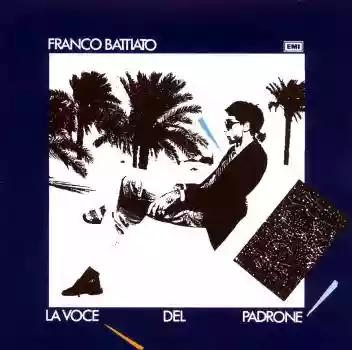
It was 1982 and Battiato was singing a handful of songs that went down in history. A true miracle when you consider that a few years earlier, the artist won the Stockhausen prize with an album containing only two pieces of pure research on the timbre of the piano, a thing for paranoid enthusiasts. With this, Battiato instead composed a commercial masterpiece, one of the very rare truly cross-cutting albums, capable of capturing anyone, from nostalgists of Italian songs to followers of new trends, an album selling a million copies, an absolute best seller. It is not known if a truly free Battiato would ever have produced such a work. After all, we are dealing with a hard-to-define character, always ready to obliterate what was done previously, but never entirely detached from the music business. And "La Voce Del Padrone", wanted by the master, EMI to be precise, was probably already in the author's mind as an album destined to set the pace, without however having first marked, and in bold, the music scene of that era. Fortunately for all, indeed, the compromise between the avant-garde artist he was and is, and the need to replenish the coffers of a record label, turned into a brilliant mix of pop, electronic, and symphonic music. A surprising exploit but not inexplicable.
"La Voce Del Padrone" is a point of arrival of a difficult and tortuous journey, but still a journey: Battiato's discography between the late sixties and 1982 is sometimes bewilderingly varied. It is not surprising, therefore, that the Sicilian artist has divided his activity over the past twenty years into a pop career and a more committed one, always keeping them on two separate levels. This is perhaps a necessary step to understand the album and its genesis, but it is not sufficient. Battiato himself asserts that he expresses himself in pop music below his capabilities, contrary to what happens with his more committed compositions in which he believes he infuses more than his talent allows. A statement that may seem a declaration of modesty but highlights the conviction of having a strong affinity for more "light" music, yet stifled by an instinct that leads him towards something else. In "La Voce Del Padrone", perhaps cornered, this affinity had such a virulent outburst that it did not even allow for a sequel, regardless of the inspiration of the moment and beyond any contractual logic.
The tracks are only seven, but with such a high concentration of musical ideas and solutions that it leaves one amazed. The leitmotiv of the album is certainly the insistent rhythm that underlies even the slower parts of the tracks: in "Summer On A Solitary Beach" the logic of a melancholic song is overturned by the symbiotic presence of a filtered saxophone and a splendid bass line. "Gli Uccelli" is instead the track with great melodic openings, where a certain symphonic vein re-emerges only to be immediately suffocated halfway through the track by the relentless pace of a drum'n'bass, as inevitable as it is fitting, given the context. A citationalism often brought to extreme consequences characterizes tracks like "Cerco Un Centro Di Gravità Permanente", in which an exhibition of references to oriental images and philosophies counterpoints a compositional choice that is nothing short of easy listening. "Bandiera Bianca" is a digression on the customs and malpractices of modern society, a track, needless to say, still relevant, where the artist's polemical vein finds one of its most evident expressions. "Cuccurucucu" and "Sentimento Nuevo" are two astonishing jokes that Battiato reserves for his listeners, the most "popular" point ever reached by the artist, who even on this occasion does not forgo associations between different cultural elements: Afghan refugees and American Indians are juxtaposed with truly notable insight. Finally, the least known track deserves a mention, "Segnali Di Vita", a divertissement on life and change, which Battiato has been insistently presenting live in recent years to restore all its dignity.
It is not essential to express a definitive judgment on this work; the five stars, as well as the review, are just a necessary act. "La Voce Del Padrone" is a unique record in Battiato's career and, as such, can be praised or criticized, depending on the idea one has formed of the artist and his qualities. It is as wrong to ignore this record as it is to consider it a peak never reached again by Battiato. And probably in this lies its importance and thus the inevitable obligation to label it, even if not entirely believed, as a masterpiece.
Loading comments slowly
Summary by Bot
Franco Battiato's 'La Voce Del Padrone' is a landmark 1982 album that masterfully balances pop, electronic, and symphonic elements. The record achieved massive commercial success while reflecting Battiato's complex artistic identity. Featuring only seven tracks, each is packed with innovative musical ideas and rich cultural references. The album remains a unique and essential work in Battiato's diverse discography.Tracklist Lyrics Videos
Franco Battiato
Italian singer-songwriter and composer from Sicily, Battiato moved from 1970s electronic/progressive experimentation to chart-topping pop with La voce del padrone, and later to spiritual, orchestral and operatic works. He frequently collaborated with arranger Giusto Pio and philosopher Manlio Sgalambro.100 Reviews
Other reviews
By piergiorgio
Listening to him puts us in touch with a part of ourselves we didn’t know we had.
Every Battiato record is a window through which to look within oneself. Take a look, if you feel like it.
By STIPE
La Voce Del Padrone is an intense album, rich in meaning, that delivers great emotions.
Thanks to the language of pop-rock Battiato tells and brings to life moments of his personal life.
By Fiumani
With over a million copies sold, in 1981, Franco Battiato forcefully enters the homes of all Italians, creating a phenomenon of vast and unimaginable proportions.
Strangely and exceptionally, in Italy, everyone begins to hum about 'Jesuit Euclideans' and 'minima immoralia'...
By trout_mask
"The album remains coherent until the end without excesses or flaws."
"Battiato’s typical refinement, the richness and originality of the arrangements... remain intact."
By POLO
"I don’t care at all that 'La Voce del Padrone' is deemed a masterpiece; I don’t like it."
"You don’t fight the revolution with flat music. You can’t deceive people with pop music made just for the sake of it."
