
 •
Rating:
•
Rating:
THE REVIEW
When good music and big profits get along...
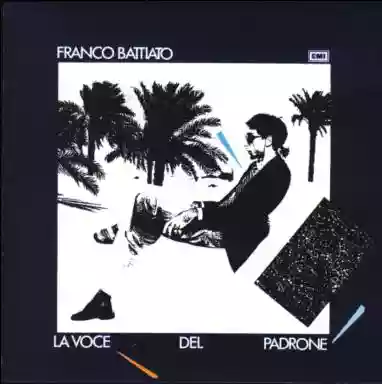
In 1981, Emi released Franco Battiato's new work "La voce del padrone". After the first three albums ("Fetus", "Pollution", "Sulle corde di Aries") in which the artist from Jonia had accustomed the audience to avant-garde electronic music and major experiments akin to Stockhausen and Schulze, "L'era del cinghiale bianco" marks the artist's pop turn towards more immediate and familiar sounds. In "La voce del padrone", Battiato's new pop verve reaches its expressive peak by delivering five gems such as:
- Summer on a Solitary Beach
- Bandiera bianca
- Gli uccelli
- Cuccurucucù
- Segnali di vita
- Centro di gravità permanente
- Sentimiento nuevo
The album remains coherent until the end without excesses or flaws. Always catchy melodies, catchy choruses as in "Cuccurucucù", pounding, almost dance-like rhythm section, are the echoes of "the master's voice", Emi, finely crafted by Battiato as a humble journeyman of song. The target is fully hit: the record sells more than a million copies, maintaining the top spot on the charts for a long time and becoming the icon of Italian pop in the eighties. "Centro di gravità permanente" is the hit song of those years and is also picked up by the commercial dance of the early two-thousands.
Yet within the simple and accessible structure of the album, Battiato's typical refinement, the richness and originality of the arrangements (the wonderful strings in "Gli uccelli"), as well as the refined vocal acrobatics, remain intact. The lyrics condense culture, divertissement, and a sharp critique of society ("Siamo figli delle stelle/ pronipoti di sua maestà il denaro"), without sparing the music world with the author's amused self-irony and a certain undeniable snobbery, so fascinating, ("A Beethoven e Sinatra preferisco l'insalata/ A Vivaldi l'uva passa che mi dà più calorie", "e sommersi soprattutto da immondizie musicali", "Non sopporto i cori russi la musica finto-rock la new wave italiana il free jazz punk inglese/ neanche la nera africana") in a mosaic of quotes and distortions. Perhaps never before had anyone succeeded like Battiato in bringing the great public closer to such naif lyrics.
In conclusion, "La voce del padrone" presents itself as an album of pop songs, without too many pretensions, ironic and light, in which, however, the refinement and the condensed musical research of Franco Battiato are hidden, succeeding in pleasing both fine palates and distracted listeners.
Loading comments slowly
Summary by Bot
La Voce del Padrone is Franco Battiato’s iconic 1981 album marking his transition to accessible pop without losing artistic originality. Featuring hits like 'Centro di gravità permanente', it combines catchy melodies with refined arrangements. The lyrics blend cultural references and social satire, making it a milestone in Italian pop music. The album’s commercial success reflects its broad appeal.Tracklist Lyrics Videos
Franco Battiato
Italian singer-songwriter and composer from Sicily, Battiato moved from 1970s electronic/progressive experimentation to chart-topping pop with La voce del padrone, and later to spiritual, orchestral and operatic works. He frequently collaborated with arranger Giusto Pio and philosopher Manlio Sgalambro.100 Reviews
Other reviews
By voiceface
A brilliant mix of pop, electronic, and symphonic music.
'La Voce Del Padrone' is a unique record in Battiato's career and, as such, can be praised or criticized, depending on the idea one has formed of the artist and his qualities.
By piergiorgio
Listening to him puts us in touch with a part of ourselves we didn’t know we had.
Every Battiato record is a window through which to look within oneself. Take a look, if you feel like it.
By STIPE
La Voce Del Padrone is an intense album, rich in meaning, that delivers great emotions.
Thanks to the language of pop-rock Battiato tells and brings to life moments of his personal life.
By Fiumani
With over a million copies sold, in 1981, Franco Battiato forcefully enters the homes of all Italians, creating a phenomenon of vast and unimaginable proportions.
Strangely and exceptionally, in Italy, everyone begins to hum about 'Jesuit Euclideans' and 'minima immoralia'...
By POLO
"I don’t care at all that 'La Voce del Padrone' is deemed a masterpiece; I don’t like it."
"You don’t fight the revolution with flat music. You can’t deceive people with pop music made just for the sake of it."
