 •
Rating:
•
Rating:
THE REVIEW
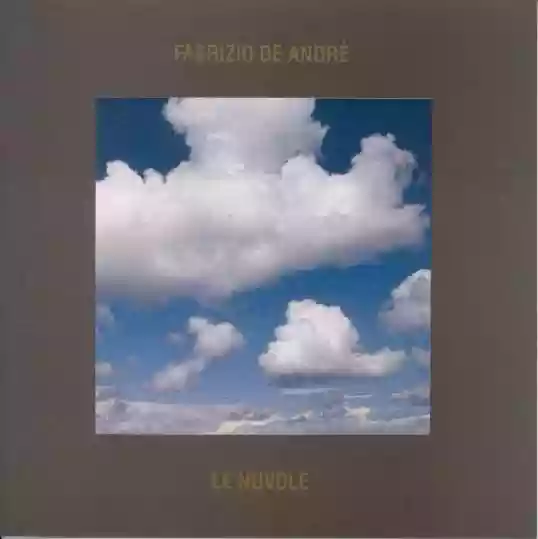
I know very well that there are myriad reviews of Fabrizio De André's albums, but it seems worthwhile to write another one about "Le Nuvole". It is the penultimate album by De André, and it encompasses all the maestro's past experiences, his collaborations (Mauro Pagani, Massimo Bubola), and even future ones (Ivano Fossati).
Fabrizio De André, as is well known, meticulously studied every word of his poems, and in this album even the title is important, demonstrating the maestro's great culture. Le Nuvole are not merely atmospheric phenomena, but they are the Clouds of Aristophanes' Greek comedy, the cumbersome characters of our society, who cast a shadow over the sun, just like the Clouds. And that's how the first track of the record is titled: "Le Nuvole" is not a song; it's a recitation, two women's voices, one old and one young, intertwine to explain to us what the Clouds really are.
"Ottocento" is the "Carlo Martello" of the '90s, boisterous, but much more refined: De André allows himself some verses in German, and even a final yodel. It is followed by one of De André's most famous songs: "Don Raffaè", written in highly comprehensible mock Neapolitan, tells of an intellectual who gathers everyone and reads the newspaper in the evening, explaining the news. Here begins De André's harsh attack on the State, borrowing the words of Spadolini in Palermo, on the occasion of one of the many mafia massacres: "I am dismayed, I am indignant and I commit myself...".
"La Domenica delle Salme" is entirely a denunciation of the loss of ideals by people following the fall of the Berlin Wall. It also mentions Renato Curcio: according to De André, unlike mass murderers and authors of massacres, Curcio was in prison without having killed anyone, perhaps because he had never repented, disassociated, or precisely lost those ideals. The A-side of the album, written in Italian, ends here, and the part in Genoese begins, but not only: "Mégu Megùn" is written in Genoese, like all the songs of "Creuza de Ma", and follows the trace of the previous album.
"La Nova Gelosia" instead is a popular Neapolitan song, De André limits himself to rearranging it, doing so masterfully, his voice and the music are sweet, and they flow smoothly like silk. A timeless song. Probably one of the main themes of Genoese culture is food, and this is what "A çimma" talks about: cima is a poor Genoese dish, a kind of meat pocket, flavored and filled with scraps. It seems like a theme no one would ever write a song about, but even from this Fabrizio De André manages to create a splendid poem; Genoese seems, with De André's songs, a perfect language for writing music, but perhaps he would have succeeded with any language. Here, in fact, is "Monti di Mola", written in Gallurese, and the difference can be felt compared to Genoese. The song talks about an impossible marriage between a donkey and a young man, in Costa Smeralda, anciently called Monti di Mola. A beautiful farewell for this splendid album.
Fabrizio De André revolutionized Italian music with "Creuza de Ma", but with this album, he takes a step forward, manages to combine Italian tradition, his tradition, the Genoese one, political denunciation, folk song, and poetry. I wonder what Fabrizio De André would think of today's world, after 9/11, the wars: what would he write? Surely, the denunciations of "Le Nuvole" are still relevant today, and no one will ever forget the poetry and extraordinary communicative ability of Fabrizio De André.
Loading comments slowly
Summary by Bot
Le Nuvole is Fabrizio De André’s penultimate album, showcasing his mastery of blending Italian tradition, political commentary, and poetic songwriting. The album features collaborations and linguistic diversity, from Genoese to Neapolitan and Gallurese. It is praised for its political denunciations and cultural depth, confirming De André’s lasting impact on Italian music.
Fabrizio De André
Italian singer-songwriter (cantautore) Fabrizio De André (18 Feb 1940 – 11 Jan 1999) is known for poetic lyrics, narrative songs about marginalized people, and landmark albums including Creuza de mä and La buona novella.92 Reviews
Other reviews
By Grasshopper
The chorus of cicadas symbolizes the only 'vibrant protest' left in a country that is falling apart.
The chilling and total desolation of an Italy where Utopia is now a corpse and over everything reigns a 'terrifying peace.'
By JpLoyRow
"Le nuvole is the highest example of how two worlds, music and poetry, can be reconciled."
"One of the most prophetic, heartbreaking, and tragic pieces of the entire Italian songbook."
