
 •
Rating:
•
Rating:
THE REVIEW
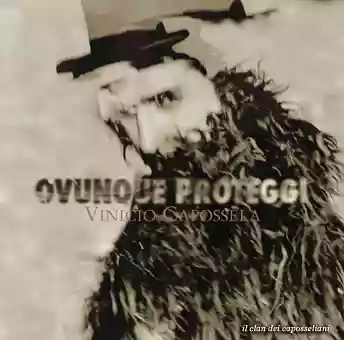
Vinicio Capossela has always shown a desire to avoid any label. Although he is overtly inspired by Tom Waits, he has never imitated him (to the point of appearing ridiculous) but has always sought to mold himself, to improve, to seek new sounds to always and inevitably surprise the listener. He tried with "Canzoni a Manovella" in 2000, achieving the goal. But even in albums like "Camera a Sud" or "Ballo di San Vito," something set him apart from ordinary Italian artists; you could sense the flair and originality of this singer/songwriter, but it was still uncertain what Vinicio Capossela could become. And today, January 20, 2006, by listening to "Ovunque Proteggi," I was able to see what this eclectic artist has become. Unfortunately, we do not have a repeat of "Canzoni a Manovella" (only a few fragments of the effervescent "Bardamù" remain in the song "Nel Blu"), nor do we find a second "Ballo di San Vito." But we are confronted with a totally renewed and mystic Capossela, more versatile and eccentric than before, and especially more elect(r)onic. Certainly, there are old-style ballads, and there are some lyrics that do not abandon Capossela's usual writing style, but everything is renewed and has a new guise. "Ovunque proteggi" is an epic album in epic proportions; it sometimes approaches, in a cryptic way, some completely unusual biblical and mythological themes but, at the same time, retains the tender and melancholic spirit of the solitary lover still waiting for his beloved.
The album begins with "Non trattare," a monotonous and insipid start to an album that fortunately promises better things, even textually; it continues with "Brucia Troia," noisy, raucous, confused, and delirious but with a fabulous chorus, culminating in the beautiful first radio single, "Dalla parte di Spessotto," which slightly echoes "Marajà" and "Canzoni a Manovella" but is of an entirely different kind. This song tells of lost youth, it's hopelessly nostalgic and structured like a nursery rhyme. "Inno alla gioia" is dedicated to the "Cristo Risorto" of Scicli, while "Medusa Cha Cha Cha" closes the first part of the CD, which, in my opinion, I can judge as decent, except for the awful and repeated lament of the "Colosseo/Rosario della Carne." With "Nel Blu," the second part opens, which is more acoustic, less heavy and noisy but much lighter and tormented, perhaps more heartfelt. The poignant "Dove siamo rimasti a terra Nutless" deserves careful listening as it talks about friendship and changing lives, where Vinicio resumes a character he had already hinted at in his poor-quality book. Finally, "Ovunque proteggi" is the thirteenth song, the "Title track," and it is a melancholic love ballad that evokes atmospheres like "Ultimo amore," moving and with refined lyrics, a bit like Tom Waits of OI' 55 but definitely valid and full of colors and emotions.
In short, "Ovunque Proteggi" is an album that disappoints at first listen but could gradually reward the listener significantly, introducing them to the new Capossela, who has shown himself to be (even in ideas), at the same time, traditionalist and innovator.
Loading comments slowly
Summary by Bot
Vinicio Capossela's 'Ovunque Proteggi' marks a significant artistic evolution, blending mystery, electronic elements, and heartfelt ballads. Though it starts slowly, the album gradually reveals a versatile and eccentric artist who balances tradition with innovation. The lyrical themes delve into biblical and mythological territories while maintaining emotional depth. This album challenges listeners but rewards patient engagement.Tracklist Lyrics Videos
Vinicio Capossela
Italian singer-songwriter and performer, born in 1965 in Hannover, Germany, known for theatrical, eclectic albums and live shows that mix folk, Mediterranean and world influences. Active since the early 1990s.42 Reviews
Other reviews
By Basettoni1
"Ovunque Proteggi is an album that isn’t beautiful, but it becomes so, becomes splendid, perfect: a sound gallery that contains the entire emotional climax of the human soul."
"Once you manage to tame the ear, the 'Inno alla gioia' truly expresses joy, pure joy, becomes the most vital band piece you have ever listened to."
By clako
Every song is enveloped in an aura of classicism, beauty, and eternal epic quality.
It is all too easy to define this album as one of the best ever produced here in Italy.
