
 •
Rating:
•
Rating:
THE REVIEW
Today, Therion are to be counted among the elite of the most daring and experimental gothic metal. But originally, Therion was a band devoted to a raw death metal, only occasionally streaked by those insights that over time would germinate and blossom, eventually taking over in their mature works. If albums like "Of Darkness..." and "Beyond Sanctorium" outline a death metal that is already intelligent and full of winning flashes, yet still confined within the narrow boundaries of the genre, in "Symphony Masses: Ho Drakon Ho Megas," the true seed of Therion's artistic genius begins to emerge with force, ready, at least in thought, to embark on an ever more arduous and bold path of emancipation.
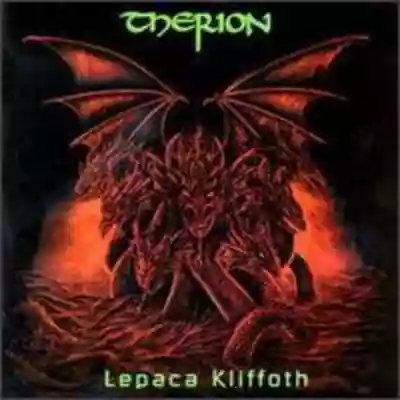
"Lepaca Kliffoth" is the leap in quality: reaching their fourth work, Therion are already part of another planet.
I say this because, if in 1995 (the year the album was released) the expression "experimental death metal" inevitably brought to mind the jazz and fusion digressions of bands like Cynic, Atheist, and Pestilence, Therion instead imposed themselves with an unprecedented and bizarre formula that saw heavy metal, classical music, ethnic alembics, and dark mysticism flirting. Although it sounded truly novel at the time, today "Lepaca Kliffoth" appears somewhat antiquated, engulfed by the daring and grandiosity of subsequent works, starting precisely with that "Theli," the band's undisputed masterpiece, which would exaggerate the solutions experimented within it.
However, "Lepaca Kliffoth" should not simply be seen as a necessary stage in an incredible evolution, the watershed between the old and new Therion. "Lepaca Kliffoth" is actually a unique episode in the Swedes' career, for solutions and creative verve. A good work, penalized, in my opinion, only by the monotonous voice of mastermind Christofer Johnsson (who will wisely decide in the future to hand over the microphone to the notorious operatic choirs and professional singers). Apart from this detail, which should be read as a personal disappointment, Therion's sound is already incredibly mature, forged with care and expertise by a band that still has everything to prove: a band that plays (and plays well!), builds, invents, assembles, sews, and sweats the proverbial seven shirts to create a successful and original product.
In other words, "Lepaca Kliffoth" wins for its genuineness, conviction, and courage, presenting us with a band still "nude," not yet masked, not yet hidden behind the daring screen of a formula that will inevitably lose the revolutionary character of its origins over the years. Personally speaking, what I most reproach Johnsson for is having gradually lost the avant-garde push that distinguished him from the beginning. No less, the flaw of having totally given up refining his technique and style, ending up flattening himself, riding a winning formula, on sounds borrowed from classic heavy metal, riding the power metal wave (aaarrggghhh!!!!) of the late nineties. In "Lepaca Kliffoth," instead, Johnsson was still delivering, both in terms of guitars and keyboards. Imaginative as a composer and impeccable as a musician.
Indeed, speaking of death metal in the strictest sense is out of place, and if Therion's picturesque music is already outside any possible categorization, significant analogies can be found with the Celtic Frost of "Into the Pandemonium." And it's not by chance that we find as a guest Claudia Maria Mokri, the soprano who "illuminated" Frost's path in that very masterpiece. And it's no coincidence we encounter a superb rendition of the legendary "Sorrows of the Moon," a tribute to the art of a band that has always been the guiding star of Johnsson's journey. Precisely the experimental verve of Celtic Frost, understood more as a contaminating urge than as a true stylistic revolution, animates "Lepaca Kliffoth."
After all, more than once, Johnsson has clarified that Therion's evolution has been closely linked over time to budget constraints, given that it is precisely with the increasing economic returns that the possibility of realizing long-held ideas, such as using an operatic choir or a real orchestra, has gradually materialized. In 1995, the money still wasn't there, so our group had to make do with keyboards and the occasional vocal appearances of Mokri and baritone Hans Groning. No matter: the album already enjoys a clear and professional production that can bring out all the nuances of this unique music, full of ideas.
The Therion of 1995 burst into our ears with "The Wings of the Hydra," a superb opener that overwhelms us with powerful riffs, bacchanalian percussion, and a sound that is fresh and at the same time arcane (universal is the right word?). A sound that "rocks," yet at the same time does not forgo unprecedented melodies (for the serious world of metal) so bizarre as to be entertaining. Johnsson's voice is no longer a growl, but a crude scream that seems to come from those bizarre wooden masks with big eyes and large lips, used in rituals by certain primitive peoples. His guitars grind out massive crushing riffs, oriental and neoclassical scales, arpeggios, and fine solos. The intertwining with keyboards that weave captivating and sometimes demented patterns is sublime, giving a baroque touch (not to say gaudy!) to the compositions. Piano, flutes, violins, harpsichords, Indian sitars, choirs, entire orchestras and much more emanate from Johnsson's excellent keys: an army of sounds called upon to animate brief yet dynamic compositions, for forty minutes in which it will be truly difficult to get bored. The imaginative and sparkling drumming of the cheerful Piotr Wawrzeniuk, on his part, settles on lively and progressive tempos, always ready to support the verve of the guitars and the tricky keyboard patterns (how we miss you, Piotr!).
In "Lepaca Kliffoth," death metal thus gives way to the pomp of classic metal, gradually illuminated by crazy Arabian whims ("Melez"), daring progressive escapades ("The Beauty in Black"), psychedelic openings ("Darkness Eve") and the proverbial operatic interludes. How not to mention, in this regard, the duo "Arrival of the Darknest Queen," a brief instrumental interlude, and "The Beauty in Black," graced by the romantic duet of Mokri and Groning, whose voices twirl and intertwine in dreamlike atmospheres in one of the most beautiful and touching pieces ever written by Johnsson. The philosophical contribution of friend Thomas Karlsson, also belonging to the mysterious order of Dragon Rouge (to which the album is dedicated: "Lepaca Kliffoth" means "Ride the Dragon"), lends the whole a mystical aura. A component not negligible in Therion's music, which finds its peak in the title-track, a dark procession of incomprehensible formulas, that ends up exploding into frantic races of mad monks, thus recovering the violence and dark charm of the early works. An episode, this one, that not by chance recalls the Shadowseeds of the same Karlsson, released the same year with the good "Dream of Lilith."
The composite "Evocation of Vovin" closes with fantasy and baroque finds a unique, revolutionary album, that today might seem outdated, but that actually delivers the most substantial, creative, pragmatic Therion, not yet victims of a brilliant invention that little by little will corrode them until trapping them in an incorrigible armor. An armor that will suffocate the core principle of Therion's music: that ride the Dragon, that fly high and free that has made them a unique entity in the metal scene of the nineties.
Loading comments slowly
Summary by Bot
Lepaca Kliffoth marks a significant evolution for Therion, blending death metal roots with classical, ethnic, and mystical elements. Released in 1995, it showcased bold experimentation ahead of their more polished later works. The album features innovative compositions and a mature sound, despite some vocal monotony. Its creative fusion and emotive depth make it a distinctive chapter in the band's journey. Lepaca Kliffoth established Therion as pioneers of avant-garde metal.Tracklist Lyrics Videos
Therion
Therion are a Swedish metal band often described in these reviews as evolving from early, raw death metal into a symphonic/operatic heavy metal style with choirs and orchestral elements, frequently built around esoteric, mythological, and philosophical themes.17 Reviews
