
 •
Rating:
•
Rating:
THE REVIEW
There is no need for pompousness, to declare it a masterpiece, to resort to grandiose words for a work that has already been widely assessed and reassessed by those who are competent and far more capable than the writer. In an exception cherished by Reed, I will limit myself to being a chronicler rather than a judge.
Reducing the "Velvet Underground" to merely Lou Reed's backing band is the biggest mistake one could make. It's equally erroneous to consider them as solely the artistic expression of Andy Warhol, mere musical accompanists of the Exploding Plastic Inevitable: a wild, amphetamine-driven multimedia show colored with strobe lights, soap bubbles, psychedelia, cinema, and of course, music.
White Light / White Heat knows how to smack the skeptical and uninformed listener on the hands.
However, it's necessary to first provide some brief and useful historical context.
It's 1968, the poor sales of the first album, recorded in 1966 under Warhol's aegis and actively accompanied by the magnetic chanteuse Nico, certainly did not boost the spirits of the band members. Verve is disappointed, Tom Wilson seems to still believe. They return to the studio, and this time there are no obstacles. But that won't quite be the case.
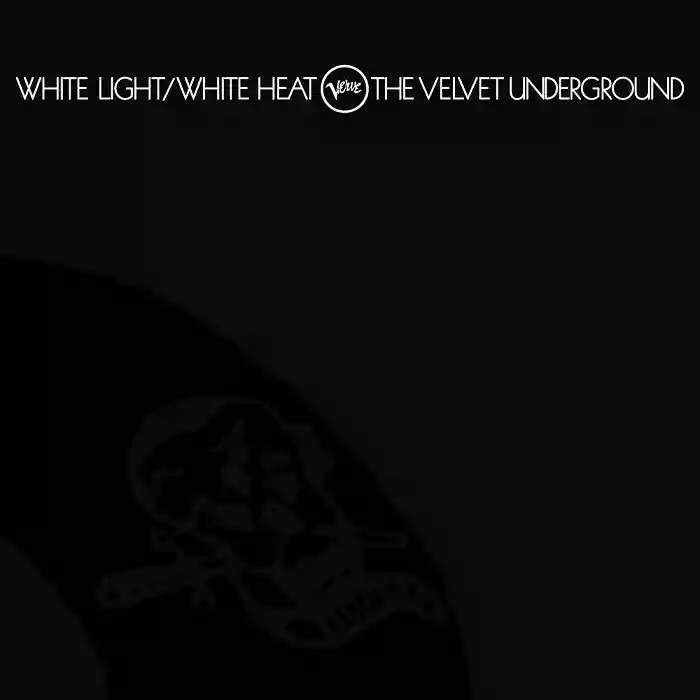
1969 will start with a new lineup. Cale is ousted by Reed, and the true sound of the band is sucked into a black hole, leaving no trace, one that no one else could ever replicate. A bleak temporal universe depicted right from the album cover, created by photographer Billy Name, a partner of Warhol's Factory. A tattoo depicting a skull in relief, impossible to catch unless in backlight. Minimalism, extreme experimentation; deafening volumes, too much for the equipment of the time: the album is, quoting Sterling Morrison's words, "a technical failure."
Distinguishing the instruments is often a daunting task, but let's go step by step, or rather track by track.
1 - White Light / White Heat
John Cale furiously pounds the minimalist piano. Reed's and Morrison's rhythm guitars screech, the excessive noise doesn't help distinguish them. The inflexible and shy Tucker beats the bass drums in time, the most hidden instrument of the track, overshadowed by the annoying "white" noise that envelops the listener. Technically poor, artistically sick. Reed, mocking, without a hint of vocal timbre, empty and pathologically detached, simply recounts the effects of amphetamine on a human body in overdose. A train speeding full throttle, as it was meant to be for "I'm Waiting for the Man" from the first record (and the sound similarities are not few), is launched against the listener's wall.
A track of great influence for generations, especially punk, to come. Honored by Bowie, performed live during the 1993 reunion.
2 - The Gift
The track which, since its release was promoted as a great novelty. Verve Records even released a promotional 45 in which Cale and Reed discussed it with the ardent producer Tom Wilson. Nothing simpler: an improvised musical base, riddled with feedback, taken from a live performance on Cale's idea. The same Cale steps up to the microphone and, with a Welsh accent, reads an old essay by Lou Reed for a creative writing course at Syracuse University. Waldo is the protagonist, far from his girlfriend, jealous, too paranoid and too broke to move closer to his beloved. He decides to have himself shipped in a gift package. A well-conceived surprise, but the same girlfriend will perform an angry act, in an attempt to open the unwanted and unexpected gift, which will end with the boyfriend's death. A pair of scissors right through the forehead, and everything ends in a spurt of blood. Reed puts on a show and in music, as never before, a grotesque decadence, symbolism without moral lessons nor stands taken, just a chronicler. E.A. Poe proves to be a great inspiration, just like his old master Delmore Schwartz. Cale seasons it all with a voice like an old forgotten BBC journalist, or perhaps shunned...
3 - Lady Godiva's Operation
Perhaps a precursor of "industrial" rock. The ending of this track, which narrates a botched surgical operation ending in tragedy, presents sounds and noises typical of an operating room. Sounds of respirators, pistons and completely sinister electronic instruments, this time distinguishable in the orgy of lascivious guitar sounds and Tucker’s frantic drumming. It goes even deeper. Cale is again on the microphone, Reed accompanies him only at the end by intoning words in time, as if to pronounce the unfortunate "Lady Godiva's" demise.
4 - Here She Comes Now
The only track reflecting the quiet ballads of the previous album, in fact, it was written for Nico and revived for the occasion. Not much to say, a classic breath of air in Velvet Underground style or, if you will, a missed opportunity. Later bands will not really think so, Nirvana will pay tribute several times in live with this song to the V.U.
5 - I Heard Her Call My Name
A prelude to the last ride, the fifth track fires the first noisy salvos and after a text of paranoia and love, Reed alone vents his rage on a long guitar solo that has become legendary. It's just an introduction.
6 - Sister Ray
The heart of the record is all in the sickest track, and certainly the most representative of the Velvet Underground. Sterling Morrison will later explain that it was an "internal challenge". Every egomaniac band member always tended to choose the takes of the songs where their instrument gave the best effect. Sister Ray was a compromise: if there's something to prove, do it "now or never". First take was good, few chords, lots of energy. Who follows whom? That's up to the listener's judgment.
Sister Ray starts with the weight of "Venus in Furs". The guitars explode, Tucker's neurotic beat accompanies them and gives the listener a sense of time in that minimalist orgy. An orgy to which John Cale's organ then explosively and beyond any volume range joins. It overwhelms them all and beats them to the punch. Cale generates an epic racket reminiscing his experiments with LaMonte Young. This time the drones go deep and Sister Ray creates a wall of sound that begins to float only after about 6 minutes, where the organ lowers its guard, and the guitars battle each other with feedback, dissonances, noise, and explosions. Tucker, a girl at the time and with apparent physical weakness, slightly yields to the other instruments after about 7 minutes in which she lowers her fierce, manic rhythm, with a violent African-like drumming of the best class; listen to Babatunde Olatunji and his "Drums Of Passion" to which she has always declared to be inspired.
They all came from different schools. Cale’s minimalism; Reed’s amphetamine-driven, sick free-jazz attitude, who often declared he wanted his electric guitar to sound like a sax; Morrison’s rawest rock n' roll; Tucker’s "African" drums. Sister Ray represents the sum, the musical core to which all these crossroads have led. Each set out with his baggage and with his arrogant, dissolute character of a Punk before the Punks made their appearance to stir Rock music.
Drumming at the edge of bearability and unprecedented energy, the Velvet Underground lay on a silver platter the birth of the rawest Punk (and Heavy Metal) sound that exists and never replicated. The tributes in Cover form, from Joy Division (and then New Order), to Suicide, to Sisters of Mercy, are countless.
After this record, Reed will continue his experience, giving a name to a group that never was, and it will be he (and John Cale, soul and voice of the "musical reason", with some hint of irritation) himself to admit it.
WL / WH reflects the true Velvet Underground. Sure you're satisfied with the first album?
Loading comments slowly
Summary by Bot
This review chronicles The Velvet Underground's 'White Light/White Heat' without grandiose praise, offering a detailed, track-by-track exploration of its raw and revolutionary sound. It highlights the band’s evolution, lineup shift, and innovative noise-driven style that influenced punk and heavy metal. Special attention is given to the album’s chaotic energy, technical flaws, and its status as a pioneering masterpiece.Tracklist Lyrics Videos
The Velvet Underground
The Velvet Underground were an American rock band formed in New York City in 1964, known for their influential, experimental sound and association with Andy Warhol; core members included Lou Reed, John Cale, Sterling Morrison and Maureen Tucker.49 Reviews
Other reviews
By easycure
Never has a band had such enormous influence and never has a band been so unique, essential, outside any genre yet incredibly important.
'Sister Ray'... is the pinnacle of the album and perhaps the entire career of the VU: 17 minutes of hypnotic ride, with a shamanic crescendo and a climax of noise.
By Antonino91
The sound quality of the album is terrible... but this gives the album a special character that distinguishes it from any other album.
'Sister Ray' is truly devastating, aggressive, raw, beautiful, and spiced with a funny text... an absolute masterpiece.
By joe strummer
The descent into the inferno of The Velvet Underground continues in the second work of the group, this time without Nico nor Warhol.
"Sister Ray"... encapsulates an entire philosophy of life and, more generally, a state of mind.
By Fast&Bulbous
'White Light/White Heat' is dirty. It’s hard. It’s punk before punk, metal before metal, new wave before new wave.
'Sister Ray' is the most shocking track ever created by a musical group... 17 minutes of madness, 17 minutes of musical libido.
By Neu!_Cannas
This black record is that indelible black of anger and aggression from first to last groove.
'Sister Ray' is a single burning mass of lava that will never solidify, rewriting the musical path up to today.
