
 •
Rating:
•
Rating:
THE REVIEW
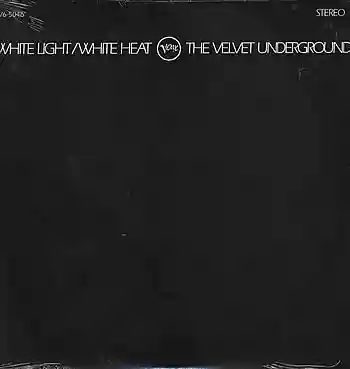
Take your black copy of this black record and put it in your player. It doesn't matter if for the first time or the tenth in the same day. Take the cover, look at it closely. What do you see? Black. It's all black. But not that dirty black that gradually goes away with rubbing. This is that indelible black. That black of anger, of aggression that runs from the first to the last groove of the circular object.
Hell, we're talking about White Light/White Heat, go take a shower or freshen up for the occasion. Actually, no, stay filthy and dirty just as you are now, maybe it's better that way.
We are talking about the most beautiful musical work of the '90s without half measures, without shame and without presumption from my side.
Don't agree? Then insert your copy into your stereo, CD player or whatever, with a delicacy that not even a 500-year-old Ming dish deserves.
The wait is really short, actually none, and here the title-track, fast and rocking, welcomes the listener who might have been expecting another album with the banana on the cover and with the angelic Nico singing love songs.
Get it in your head now. Here there's no Andy getting in the way of Cale and Reed.
Here the two rise four spans above other men, and at the same time lower themselves by eight, reaching the heart of the New York underground.
Finished.
Oh, the second isn't a more or less normal song like the first one just heard, oh no.
It's called "The Gift" and it's a poem written during school days by Reed himself, apocalyptically recited by Cale on one audio channel, while on the other runs a scratching and dirty music. Here's the story of Wado Jeffers and his beloved advancing on this rough carpet of guitar notes and noises that make the listener even more involved.
Finished.
For the third track, we have "Lady Godiva's Operation". Magnificent. Wonderful. One of Reed's most inspired lyrics, always sung by Cale himself, but towards the end, here's Reed marking the end of the verses with his voice, alternating in singing, all covered by a guitar riff as anguished as the waiting for the surgical operation and as bad and sad as the failure of the operation itself and the death of the protagonist.
Finished.
Don't be overwhelmed. The fourth track is a song sung by Reed, lasting 2 little minutes from the first LP. "Here She Comes Now". A bit of a truce for our ears, or simply the calm before the storm that will soon rage among your neurons.
Finished.
"I Heard Her Call My Name" is the fifth and penultimate track. I heard her call my name. A bit unlikely since in the four and a half minutes of the song, the noise reaches peaks never achieved by music. Aggressiveness only brushed by punk. Seven years before it.
Finished.
I'm listening to it, and I don't know if I can be 100% lucid, but I will try.
Here are Reed's memories of recording Sister Ray:
"When we recorded the song, we put the volume at ten, with the sound blasting everywhere.
They asked us what we would do. And we: We are about to start.
They asked: who plays the bass? And we: There will be no bass.
They asked when it would end. And we: I don't know. It will end when it ends."
It's 17 and a half minutes.
It's the apotheosis of Rock and related genres.
Forget the riffs of the Rolling Stones or the Rock 'n' Roll era. Here is a single burning mass of lava that will never solidify. Here there is Punk, here there is heavy metal, here there is hard rock, here there is all '90s rock music, here are the experiments from the school of Stockhausen or La Monte Young, here is the past, present, and future of Rock.
The instruments are not distinguishable, not identifiable but wrapped in the dense and thick fog of distortion (maybe this is where Reed started to think of Metal Machine), not at all harmless but sharp, massacring, distressing. The text then repeated obsessively and ever more intensely by Reed (who must almost scream to overcome the wall of noise) tells of an orgy where a sailor ends up dead, but all the guests seem to care only about the bloodstained carpet. But the only orgy here seems to happen among Tucker's drums, Reed's guitar, and Cale's organ that merge into a single block that is thrown at you for the entire duration of the song (or as long as you can endure) and you remain enchanted, almost happy in your masochistic pleasure seeing your sense of hearing, and the entire nervous system, violated and left there like they do with the poor sailor mistakenly deceased. This is truly the culmination of that search in experimentation that had as its main stages the last two tracks of The Velvet Underground & Nico or the track preceding this one.
This is also the highest, but at the same time low and dirty, point of contemporary music, and nothing after Sister Ray has remained the same.
Less than 20 minutes to rewrite the musical path up to today.
Two albums to become a Legend.
Infinite.
Loading comments slowly
Summary by Bot
This review passionately celebrates The Velvet Underground's White Light/White Heat as a landmark album of the 1970s, marked by raw aggression and innovative sound. It details each track's role in creating an intense musical experience that influenced punk, metal, and experimental rock. The reviewer emphasizes the album's power, especially the epic 'Sister Ray,' calling it a transformative and legendary work.Tracklist Lyrics Videos
The Velvet Underground
The Velvet Underground were an American rock band formed in New York City in 1964, known for their influential, experimental sound and association with Andy Warhol; core members included Lou Reed, John Cale, Sterling Morrison and Maureen Tucker.49 Reviews
Other reviews
By easycure
Never has a band had such enormous influence and never has a band been so unique, essential, outside any genre yet incredibly important.
'Sister Ray'... is the pinnacle of the album and perhaps the entire career of the VU: 17 minutes of hypnotic ride, with a shamanic crescendo and a climax of noise.
By Antonino91
The sound quality of the album is terrible... but this gives the album a special character that distinguishes it from any other album.
'Sister Ray' is truly devastating, aggressive, raw, beautiful, and spiced with a funny text... an absolute masterpiece.
By joe strummer
The descent into the inferno of The Velvet Underground continues in the second work of the group, this time without Nico nor Warhol.
"Sister Ray"... encapsulates an entire philosophy of life and, more generally, a state of mind.
By Fast&Bulbous
'White Light/White Heat' is dirty. It’s hard. It’s punk before punk, metal before metal, new wave before new wave.
'Sister Ray' is the most shocking track ever created by a musical group... 17 minutes of madness, 17 minutes of musical libido.
By Luca Ventura
Thanks to their negligence we now have this colossal ancestor of lo-fi.
I recommend this album to anyone wanting to have fun at the cost of scorching their ears.
