
 •
Rating:
•
Rating:
THE REVIEW
The Rolling Stones are not my favorite band: in their best lineup (the one with Mick Taylor), they would be around the 10th place among those I listen to most.
However, they are certainly the ones I've been listening to the longest: after all, a first love is never forgotten!
So now that we are talking about them again, both, unfortunately, because of the loss of Charlie Watts and because of the encounter with Maneskin (the Italian group of the moment), I thought of reviewing some of their albums: partly to have the chance to listen to them again, and partly, I hope, to help some younger friend who would like to deepen their knowledge but feels a bit lost given their vast production (the truth is their best period is relatively short).
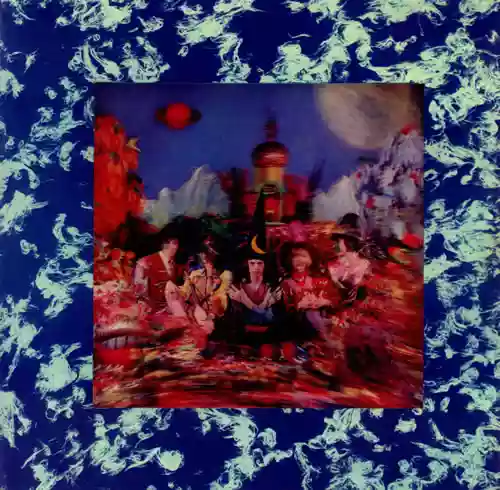
Why start with "Their Satanic Majesties Request," an album criticized by critics, disowned by the Stones themselves, and not even with my favorite lineup?
Well, for sentimental reasons (it was, among other things, the first LP I bought), because it is a unique example in the British group's production, but above all because it is emblematic of a period when all of Rock was evolving from a phenomenon of pure entertainment to a phenomenon with artistic aspirations. I talk about aspirations because everything began by following a trend: Psychedelia. However, this trend was demanding: it required more expensive instruments, increasingly sophisticated electronic effects were used, complex arrangements with entire orchestral sections were required, song durations were longer, etc. Moreover, psychedelic music presupposed greater involvement of the listener: hence more importance to live concerts, along with the need to replicate fairly faithfully live what had been created in the studio.
This is how evolved Rock genres were born: Progressive, Hard Rock, Heavy Metal, Jazz Rock, etc. But many were the groups that preferred to return to the origins: to Blues, perhaps enriched with new elements taken from Folk, Country, and World Music. Among these, of course, are our friends, the Rolling Stones.
In "Their Satanic Majesties Request," precisely to incorporate the experiments suggested by the psychedelic trend, much space was given to Brian Jones: the multi-instrumentalist, in search of his role within the group, manages to make his most significant personal contribution here (it will be the last time, then he will end up excluding himself from the project he was one of the founders of).
Bill Wyman will also have the (unique) opportunity to make a contribution as a musician at 360 degrees: afterwards, he would return to limit himself (so to speak) to his role as a bassist.
But despite these elements of uniqueness, in some tracks of the vinyl, the unmistakable "sound" of the Stones of the origins is still recognizable: I am referring especially to "Citadel" and "2000 Light Years from Home" (which will remain for years in the live concert setlist). In other tracks, folk and country elements are inserted, which will be more present in the subsequent album "Beggars Banquet": I am referring to "2000 Man" (of which a cover will be made by Kiss), "The Lantern," and "Gomper."
Finally, noteworthy is "She's a Rainbow" for the use of the mellotron, played by Brian Jones, the piano part performed by Nicky Hopkins, and the string arrangement by John Paul Jones, future bassist and keyboardist of Led Zeppelin.
Loading comments slowly
Summary by Bot
This review explores The Rolling Stones' unique psychedelic album Their Satanic Majesties Request, highlighting its experimental sound and significance in rock history. The reviewer appreciates the album's sentimental value and key contributions from band members Brian Jones and Bill Wyman. Despite mixed critical reception and the band's own later disowning of the album, some tracks still embody classic Stones sound. The review also sets the record in the context of rock’s evolution during the 1960s.Tracklist Lyrics Videos
The Rolling Stones
English rock band formed in London in 1962. Key long-term members include Mick Jagger and Keith Richards. Known for blues-influenced rock, enduring live performances and a prolific discography.81 Reviews
Other reviews
By Lewis Tollani
Sing This All Together (See What Happen) is their manifesto of lysergic avant-garde.
The Stones mix acid-induced mental trips with an experience outside our galaxy.
By enbar77
An apparently out-of-tune piano and the not entirely dissipated intoxication of a hangover from an improbable brass group serve as the opening to what I personally define as the highest quality work of the Rolling Stones.
Were it not for the evident uncertainties, unfortunately easy to catch in Watts’ percussion commentary, 'She’s a Rainbow' would be an authentic masterpiece.
By Valeriorivoli
It’s their anomalous masterpiece, they won’t sound like this again.
Years go by: the guitars end up on the shelf, myths crumble, but the beautiful songs remain.
