
 •
Rating:
•
Rating:
THE REVIEW
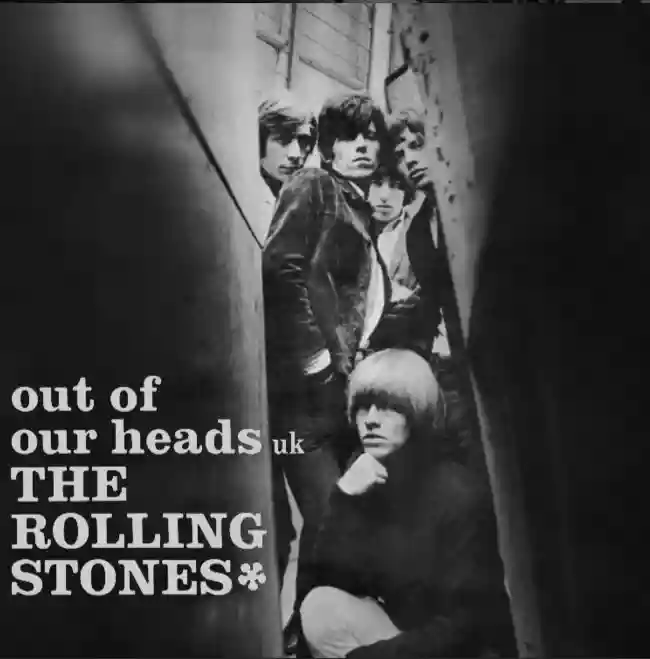
I wonder what happened to that Decca executive who decided to exclude from the UK version of the reviewed album the first hit of the Stones, that "(I Can't Get No) Satisfaction" which recently turned 60. And, above all, what remains today of the third work (fourth in the USA) of the immortal band without that timeless hit? Over the years, critics have always considered "Out Of Our Heads" an inferior album compared to the first two eponymous ones by the Rolling Stones (always respecting the chronology of UK releases), attributing missteps in the choice of some covers and, most importantly, the lack of substance of the four original tracks. In fact, only seven months later they would release "Aftermath," and everything played and written until then would suddenly lose its importance. Although, to be fair, the UK version of the first Rolling Stones' masterpiece on 33 rpm did not include "Paint It Black," which makes me think that if that executive was spared for the first blunder, after this, they must have been at least paved and feathered!
Released on September 6, 1965, "Out Of Our Heads" shows all the limitations and all the virtues of an album conceived in a period of great upheaval. The first "British invasion" started by the Beatles was in full swing with British bands like the Yardbirds, Kinks, Animals, and Rolling Stones, using the Ed Sullivan Show as a Trojan horse to conquer the Billboard 200. And if the British kids, each in their own way, had drawn heavily from the Blues and Soul repertoire and the Rock & Roll of Chuck Berry, Little Richard, and Bo Diddley, they themselves were seminal for the nascent USA Garage Rock movement. Certainly, the Yardbirds (with Jeff Beck) and the Kinks would have more impact on garage bands for the massive use of fuzztone and feedback, but the singing style is heavily inspired by Mick Jagger's sneering and defiant vocal approach, not to mention the Stones' bad boy image. But there is one thing that distinguishes the Stones from garage bands: rhythmic ability. That war machine of Bill Wyman and Charlie Watts known for their solid R&B foundation and with a level of technical skill not always present in garage bands, such that they would, in turn, inspire the more instinctive and aggressive strains of the rock universe (from Punk to Grunge).
But let's leave aside the fil rouge that connects the rigging of the Rock ship and return to the mid-sixties, specifically on June 10 and 11, 1964, when the band was at 2120 South Michigan Avenue in Chicago. At that time, Mick dreamed of singing like Muddy Waters, Keith dreamed of playing like Chuck Berry, and Brian aspired to become ... Brian Jones! A precocious fellow—at twenty, he had already fathered three children with three different women, and at 17 he was kicked out of the house for dishonoring the family—he was the real leader of the group at the time. He was a co-founder, gave the band its name, and played a significant role in shaping the initial sound crucial for the first Stones' success. Before they had a manager, he was the one calling venues to find good gigs, and it was mainly him who brilliantly engaged with the media, presenting himself as the most pleasant and eloquent member of the band. The three boys, even if they didn't realize it, were about to enter not only Chess Studio but rock history.
The visit to Chicago was a fundamental event for the entire band, seeking to render on record the sound they had live, that kind of roughness mixed with the funky groove combined with power. All of this was magically born thanks to the peculiarities of the Chess studios where you could play at high volume and with a unique reverb. In reality, only three tracks were recorded in Chicago: "Mercy Mercy," "That's How Strong My Love Is," and "The Under Assistant West Coast Promotion Man," while the remaining material was recorded between Los Angeles and London, but those sessions instilled confidence in the band. Bill Wyman recounts that in front of Chess Records studios, they found Muddy Waters himself who helped them carry guitars inside, and Chuck Berry even sneaked into the room and stopped to chat about amplifiers and other trivialities, even praising the band's sound.
The confidence in their own means, which spills over into a personal and recognizable sound, more than anything characterizes this recording. Suddenly not just a cover band but the Rolling Stones with that fuzzy, joyful, and boisterous guitar sound, drums and bass fueled by R&B, and Jagger’s personality-laden smirk, sweet and unpleasant at the same time. Moreover, if in the covers the album draws inspiration from the previous two albums and is based on their reputation as a band with deep Blues and Soul roots, with the originals they introduce new topics in the lyrics. The pens are those of Jagger and Richards because, although Jones is the brilliant multi-instrumentalist playing guitar, both electric and acoustic (in "Good Times" and "I Can't Get No Satisfaction"), organ, piano, and harmonica (in "The Under Assistant West Coast Promotion Man" and "One More Try"), he lacks the self-confidence to write songs. Additionally, the band's manager, Andrew Loog Oldham, encourages Jagger and Richards to write following the collaborative style of Lennon and McCartney. And from the arrogance of the Glimmer Twins arise lyrics in stark contrast to standard Blues or Soul, where the protagonist is either a suitor imploring his beloved to have mercy on him ("Mercy Mercy") or a loser who with self-deprecating humor recounts his numerous difficulties in winning over the elusive, and perhaps not overly interested, woman of his dreams ("Hitch Hike"). Instead, the minds of Jagger and Richards shape a male character who gains the upper hand over the woman. It moves from supplications to coercion ("Gotta Get Away": "Baby, the truth has come out, so don't deny it/Baby, think that I believed all your lies/Baby, I can't stand to see your face/It's the truth, you understand/I gotta get away, gotta get away"), from submission to misogyny ("Heart Of Stone": "There have been so many girls I've known/I made so many cry and still I wonder why/Here comes the little girl/I see her walking down the street/She's all alone/I try to knock her off her feet"). This stance towards women, even obvious in hindsight and which would become more evident shortly after in songs like "Stupid Girl" and "Under My Thumb," is what struck the contemporary audience the most.
In hindsight, "Out of Our Heads" established the Rolling Stones as one of the seminal influences in the course of rock for their approach to life, themes, and sound, contributing to defining the idea of Rock. Just as Bob Dylan had expanded and deepened rock music by introducing folk and more introspective lyrics, and the Beatles had created a sublime and dreamy version of pop/rock, the Rolling Stones were the group that dedicated themselves to integrating blues and soul into mainstream rock. From an enterprising cover band to original authors with a powerful and recognizable sound, they had a decisive impact on a generation of young rock musicians and the musical tastes of the public. The success of these early innovators in establishing the broadest possible definition of rock music was one of the main reasons for the band's popularity.
A
- She Said Yeah (Christy/Jackson) - 1:34
- Mercy, Mercy (Covay/Miller) - 2:45
- Hitch Hike (Gaye/Stevenson/Paul) - 2:25
- That's How Strong My Love Is (Roosevelt Jamison) - 2:25
- Good Times (Sam Cooke) - 1:58
- Gotta Get Away (Jagger/Richards) - 2:06
B
- Talkin' 'Bout You (Chuck Berry) - 2:31
- Cry to Me (Russell) - 3:09
- Oh Baby (We Got a Good Thing Goin') (B.Ozen) - 2:08
- Heart of Stone (Jagger/Richards) - 2:50
- The Under Assistant West Coast Promotion Man (Nanker Phelge*) - 3:07
- I'm Free (Jagger/Richard) - 2:24
*pseudonym of Jagger/Richards
Loading comments slowly
Summary by Bot
This review praises 'Out of Our Heads' as a strong showcase of The Rolling Stones' raw energy and blues-rock roots. It highlights the album's timeless appeal and the band's cohesive performance, noting its significance in 1960s rock history.Tracklist Lyrics Videos
The Rolling Stones
English rock band formed in London in 1962. Key long-term members include Mick Jagger and Keith Richards. Known for blues-influenced rock, enduring live performances and a prolific discography.81 Reviews
Other reviews
By charles
We immediately find ourselves facing the greatness of the Jagger character, not a great singer but with an interpretative ability truly among the best.
"Satisfaction," to which any description or commentary would definitely be superfluous.
By Viva Lì
"'(I can't get no) Satisfaction' is a timeless masterpiece that owes all its strength and effectiveness to the artistic genius of Keith Richards."
"The Stones unleashed a fierce and irresistible album, cruel and playful, that reshaped the rules of rock and inspired future genres like hard rock, disco, and punk."
