
 •
Rating:
•
Rating:
THE REVIEW
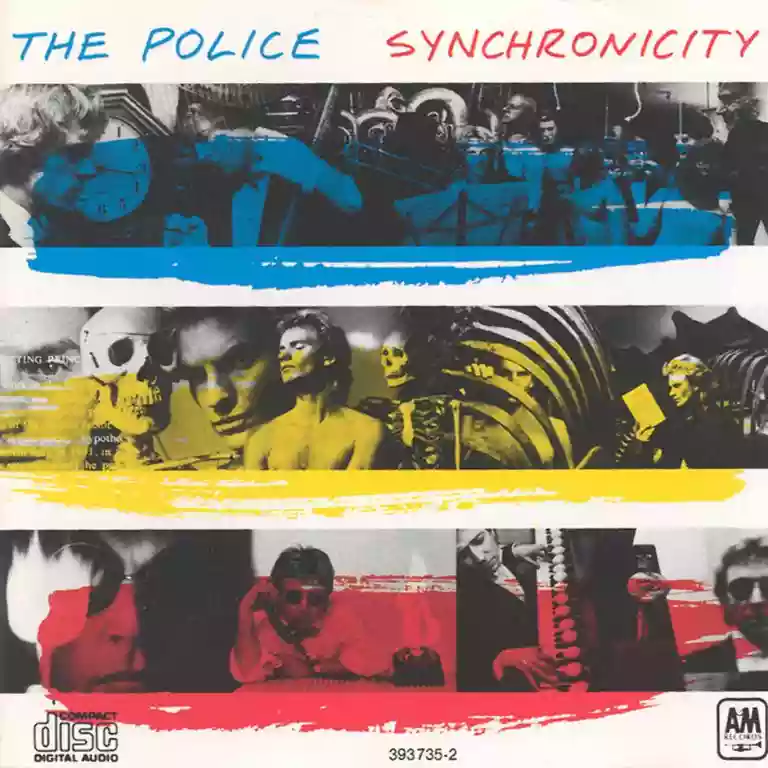
Well, with ‘Synchronicity’ we reach the final chapter of the studio discography of the three policemen; we can affirm that prior to seeing ‘Synchronicity’ in store windows, the longest interval ever between two releases by Sting’s group had passed.
To be fair, we must remember that although 1982 did not see an album from The Police, the three Englishmen released three new songs (‘How Stupid Mr Bates’, ‘A Kind Of Loving’, and ‘I Burn For You’) which served as the soundtrack for the film ‘Brimstone & Treacle’.
‘Synchronicity’ immediately makes it clear that the group has once again opted for various changes that cover both the song topics—with a greater focus on human relationships and love, which truly dominate, without forgetting the analysis of Jungian thought, which finds in synchronicity one of its most interesting themes—and the music, with the eternal search for the new, whether it’s the sound impact which seems to find a "perfect" level of realization. The nervous beginning of ‘Synchronicity I’ gives way to a driving vocal melody that integrates well with musical parts endowed with solidity and compactness, where harmonies and counterpoints create a track full of vigor and incisiveness that only this new musical path of Sting & Co. could help bring out. The intro of ‘Walking In Your Footsteps’ is one of the many facets of this innovative path undertaken by the group, where Copeland’s percussion supports Sting's sharp vocals to give the song the semblance of a ballad with a primitive flavor, also showing why the genius bassist is unmatched even for his vocal qualities.
‘Oh My God’ seems to really come out of nowhere, presenting itself as a track that will not remain in the listener’s mind at first but with its extreme simplicity can still please a not particularly demanding listener, offering an appreciation of a sax-based soliloquy at the end. ‘Synchronicity II’ is definitely one of those tracks that shows the most elegantly rock face of the trio; after a space intro, a well-crafted and airy verse, heavily influenced by Summers, makes it all the more edgy leading to a solid, artfully polished bridge, finding sublimation in a remarkable chorus with commendable melodic impact. For a track of extreme value that closes the first part of the album, another of certainly superior caliber inaugurates the B-side, titled ‘Every Breath You Take’. The song, with lyrics every woman would want to be dedicated to her, presents neither rock, reggae, nor punk reminiscences, but a true and sublime concentration of all those positive qualities we’d want in all the pop songs we subject our ears to. From the captivating and easily memorable verse to an amiable chorus that has every potential to induce justified pleasure in the listener, making the Sting, Copeland & Summers partnership reach a composing and performing perfection goal still to be achieved, that tangible unity of spirit that perhaps only the early "Cream" and a few others can claim to have firsthand experienced.
The piano of ‘King Of Pain’ immediately clarifies any doubt, The Police know how to navigate confidently even in such unconventional musical realms as this, where a track with a slow initial pace transforms into a rock song of fine quality reaching its zenith in that simple verse followed by an intense refrain enriching its artistic value. Personally, I don’t believe that as one progresses towards the end of the album, one encounters tracks that merely fill an unfortunate filler role. The mainstream and delicate ‘Wrapped Around Your Finger’ along with the dim and veiled atmosphere of ‘Tea In The Sahara’ serve as examples, guiding the listener through musical pathways filled with continuous and pleasant surprises. With this work, Sting’s leadership is clearly won, increasingly mastering his composing skills which see him credited as the author of no less than eight tracks, consequently reducing the creative contribution (but not instrumentally, of course!!) of Summers and Copeland to no more than five minutes total, respectively divided between the madness of ‘Mother’ and the avant-garde story of ‘Miss Gradenko’ (...with the word glasnost only to be learned a few years later...).
For those who might have fallen into the error of believing that the English trio had coined a genre to be squeezed throughout an entire artistic career, never could they be more mistaken than demonstrated with the release of ‘Synchronicity’, an album which in its intelligent and unusual heterogeneity proves itself to be a indisputable winning proof of those who have risked their artistic maturity on their skin, besides being the epitaph of a timeless band.
Loading comments slowly
Summary by Bot
‘Synchronicity’ is the final studio album by The Police, marking a significant evolution in their music and songwriting. The album blends themes of human relationships and Jungian ideas while innovating musically. Tracks like ‘Every Breath You Take’ and ‘Synchronicity II’ showcase the band’s maturity and creative unity. The album avoids filler songs, maintaining a balance of artistic experimentation and accessible melodies. This release confirmed Sting’s dominant creative role and remains a timeless classic.Tracklist Lyrics Videos
The Police
British rock trio formed in 1977 (Sting, Andy Summers, Stewart Copeland) known for blending rock, reggae and new wave and for hits such as "Every Breath You Take".35 Reviews
Other reviews
By luciano
This album is nervous, grumpy, dry, disjointed. It’s even more bare than Ghost in the Machine. Yet it is absolutely essential to have.
With Synchronicity, Sting must chase with his voice the energy of the percussion: like a master dragged on a leash by a big dog, he follows, seeks, asks to have his role recognized.
