
 •
Rating:
•
Rating:
THE REVIEW
NO! THIS IS NOT THE USUAL REVIEW ABOUT SERGEANT PEPPER!
I think it's fair to warn you in advance because I know there are already about a dozen reviews. However, what I will say in this one is totally different from everything you’ve read before. At least for me, it is, if it's not for you, feel free to vent in the comments. I even accept severe insults.
Having made this small personal premise, let me make another one regarding the work: Sgt Pepper is undoubtedly the most misunderstood album in the history of Rock and Pop. And now I'll explain why.
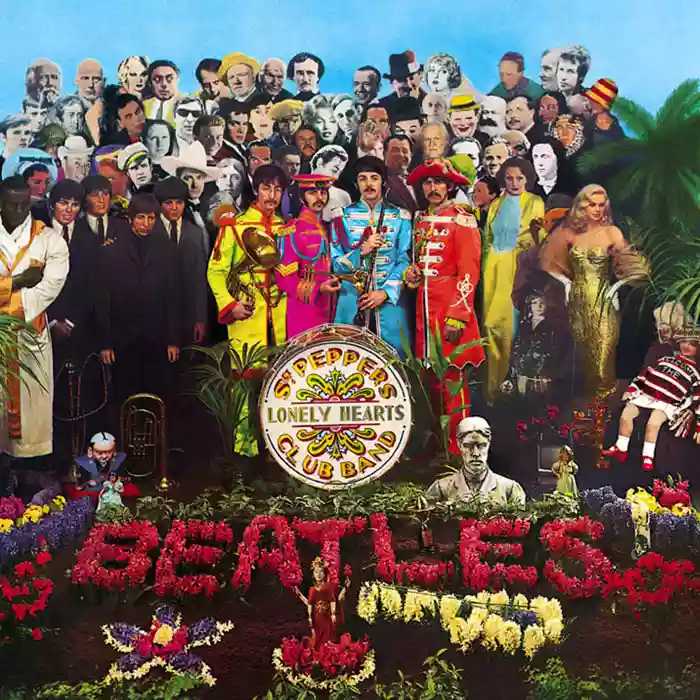
It's 1967. A hot and muggy June, to be precise: we are fully immersed in the so-called "Summer Of Love." Among the shelves of record stores, a brightly colored and overcrowded album cover emerges. It’s the Beatles’ eighth album, which will unanimously be considered the "bible" of this summer of love. At least apparently, I say.
Now I ask you to move forward a few months in time. It's September 1968, and among the same shelves of those stores appears an album very similar to Sergeant Pepper. But when you listen to it, you understand it is a brazen parody of this and all "Flower Power": it’s We're Only in It for the Money by Frank Zappa. An ironic critique of the Hippie lifestyle and philosophy.
"Something new, original, not homologated like Sgt Pepper, which cleverly exploited the trend of that time," the most cerebral critics think. And I reply, "No, no. You are very mistaken. Because there was already someone before Zappa who parodied the ‘Summer of Love’ much more irreverently. And it was the Beatles themselves!"
Yes! Everyone thinks that this album is the cradle of Hippie philosophy. I believe, instead, it is exactly the opposite: the true parody of 'Flower Power' is precisely Sgt Pepper Lonely Hearts Club Band. But let’s analyze its contents thoroughly.
First of all, it’s very clear that the whole concept (creating alter-egos, dressing in that extravagant way, making such a rich and full cover, but in reality so devoid of emotion, making the album a concert, not of the Beatles, but of this unknown band with an impossible name) has a clear ironic and parodic intent.
The Title-Track that opens the album is the most evident presentation: Our Macca has always admitted wanting to parody the Californian bands, all of which had these unpronounceable and very long names. Moreover, the structure of the song itself is quite ironic and very “Zappa-like”: it begins with a riff-laden, hard rock, and then evolves into village band music. If Zappa had done something like this, he would have been called a genius. But since it’s the Beatles, they are considered commercial.
The band presents the singer, Billy Shears (played by none other than Ringo! Tell me this isn’t parody, come on!) who sings the famous With a Little Help From My Friends: a harsh but ironic critique of singers and musicians who needed a little help from drugs to do their job well, that is, a little help from their friends.
Connected to this is Lucy in the Sky with Diamonds, a funny parody of LSD-induced hallucinations (it's evident that it’s a parody since the images are too "Lewis Carroll-like". Something not found in Barrett's psychedelic songs because they are serious.)
The fourth track, Getting Better, is perhaps the most emblematic and best represents the album's idea. The song talks about a boy, violent with women, who can’t stand rules, and at some point, someone puts him on the right track (You gave me the word, I finally heard, I'm doing the best that I can). In the chorus though, when Paul sings "It's getting better" (it's getting better), strangely, John harmonizes in the background "I can't get no worse" (it can't get any worse!) Is it a simple oxymoron without meaning or something more? The irony of the Beatles is a typically English irony, very, perhaps too subtle. This song means nothing but the disintegration of young people's values, who despite thinking it's getting better, deep inside they know they are playing into the hands of power, which wants them well drugged and sedated, not awake and ready for revolution.
In my opinion, Fixing a Hole is not an apology of marijuana, instead, it's a well-crafted attack. (I'm fixing a hole, where the rain gets in, and stops my mind from wandering). Drugs prevent thinking, they prevent escape, they keep the youth calm and unaware of the events around them because they are increasingly distant, increasingly alienated due to hallucinogens.
And it’s precisely the alienation of young people that is the main theme of the next track, She's Leaving Home, which only apparently tells of a girl running away from home, but is actually a metaphor for the detachment from reality that young people increasingly pursue.
Being for the Benefit of Mr Kite! is another psychedelic parody by Lennon. The "Summer of Love" and "Flower Power" are compared to an equestrian circus, a mere Cabaret show intending to change and challenge the world ( In this way, Mr Kite will challenge the world!) but in reality, only aims to make money (and tonight Mr Kite is topping the bill!)
While Within you, Without you is the parodic extremization of the "influence" that Indian culture was having in Rock music, When I'm Sixty-Four lets us understand how this age, innovative and revolutionary for everyone, is actually conservative and moralistic, for the reasons already described.
Lovely Rita and Good Morning Good Morning are two parodies of the psychedelic songs of the period: the first with a bland text and a playful and amusing cabaret music, the second with the emblematic (I've got nothing to say, but It's ok), representing the total uselessness of the lyrics, most of the time nonsensical, of these songs.
After the famous Reprise, which is functional in making the album truly a concept, here we are at the last gem of this record.
Have you ever wondered why A Day in the Life was separated from everything else on the album? Haven’t you been able to give yourself a convincing answer? Because in this song, the Beatles return to being the Beatles, because before bidding us farewell, they want to tell us something important.
It’s hard to explain, but I will try to do so this way.
A music critic, perhaps Lewisohn, I don’t remember well, said this about the song: "A Day in the Life is the Wasteland of Rock" referring, of course, to the great poet Thomas Eliot.
Well, I believe the Beatles wanted to convey just this: the Summer Of Love is nothing but an illusion, the Flower Power is nothing but a dirty power game. In front of us, unfortunately, there lie many more long, unreachable wastelands to overcome with effort.
Loading comments slowly
Summary by Bot
This review offers a fresh and serious interpretation of The Beatles’ Sgt Pepper’s Lonely Hearts Club Band. It argues that the album, often seen as an emblem of flower power, is actually a subtle parody and critique of hippie culture. Each track is analyzed to reveal ironic and satirical elements, uncovering the band’s deeper, often overlooked messages about youth alienation and societal illusions. The review challenges common perceptions and highlights the album’s complexity beyond its psychedelic surface.Tracklist Lyrics Videos
The Beatles
The Beatles were a British band formed in Liverpool in 1960 by John Lennon, Paul McCartney, George Harrison and, from 1962, Ringo Starr. They revolutionized popular music through songwriting, studio innovation and cultural impact, releasing landmark albums from Rubber Soul and Revolver to Sgt. Pepper’s, the White Album and Abbey Road before disbanding in 1970.173 Reviews
Other reviews
By Aerith
The most beautiful track on the album is the closing one: A Day In The Life is perhaps one of the most beautiful and modern songs by the Beatles.
She’s Leaving Home still manages to move me, blending perfectly in the myriad of bright lights and colors of the album.
By waties
"’A Day In The Life’ is the masterpiece above another 4-5 masterpieces, I seriously wouldn’t know how to define it."
"It’s like going to the theater and seeing 4 strangely dressed guys doing strange things singing natural, human music."
By Sanjuro
The whole class watches him squirm like a Houdini of the urban underclass, the new feminist girls then... kick the male chauvinist bear and spit rains down everywhere.
Davide X instead of lady laxatives could have found with unchanged results... a copy of the already much-mentioned Sgt. Pepper’s Lonely Hearts Club Band.
By vellutogrigio
Although inferior to contemporary "hard" rock songs by The Who, Rolling Stones or Kinks, it perhaps has the merit of introducing this kind of music to less attentive listeners.
A masterpiece that seems to have no weak points... you won’t hear it played in any dance entertainment for sixty-year-old professionals. Chapeau.
By enbar77
"Sgt. Pepper’s should be protected by an impenetrable case to avoid attacks from any deterrent agent of natural or artificial origin."
"Anyone who loves rock music and beyond MUST own ‘Sgt. Pepper’s.’"
