
 •
Rating:
•
Rating:
THE REVIEW
Reviewing "Sgt. Pepper's" has become a worn-out and overused tradition for industry insiders. Being one of the potential rodents myself, I take advantage of this opportunity to share my thoughts on the eight decades of its resilience, simply extending a broth of excellent quality.
The album in question fully outlines the greatness of those who composed it. The Beatles, up until 1964 (just two years of activity), had been magnified by the media power of the press, radio, and television, by mass delusions never seen before, and by the still catchy songs that lined up like a coral reef at the upper extremities of the world charts. Let's not forget, however, that in the period in question, there are also hints of small ingenuity still in an apprenticeship status, contrasted only by the Rolling Stones.
In 1965, they began to tire of the exhausting tours until they abandoned them entirely in 1966. Exhausting concert tours that flowed into a brutal whirlwind of delirious screams, crying, fainting, and voluntary scalping. A mixture of noises caused by the furies, so cumbersome as to almost cover the sounds coming from the stage, so much so that the poor Fab4 could have sung "San Martino, campanaro" without anyone noticing. Meanwhile, "Rubber Soul" and "Revolver" are released, gaining intercontinental acclaim despite the beatings taken in Manila, John Lennon's forgiven blasphemy, and the condemnation to burn the works sold so far and then repurchased. But that's another story.
On the first of June 1967, music takes a pause to make room for the greatest album in rock history. Without any hesitation and no regret caused by clichés or half-terms. "Sgt. Pepper's" should be protected by an impenetrable case to avoid attacks from any deterrent agent of natural or artificial origin. The latest "Rolling Stone" census says it too, for those who still have doubts. Whether you like it or not is natural, but I would look around carefully before venturing to say it is a worthless album. Surely after saying this, the usual protests from those who have not understood the point will start to rain down. Anyone can say that Mozart didn't write "Eine Kleine Nachtmusik" or that Guttuso didn't paint "La Vucciria," but the heresy produced by this individual must reckon with history and then suffer a resounding defeat in credibility. Anyone who loves rock music and beyond "MUST" own "Sgt. Pepper's." In my opinion, and I believe not just mine. What I am writing contains no hint of arrogance or haughtiness of munginiana memory. I want to make it clear. I am just a poor forgettable reviewer commenting on what has been written by history.
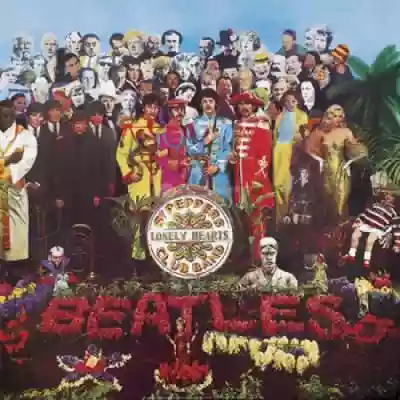
The Beatles took a long time to discover and transfer to a "four" track recorder the sounds kindly offered by nature or masterfully derived from each one's creativity. Starting from the fulfillment of a buzz of spectators from some undefined place, accompanied by musicians in preparation phase that is shattered by a mighty electric guitar marking the beginning. We are the Sgt. Pepper's Lonely Hearts Club Band, and without any pretense, we are here to entertain you, just follow us, and you won't regret it. Never before has an invitation message been so apt and innovative. A message that melts into a triumph of sparkling colors that decorate every empty space left by music preceding this monumental work that dazzles throughout its duration.
After the explosive opening, the way is given to a quieter Billy Shears (Ringo Starr), who invites, with his not excellent but incredibly sincere voice, to go beyond and not stop in front of obstacles, maybe with a little help from some friend or person you can trust. A song that glides smoothly to its conclusion, from where the second overture of the album, "Lucy in the Sky with Diamonds," originates. A psychedelic overture, at times mystical, that provides nectar to all other hungry slots of the work. Metallic, muffled voices, never heard before the time, distorted, skillfully manipulated, settle into tracks wrapped in simple yet ferocious electric guitar riffs and sounds still unmatched (in the digital age!). Sometimes gentle choirs, other times melancholic, accompany the clear voices of "Getting Better" and "Fixing a Hole" up until they conclude in the spongy and colorful "Being for the Benefit of Mr. Kite," taken even from a poster.
From here, the third overture begins. The cloud of Indian breeze "Within You Without You" manages to penetrate every hidden corner of the human imagination when listened to properly. The sitar and the tabla are worthy instruments for this descent into the pure depths submerged by the bleak daily materialism. George Harrison teaches how to meditate on vital concepts and suggests to the followers invited at the beginning of the work to do as he does. The result is excellent, and this is highlighted by the piece that follows, "She's Leaving Home," taken from a real-life news clipping. The song is wonderfully atypical, compared to the Beatles' standards, as it is interpreted by voices only accompanied by strings and harp. The timbres of the various singers overlap gently like layered veils, letting through a lightness that permeates the entire body of the poem predominantly recounted by McCartney.
The commercial overture could not be missing, however, anticipated by a nice story a grandfather would tell his grandson in "When I'm 64." It would have been far too perfect, and thus the onslaught of heavy orchestrations and inadequate metrics, even with some highlights (the final piano solo in Lovely Rita), seems almost justified. "Lovely Rita," in fact, and "Good Morning Good Morning" do not lend much incisiveness to the work. More than anything, it's a pretext to invite the followers to the band's thanks, with the hope of a new influx seen in the reprise of "Sgt. Pepper's." At the end of it, the miracle happens. From the festive voices dissolving arises a simple and clear guitar played by John Lennon, who begins to sing "A Day in the Life."
"A Day in the Life" is history. Innovative in its lyrics, concept, sounds, effects. It's the testament written by the Beatles ahead of its time. What follows is a copy. The story of every common mortal told by powerful swirls of strings and brass that violently break every temporal boundary, in 5 minutes and a bit more including the inner groove. Irregular percussive comments delineate the power of making music, of staging exceptional races against time.
Majestic work to be listened to in reverent silence that highlights the greatness of the Beatles from every angle. I repeat with clarity that all this was born from texts already written for history. A gentle comment on what has already been widely told. And without any arrogance, in fact with sympathy, I want to conclude with a note. Those who love music and say that "Sgt. Pepper's" is an irrelevant or low-value album should go to confession. They have just blasphemed. And I can say it because I am backed by history.
Loading comments slowly
Summary by Bot
This review celebrates Sgt. Pepper's Lonely Hearts Club Band as the pinnacle of The Beatles' artistic journey and a landmark in rock history. It highlights the album's innovative sounds, timeless themes, and unmatched influence on music and culture. The author emphasizes the album's essential place in any rock music lover's collection, underscoring key tracks and their unique qualities. The review also addresses the initial challenges faced by the band and the transformative period leading to this seminal work.Tracklist Lyrics Videos
The Beatles
The Beatles were a British band formed in Liverpool in 1960 by John Lennon, Paul McCartney, George Harrison and, from 1962, Ringo Starr. They revolutionized popular music through songwriting, studio innovation and cultural impact, releasing landmark albums from Rubber Soul and Revolver to Sgt. Pepper’s, the White Album and Abbey Road before disbanding in 1970.173 Reviews
Other reviews
By Aerith
The most beautiful track on the album is the closing one: A Day In The Life is perhaps one of the most beautiful and modern songs by the Beatles.
She’s Leaving Home still manages to move me, blending perfectly in the myriad of bright lights and colors of the album.
By waties
"’A Day In The Life’ is the masterpiece above another 4-5 masterpieces, I seriously wouldn’t know how to define it."
"It’s like going to the theater and seeing 4 strangely dressed guys doing strange things singing natural, human music."
By Sanjuro
The whole class watches him squirm like a Houdini of the urban underclass, the new feminist girls then... kick the male chauvinist bear and spit rains down everywhere.
Davide X instead of lady laxatives could have found with unchanged results... a copy of the already much-mentioned Sgt. Pepper’s Lonely Hearts Club Band.
By vellutogrigio
Although inferior to contemporary "hard" rock songs by The Who, Rolling Stones or Kinks, it perhaps has the merit of introducing this kind of music to less attentive listeners.
A masterpiece that seems to have no weak points... you won’t hear it played in any dance entertainment for sixty-year-old professionals. Chapeau.
By granpaul
It is no secret that the four used acids and the like, and with this album they show the damage that drugs cause to the brain.
I can’t fathom how some people dare to call it a record, even Wonderful, not realizing that they have in their hands the sickly vomit of four delirious drug addicts.
