
 •
Rating:
•
Rating:
THE REVIEW
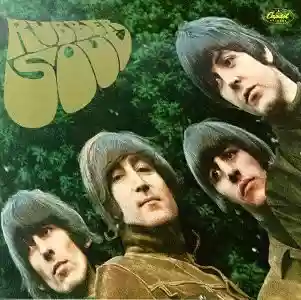
The recent reissue of the entire official Beatles discography, remastered and dressed up with various accessories, would have been a great idea, but the exorbitant and utterly anachronistic price these CDs are set at makes the whole operation solidly distasteful. If you still have the desire to sacrifice almost twenty Euros to the greedy market rules, I would recommend starting with this "Rubber Soul" from 1966 because, in their entire discography, this is the album where the sharpest improvement is apparent compared to the one that precedes it.
Let's list some of the novelties: marijuana and hashish take the place of alcohol as "inspirational drugs," Harrison and McCartney start to abandon their semi-acoustic instruments, good for jazz and rock'n'roll but not sufficiently rich for pop and rock, experimenting here with the first performances on Fender Stratocaster and Rickembaker bass, crucial for focusing their sound and style and gaining full dignity and lasting respect also as instrumentalists. The lyrics almost entirely cease to be banal and obtuse (there had already been signs in the previous "Help") and often become introspective or at least witty. Moreover, musical inspiration models shift decisively: not only the great Americans of rockabilly and rhythm & blues but also the more avant-garde "competition": Dylan, Byrds (especially), Beach Boys.
The album contains at least three masterpieces, songs whose influence, inspiration, comfort, emotion, and pleasure for billions of people are indisputable: in order of appearance in the track list, they are "Norwegian Wood", "Michelle" and "Girl".
"Norwegian Wood" falls among the deadliest fifty-fifty combinations of Lennon’s genius (the verse) and McCartney’s (the chorus). Very few chords but with devastating effectiveness: Lennon starts by fiddling, as all guitarists in the world do, with the D major position, which allows many inversions by alternately moving some fingers on the fretboard, and finds within this chord a memorable descending and undulating melody of thirteen notes, long since entered into the musical heritage of everyone, from the housewife to the orchestra conductor, from the strummer under the picnic tree to the jazz trio. So beautiful that the vocal line sung by John cannot but follow its trace. Not only that, but even George Harrison, wielding a novel sitar, travels appropriately on the same notes. Then comes McCartney’s added value, resolving the refrain with a minor passage that puts everything in temporary suspension, quickly resolving into the longed-for return to the major setting through an A chord capable of transmitting an unprecedented sense of relief and shelter, again and again, even if the ear rests upon it for the thousandth time (for the strummers: the song is actually in E major, achieved by equipping the guitar with a capo on the second fret).
"Michelle" has a completely different type of charm and beauty, more icy, sophisticated, distant, didactic, reflecting McCartney's character, more superficial and sunny compared to his colleague. We are, in any case, in the empyrean of creativity of this absolute natural melodist, capable in those youthful years of stratospheric numbers in terms of harmonic and melodic inventiveness. The execution of the song is entirely his own as well, much like it happened with "Yesterday" from the previous album, perhaps even including the drums, given there's an evident slowdown in the entire second part of the piece, a flaw into which a more skilled drummer like Ringo would hardly have fallen. The little guitar solo, with completely muted tones, is surely the handiwork of Paul.
"Girl" features one of Lennon’s most beautiful vocal performances, capable of conveying the troubles of the classic, painful search for the soul mate with an unparalleled timbre and interpretation. This despite the outrageous "toke" (energetic and long inhalation, hands clenched in front of his mouth) that the Beatle invents after every invocation of the song title, not to mention the falsetto chorus "Tetta, tetta, tetta..." with which he is accompanied by the other two merry singers of the group during the refrain resolved to march time. John's two faces, the melancholy and tormented person, but at the same time ironic and rebellious, proceed perfectly hand-in-hand in this memorable song.
The album certainly doesn't end here, "In My Life" is also much respected, mainly sung by Lennon but with the vocal line resulting from an alternating effort of the two great composers of the group. At the time, the very much admired, but in my opinion completely out of place compared to the introspective atmosphere of the piece, the baroque "speeded up" electric piano solo, was the work of producer George Martin.
"Drive My Car" is a lively start, with guitar and bass traveling together in a clever blues-style riff (not yet in rock style: the sounds are not thick and powerful enough), reinforced here and there by a scholastic but effective rock'n'roll piano (played by Paul), and refined by accurate arrangement of choirs and a discreetly vulgar hidden text.
"Nowhere Man" is, on the other hand, a snapshot of the more depressed and disoriented Lennon, dealing with an unhappy marriage and fatherhood, full of guilt feelings. The Byrds provide great help in inspiring a particularly sumptuous and flaming choral production.
"The Word" is very black, soul, rhythm & blues, for once more interesting for the instrumental performances (Paul and Ringo at their best, creative and exuberant) than for the melodies and harmonies, which are quite orthodox and derivative.
The rest is not worth much: "You Won't See Me" and "I'm Looking Through You" are two of McCartney's songs, between the meditative, the resentful, and the pissed-off towards his then-girlfriend, one leaning towards Dylan's style and the other towards that of the Four Tops. "Think For Yourself" and "If I Needed Someone" are George Harrison's two contributions and, as put excellently by the great biographer Ian McDonald, "... they possess a character of obstinacy that, combined with a preference for harsh progressions, makes them awkward compared to the gentleness of McCartney's songs, and anemic compared to the animosity of Lennon’s".
"What Goes On" is the usual solo filler for Ringo, who provides his usual melancholic and jovially understated interpretation, while Harrison manages here with his last rock'n'roll solo Chet Atkins style of career, before permanently moving on to something else. "Wait" is nothing more than a leftover from the previous album, and the concluding "Run For Your Life" is downright irritating, with a macho text from the worst Lennon and a poor performance quality from everyone.
The sixth studio album of the Fab Four is, in my opinion, if not the best, the most surprising and exciting because with it, the Beatles begin to fully justify their already overblown fame and the fanaticism created around them, providing actual numbers of high inspiration, ingenuity, and originality within popular music.
A real pity, finally, that this album does not include the two songs recorded in the same period at Abbey Road but destined only for single release, namely "We Can Work It Out" and "Day Tripper": two real gems (especially the first, among the very best of the repertoire) which, replacing two of the many fillers, would have made "Rubber Soul" definitively irresistible.
Loading comments slowly
Summary by Bot
This review praises The Beatles' Rubber Soul as a pioneering album marking a sharp artistic evolution. It highlights the shift in instrumentation, more introspective lyrics, and influences from Dylan and the Byrds. Key songs like 'Norwegian Wood,' 'Michelle,' and 'Girl' are analyzed for their genius and emotional depth. Despite some filler tracks, the album remains highly influential and exciting.Tracklist Lyrics Videos
The Beatles
The Beatles were a British band formed in Liverpool in 1960 by John Lennon, Paul McCartney, George Harrison and, from 1962, Ringo Starr. They revolutionized popular music through songwriting, studio innovation and cultural impact, releasing landmark albums from Rubber Soul and Revolver to Sgt. Pepper’s, the White Album and Abbey Road before disbanding in 1970.173 Reviews
Other reviews
By GiacomoLeopardi
Rubber Soul amazes for the eagerness with which it drives the listener, pinning them to their stereo, leaving them breathless from the very first listen.
Lennon’s lyrics: superb in 'In My Life' (absolute poetry), somnambulist in 'Nowhere Man,' prophetic in 'The Word,' cannabiolic in 'Girl.'
By Miki Page
"Rubber Soul" is a fundamental album in the history of rock, one that marks a turning point not only in the Beatles' career, but also and especially for the music that would follow.
We were starting to hear sounds that we couldn’t hear before — McCartney later admitted.
By BRIOBLUE
The Beatles were four mediocre musicians who still sang three-minute melodic songs...
Rubber Soul is certainly one of the best Beatles albums, but true music must be sought in other bands.
By currahee72
"Rubber Soul was the first album to introduce the new Beatles, the grown-up Beatles, to the world with imagination in power."
"A unique example of pop-beat music elevated to its highest artistic expression."
By Rax
"Rubber Soul is not a masterpiece... it is generally inferior to the much-maligned 'Let It Be.'"
"Norwegian Wood... is one of the Beatles' greatest melodic masterpieces."
