
 •
Rating:
•
Rating:
THE REVIEW
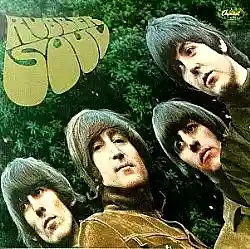
"Rubber Soul" is a fundamental album in the history of rock, one that marks a turning point not only in the Beatles' career, but also and especially for the music that would follow. And to think it is one of the most underrated albums of the British quartet, often going unnoticed, even more so than "Abbey Road," the last masterpiece of the Fab Four, as well as their musical testament.
But why is "Rubber Soul" so important? First of all, it marks the first true artistic maturation of Lennon & McCartney starting from '63, that is, from the group's first album, the unripe and, pardon, predictable "Please, Please Me". And, secondly, because it is precisely with this record that Lennon & McCartney definitively abandon the usual schemes of the pop song they themselves had established, thereby bringing the era of the Mersey Beat to an end.
The title itself is significant: "Rubber Soul", literally "rubber soul". And the music of "Rubber Soul" gives just this impression: of being malleable, colorful, rubbery. The massive use of drugs, a greater freedom to experiment in the studio compared to the past, leads the four to discover a new reality and unexplored territories, suddenly producing distorted, strange musical signals.
"We were starting to hear sounds that we couldn't hear before" McCartney later admitted. Lennon felt the same way: "We were improving both technically and musically. At first we had to take what came, we had to finish in two hours, and two or three takes were enough, but we didn't know how to make the bass sound. Then, with 'Rubber Soul,' we became modern."
And so, passing from the exotic atmospheres of "Norwegian Wood" to the sweet acoustic ballad "Michelle"; from the slow and poignant "Girl" to the rock of "Drive My Car" and "Run For Your Life", then moving on to an unusual "The Word" with very jazzy overtones or the ambitious and complex harmonies of "Nowhere Man", "Wait" and "If I Needed Someone", to the sappy pop of "You Won't See Me" and "I'm Looking Through You", to the distorted guitars of "Think For Yourself", to the soul of "What Goes On" or even to the piano ballad "In My Life".
All songs, of love and otherwise, that show a new maturity and depth, with more complete and complex harmonic and melodic structures, and less direct than those of the previous five albums.
"We had reached a point where we thought: 'Now we can extend our repertoire to slightly more surreal, slightly more fun songs'" said McCartney.
The album was released on December 3, 1965, coinciding with the single "Day Tripper/We Can Work It Out", and within a week it shot up to the number one spot on both the British and United States charts. "Rubber Soul" is therefore a joyful album, meticulously crafted, perfect, which inaugurates new recording techniques and marks the transition from beat to new psychedelic sounds: the end of one era and the beginning of another.
Loading comments slowly
Summary by Bot
Rubber Soul represents a fundamental turning point in The Beatles' career and the evolution of rock music. The album showcases Lennon and McCartney's artistic maturation and an embrace of studio experimentation. With diverse tracks blending folk, rock, jazz, and soul, it marks the end of the Mersey Beat era and the start of psychedelic influences. Released in 1965, it quickly hit number one in the UK and US charts. This masterpiece remains one of the band's most underrated and influential works.Tracklist Lyrics Videos
The Beatles
The Beatles were a British band formed in Liverpool in 1960 by John Lennon, Paul McCartney, George Harrison and, from 1962, Ringo Starr. They revolutionized popular music through songwriting, studio innovation and cultural impact, releasing landmark albums from Rubber Soul and Revolver to Sgt. Pepper’s, the White Album and Abbey Road before disbanding in 1970.173 Reviews
Other reviews
By GiacomoLeopardi
Rubber Soul amazes for the eagerness with which it drives the listener, pinning them to their stereo, leaving them breathless from the very first listen.
Lennon’s lyrics: superb in 'In My Life' (absolute poetry), somnambulist in 'Nowhere Man,' prophetic in 'The Word,' cannabiolic in 'Girl.'
By BRIOBLUE
The Beatles were four mediocre musicians who still sang three-minute melodic songs...
Rubber Soul is certainly one of the best Beatles albums, but true music must be sought in other bands.
By currahee72
"Rubber Soul was the first album to introduce the new Beatles, the grown-up Beatles, to the world with imagination in power."
"A unique example of pop-beat music elevated to its highest artistic expression."
By pier_paolo_farina
"The Beatles begin to fully justify their already overblown fame...providing actual numbers of high inspiration, ingenuity, and originality within popular music."
"Norwegian Wood falls among the deadliest fifty-fifty combinations of Lennon’s genius (the verse) and McCartney’s (the chorus)."
By Rax
"Rubber Soul is not a masterpiece... it is generally inferior to the much-maligned 'Let It Be.'"
"Norwegian Wood... is one of the Beatles' greatest melodic masterpieces."
