
 •
Rating:
•
Rating:
THE REVIEW
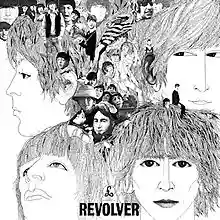
This, and not “Sgt. Pepper”, is the (musical) pinnacle of the Beatles. Even Scaruffi is forced to call it a “masterpiece”.
It's hard to imagine that “I’m Only Sleeping” did not somehow “intrigue” the creativity of Syd Barrett and company, who, the following year, went beyond the Beatles and the (great) psychedelic pop-rock of “Revolver” – even though it would be superficial to say that “Revolver” is only about psychedelia. We find the ballad (“For No One”), the electric folk ballad (“Here, There and Everywhere”), vaudeville (“Yellow Submarine”), Indian folk (“Love You To”), rock blues (“Taxman”), and classical (“Eleanor Rigby”). As Luca Biagini says, the Beatles’ masterpiece is also “the most heterogeneous album of their production.” The Beatles could have created a disaster in this pretentiousness of wanting to say something in every genre. One remains happily incredulous listening to the results achieved.
What amazes, even more than the music, is the (musical) difference between this and “Rubber Soul”. Among the bands I know, there is no such abyssal difference between one record and the previous one. Twenties turned into thirties in the span of eight months.
Although “Revolver” is a musical masterpiece, it is not a perfect album. In this album, there are some questionable choices, some really incomprehensible. Above all, the absence of a psychedelic rock masterpiece like “Rain”, released as a B-side: Ringo’s performance is beautiful, McCartney’s bass is splendid, and the early reverse crashes with “suction effect” are stunning.
Another flaw is the presence of a song like “Yellow Submarine”, which drastically lowers the album's depth. Such a pleasant song, undoubtedly well-crafted, would have been perfect as a single to play for children; on the album, it really stands out. Moreover, the version of “Got to Get You Into My Life” on the Anthology (only with organ, hi-hat, and vocals) is, in my opinion, far superior to the album version; the sober and mature singing makes it a masterpiece.
The same can be said for “And Your Bird Can Sing”: the slowed-down version of the Anthology, with the shimmering folk-rock guitar, was, as Luca Biagini says, superior to the (to me anonymous) album version.
The biggest flaws, however, are in the lyrics. In “Revolver”, there are some slips. This obviously does not apply when we talk about splendid verses like those of “For No One” (love ending due to her selfishness), “Eleanor Rigby” (loneliness told concretely), “I’m Only Sleeping” (irony against those who always live in a hurry without reason), the irony of “Taxman” and also “Tomorrow Never Knows.”
The slips concern the lyrics of songs like “And Your Bird Can Sing” (which Lennon considered “junk”), “Good Day Sunshine” (emblem of McCartney’s immature optimism), and lyrics that are really uninspired like those of “She Said, She Said”, or really trivial like “Doctor Robert.” For the lyrics, Lennon from “Revolver” is absolutely inferior to Lennon from “Rubber Soul” – and this regression saddens me a bit: wasting such songs to talk about nothing …
The historical value of this album is perhaps superior to its musical one. With “Revolver”, pop – a genre born to sell records and make teenage girls scream – becomes art. From pop to (author's) Pop through “Revolver”. When “Revolver” was released, it provoked enthusiastic reviews from critics all over the world. Suddenly experts noticed that the Beatles were not just four mop-top idiots; under the hair, there was gray matter, and they defined some pieces as “manifestations of sheer genius” – while still remaining in the realm of Pop.
Listening to “I’m Only Sleeping” (with the dreamy “backward guitar” solo that took six hours to write) and “Tomorrow Never Knows” (with sped-up violins, the “spinning” effect of voices, and all the rest…) one cannot but agree. However, this album should not be overrated, as some delirious critics praise it as “the greatest ever”. There are many albums superior in genres superior to Pop. That said, the Beatles of “Revolver” remain a miracle.
The Beatles will never again reach certain peaks of musical creativity present here – apart from “Strawberry Fields”, “A Day in the Life”, and “I Am the Walrus”. Had they continued in this sonic exploration, today, I think, we would remember them as the “Pink Floyd of Pop”. In reality, they were, but for too short a time (1966/67).
Loading comments slowly
Summary by Bot
This review praises The Beatles' Revolver as their musical pinnacle, highlighting its genre diversity and innovative sound. It notes some lyrical and track placement flaws but recognizes its crucial role in elevating pop music to art. The album's creativity and historical impact remain remarkable, despite not being flawless.Tracklist Lyrics Videos
The Beatles
The Beatles were a British band formed in Liverpool in 1960 by John Lennon, Paul McCartney, George Harrison and, from 1962, Ringo Starr. They revolutionized popular music through songwriting, studio innovation and cultural impact, releasing landmark albums from Rubber Soul and Revolver to Sgt. Pepper’s, the White Album and Abbey Road before disbanding in 1970.173 Reviews
Other reviews
By R2061478
With Revolver, they start to get really serious.
Tomorrow Never Knows sounds modern even today, a cross between the Chemical Brothers and the minimalist electronics of Radiohead.
By DanteCruciani
"The Beatles are the greatest band of all time, it seems obvious to me."
"I could never explicitly say how much I loved the Beatles because it wouldn’t be appropriate for a serious music critic... In the Beatles, there was something mystical, AND I love them."
By sausalito
"Revolver is emblematic ... the weakest record in the band's mature discography."
"A record where the disparity between fame and actual value is evident."
By JohnWinston
"Revolver is tinged with psychedelia, ballads, rhythm & blues, nursery rhymes... everything contributes a bit to the creation of this timeless masterpiece."
"Tomorrow Never Knows is the masterpiece within the masterpiece, a drumbeat that hypnotizes the subconscious and leads the psychedelic explosion of 1967."
By david81
Revolver is a revolutionary LP that anticipates the times to come by a year.
A must-have album for every respectable music collection: a Brunello di Montalcino of music!!
