
 •
Rating:
•
Rating:
THE REVIEW
"I picked up my bag, I went looking for a place to hide
Then I saw Carmen and the devil walking side by side
I said - Hey Carmen come on, let's go downtown
She said I gotta go but my friend can stick around..."
...and then, indeed, that unforgettable, legendary chorus, as if it weren't enough being delivered to history - just a few months later, if there was ever any need - by a film equally legendary.
But how many years have we asked ourselves the same questions, and still we will ask them...? For how long have we wondered what that WEIGHT, that burden the voice (not the man, but the SPEAKING VOICE) is willing to bear...? And how many times have we asked ourselves, without ever finding an answer, who was that Carmen walking with the devil through the streets of Nazareth, that elusive Luke waiting on Judgment Day, whom the VOICE asks: "what has become of young Anna Lee...?"; or again, Miss Moses or that Miss Fanny ("you know, she's the only one"), the one who carries the load that the VOICE will take upon itself...? - how many times. And how many times, listening to that "walking SIDE BY SIDE, a shiver runs at the memory of THAT blues and of the man who REALLY sang it side by side with the devil - an inevitable association, a bit like when you listen to "Jokerman" and can't help but wonder if that jester is the very same as "All Along The Watchtower", the one who was conversing with the thief on how to find a way out...
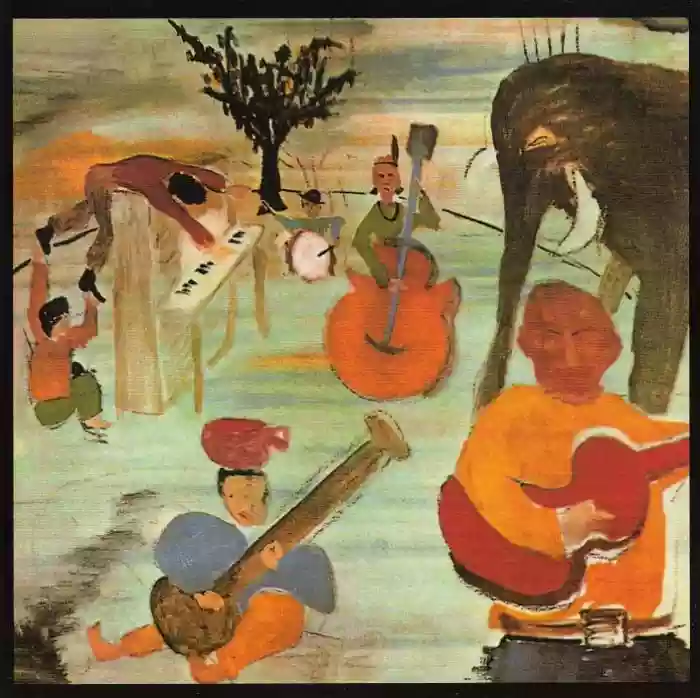
The voice of "Big Pink" is the voice of AN American, and the story told by "Big Pink" is an American story. Like so many others told. But it is told like no one else ever, has managed to. Only a band (THE Band...?) whose members had spent so much time together that they had become one thing could have managed it. More voices in a single voice, more thoughts in a single thought, one soul despite the diversity of moods and personalities. The Band was never the band of Robbie Robertson, Richard Manuel, or Levon Helm - like the Beatles could have been the band of Lennon & McCartney, like the Stones the band of Jagger & Richards... The Band was THE Band, without there being anything arrogant or pretentious in this. They could have called themselves The Robots, Paul London & The Capers, The Rockin' Revols, The Hawks (as they were all together called), but they were already The Band. They were already so when, having crossed the Canadian border to the South, they accompanied that rocker from Arkansas who answered to the name of Ronnie Hawkins, one who claimed to have picked cotton with Bo Diddley, or when they accompanied the Electric Knight on those wild unrepeatable tours between '65 and '66 - performances to be recorded and archived, simply. Memphis, New Orleans, the Mississippi, the murder ballads in their blood; Howlin' Wolf, Junior Parker, rockabilly played at school parties; in their minds the Myth of a primitive and "alive" America of the streets, of the province, of the empty and desolate frontier of the colonists, of the "homeless" without a place to sleep with a bag in hand and a heavy burden on their shoulders. Indeed, a burden. Spiritual or material...? Probably both. Behind a cover whose author is far too well-known to be named, there was not just a record. The "Pink House" is the last, desperate refuge of an America that in '68 no longer exists, or at least not in its purest form. Change - inexorable, inevitable - had swept it away. The utopian escape that counterculture carried with it, in fact, dealt it the coup de grâce: the delirious poeticism of Jim Morrison, the revolution of the Airplane in "Volunteers" and the subsequent utopian/science fiction escape of Kantner in "Blows Against The Empire", the acid trips, San Francisco, the west-coast dream (soon disillusioned) of CSN, and still the lennonian pacifism felt from the other shore of the ocean were, or would soon be, the reference points of youth culture: they were voices that rose strong, powerful, deafening in some cases. The Band spoke with biblical and ancestral language in a subdued voice, modest as the anachronistic clothing with which they entered the scene; to youth and renewal, they opposed the seed of generations, tradition (trampled upon), the America raped and then disowned by ungrateful children - it's 1968, in the meantime Nixon comes to power. Against the escape from oneself, the need to return to belong to oneself. To find a home, as the VOICE of "The Weight" asks and hopes. Not a journey without destination nor towards the infinite, but a return (hoped for). Beginning a record by shedding Dylan-like "tears of rage and pain" is something that says it all - it's Independence Day, but the air is not festive because there's nothing to celebrate, indeed, it's a funeral procession, as Garth Hudson's organ and sax enter the soul and take your breath away - and into the coffin, America itself is being led, in person, within a frozen and impalpable atmosphere, without love ("but tell me, what kind of love is this, that goes from bad to worse...?"); and the faithful children alone, forgotten and abandoned to their fate - "we're so alone and life is brief...", sings Richard Manuel as the music fades away. "Big Pink" is the road that leads to meet unsettling and blurred characters like the stories that tell them, skeletons in the closet of an America without triumphalism - from the outcast "Lonesome Suzie" to the woman of "Caledonia Mission" who lives hidden behind a wall, because the villagers have locked her gate, or to the one in "Chest Fever" who drinks poison "from a bitter cup" while the SPEAKING VOICE strives to make her stop, because it knows that the woman's salvation is also HIS salvation (satanic is the organ that opens to an Apocalypse that seems near"); and again, the murky story of "Long Black Veil" that will so obsess Nick Cave, the momentary joy of "We Can Talk" to the rhythm of Rick Danko's bouncy bass, the sinister movements of the wheel rolling in "This Wheel's On Fire", Dylan-like just like the closing of "I Shall Be Released" - here's the Light, finally! - and it is a closing that at each listening brings tears. "I see the light come shining From the West Unto The East Any day now any day now I shall be released"Loading comments slowly
Summary by Bot
This review honors The Band's 'Music From Big Pink' as a profoundly poetic and uniquely American album. It delves into the album’s deep storytelling, timeless sound, and the extraordinary unity of its members. The reviewer reflects on the spiritual and cultural weight carried by the music and its lasting impact on American rock. Overall, the album is portrayed as a masterpiece capturing a lost America.Tracklist Lyrics Videos
07 Long Black Veil (03:06)
09 Lonesome Suzie (04:04)
12 Yazoo Street Scandal (outtake) (04:02)
13 Tears of Rage (alternate take) (05:32)
14 Katie's Been Gone (outtake) (02:47)
15 If I Lose (outtake) (02:30)
16 Long Distance Operator (outtake) (03:58)
17 Lonesome Suzie (alternate take) (03:00)
18 Orange Juice Blues (Blues for Breakfast) (outtake - demo) (03:40)
19 Key to the Highway (outtake) (02:28)
20 Ferdinand the Imposter (outtake - demo) (04:00)
The Band
Canadian-American roots-rock group formed by Robbie Robertson, Levon Helm, Rick Danko, Garth Hudson, and Richard Manuel; emerged from backing Bob Dylan to release seminal albums like Music From Big Pink and The Band. Their 1976 farewell concert, The Last Waltz, was filmed by Martin Scorsese.09 Reviews
Other reviews
By donjunio
"Music from Big Pink" destined to quickly establish itself as a milestone of American music.
The sonic material shaped by the Canad-American ensemble delved deep... forging the definitive code of American roots rock.
By Missing
Robbie Robertson woke up one day with this idea in mind. He didn’t know what it was: a dream, an intuition, a naïve wit, something to end it or just an illusion.
He had never heard it but the shaman’s chant was perfectly familiar to him, as well as the songs of the Appalachians and gospel preachers, Cajun, a bit of chamber music.
