
 •
Rating:
•
Rating:
THE REVIEW
Late Sixties. A period of restless and passionate experimentation, amidst shimmering psychedelic drifts, dizzying flights into the future, and unspeakable astral visions. When it seemed that the spirit of that era could only be represented by the prophets of mutant times, a quintet seemingly composed of Mormons lost on the paths of the West Coast burst onto the scene.
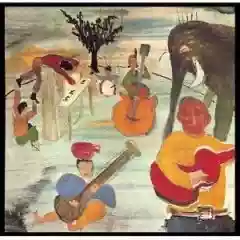
In 1968 Robbie Robertson, Garth Hudson, Rick Danko, Levon Helm, and Richard Manuel debuted on their own, after the glorious years spent backing Dylan in the most shocking surge in rock history, from the famous '65-'66 tour to the 33-rpm Holy Grail of "Blonde on Blonde". The result was a classic bolt from the blue, that "Music from Big Pink" destined to quickly establish itself as a milestone of American music. The eleven compositions presented here paved the way for the contemporaries Byrds of "Sweetheart of the Rodeo" and various Gram Parsons and Neil Young, asserting the trend of country-rock and adding a fundamental piece to the evolution of pop-rock.
But there was more. There are bands, though immense, that merely make music. Others design universes, opening the doors of perception to make them accessible in music to the masses. The sonic material shaped by the Canad-American ensemble delved deep, trimming the folk and blues roots of the forefathers, expressing a sumptuous and sophisticated blend capable of forging the definitive code of American roots rock. The group was actually a small orchestra of phenomenal multi-instrumentalists, and the sound of "Music from Big Pink" is so intricate, ramified, and lush that it seems like a fertile, grand Southern plant. Romantic and visionary music, supported by dazzling songwriting and tempered by the climates of the vast American expanses it soundtracks. Undoubtedly, this was the essence of The Band: evoking the myths of the truest and most hidden America during a period of esoteric and lysergic journeys, as well as tearing social conflicts. An apparent generational short circuit that instead produced an American mystique that fed on lost territories, frontier heroism, and microcosms with an epic and biblical flavor capable of revealing the poignant humanity hidden in the dusty trunks of the Empire. An entire generation was captivated by it, as evidenced by the most famous track of the bunch, the magnificent western dance "The Weight", which would appear in the cult film of those years, "Easy Rider", embracing its longing for life and the imagery of wide open spaces. The remaining tracks are no less remarkable, among which one cannot ignore "Chest Fever", with Hudson's incredible Hammond intro, "This Wheel's On Fire" with Robertson's magical and sharp guitar (essential in connecting with the other instruments, without excessive virtuosity) and the most versatile rhythm section remembered to lead the dance, the whispered sweetness of "Lonesome Suzie", the iridescent and elaborate harmonies of "To Kingdom Come" and "Caledonia Mission", the subdued country-soul enchantment of "In A Station", up to the absolute masterpiece "Tears of Rage", in which Manuel's voice (co-author of the track with Dylan) outlines Steinbeckian scenarios from the Great Depression, resting on a simply perfect sonic carpet, as always punctuated by the peculiar interplay between Hudson's Bach-like organ and Manuel's piano.
The magic of The Band wouldn't last long. Another breathtaking album (the eponymous one of 1969), then a progressive decline, spurred by the cold wind of the Seventies, until the famous goodbye immortalized by Scorsese's last waltz.
Richard Manuel would later be the most illustrious casualty, hanging from a rope in a remote hotel. However, the spirit of the quintet will forever linger in that imaginary line beyond which our dreams are projected and, by handling its multifaceted languages, still feels tangible and close to us.
Loading comments slowly
Summary by Bot
The review praises The Band's 1968 album 'Music from Big Pink' as a groundbreaking and influential work that helped define American roots rock. It highlights the group's rich instrumentation, visionary songwriting, and the album's impact on the music landscape, especially its role in shaping country rock. The memorable tracks such as 'The Weight' are noted for their deep cultural significance. Overall, the album is celebrated as a landmark classic with enduring legacy.Tracklist Lyrics Videos
07 Long Black Veil (03:06)
09 Lonesome Suzie (04:04)
12 Yazoo Street Scandal (outtake) (04:02)
13 Tears of Rage (alternate take) (05:32)
14 Katie's Been Gone (outtake) (02:47)
15 If I Lose (outtake) (02:30)
16 Long Distance Operator (outtake) (03:58)
17 Lonesome Suzie (alternate take) (03:00)
18 Orange Juice Blues (Blues for Breakfast) (outtake - demo) (03:40)
19 Key to the Highway (outtake) (02:28)
20 Ferdinand the Imposter (outtake - demo) (04:00)
The Band
Canadian-American roots-rock group formed by Robbie Robertson, Levon Helm, Rick Danko, Garth Hudson, and Richard Manuel; emerged from backing Bob Dylan to release seminal albums like Music From Big Pink and The Band. Their 1976 farewell concert, The Last Waltz, was filmed by Martin Scorsese.09 Reviews
Other reviews
By Missing
Robbie Robertson woke up one day with this idea in mind. He didn’t know what it was: a dream, an intuition, a naïve wit, something to end it or just an illusion.
He had never heard it but the shaman’s chant was perfectly familiar to him, as well as the songs of the Appalachians and gospel preachers, Cajun, a bit of chamber music.
By Lao Tze
"The Band was THE Band, without there being anything arrogant or pretentious in this."
"‘Music From Big Pink’ is the road that leads to meet unsettling and blurred characters like the stories that tell them, skeletons in the closet of an America without triumphalism."
