
 •
Versione 1
Rating:
•
Versione 1
Rating:
THE REVIEW
The musician’s suitcase is mostly empty, the poet’s one is broken too.
Terrence Orlando, wrapped in his coat, has a ticket for the New York Central Railroad in one pocket and in the other, clenched in his fist, a handful of good hopes, while the Lake Shore Limited cuts through the icy darkness of Illinois. "Beyond the black curtain of the night, there’s a dawn waiting for us," said someone I can't remember, but it doesn't matter. The dawn of the new day is called New York and it gets lost along the side streets of Greenwich Village in downtown. Known for its penchant for Off-Off-Broadway, the picturesque neighborhood ensures a stage and a microphone for anyone who desires it. Terry is there precisely for this. It's 1964, the sun shines brightly on New York and in the heart of its wandering devils.
"The New Folk Sound Of Terry Callier" was recorded that same year, but life sometimes enjoys playing blind man's bluff with fate, and the inconveniences that arise are easier to tell than to live: the producer goes on the run escaping to Mexico with the recorded tapes, and the album is released three years later, when the magical period of the folk revival is just a distant memory.
Another Lake Shore Limited later on, in the opposite direction, brings Terry back to Chicago on a night without stars and with no dawn on the horizon. It reeks of bitter mockery, an all-in lost without seeing the cards, the players around the table, or the chips, scattered in the wind on the way to Tijuana. But fate always leaves a door open, you just have to look for it. The door in question is that of a record store where good Terry sees, in the display, his vinyl proudly displayed. This episode rekindles his never-extinguished passion for music. In no time at all, he resumes composing, signs a contract with Chess, and shortly after, another with subsidiary Cadet. The fruit of this renewed compositional vein materializes in 1972, in the form of "Occasional Rain" and later (the same year) with the masterpiece "What Color Is Love".
"What Color Is Love" is a cry in the dark in a state of excruciating bliss, and Terry Callier is the baritone that pierces the silence, the perfect link between Motown Records and Blue Note, but light-years away from both because universal works reject labels, escape cataloging. It would suffice to list the plethora of excellent artists who participated in the album to determine its magnitude (Morris Jennings and Don Myrick above all, just to name a few), but the brilliant glow of "What Color Is Love" is much more than a prestigious list of collaborators.
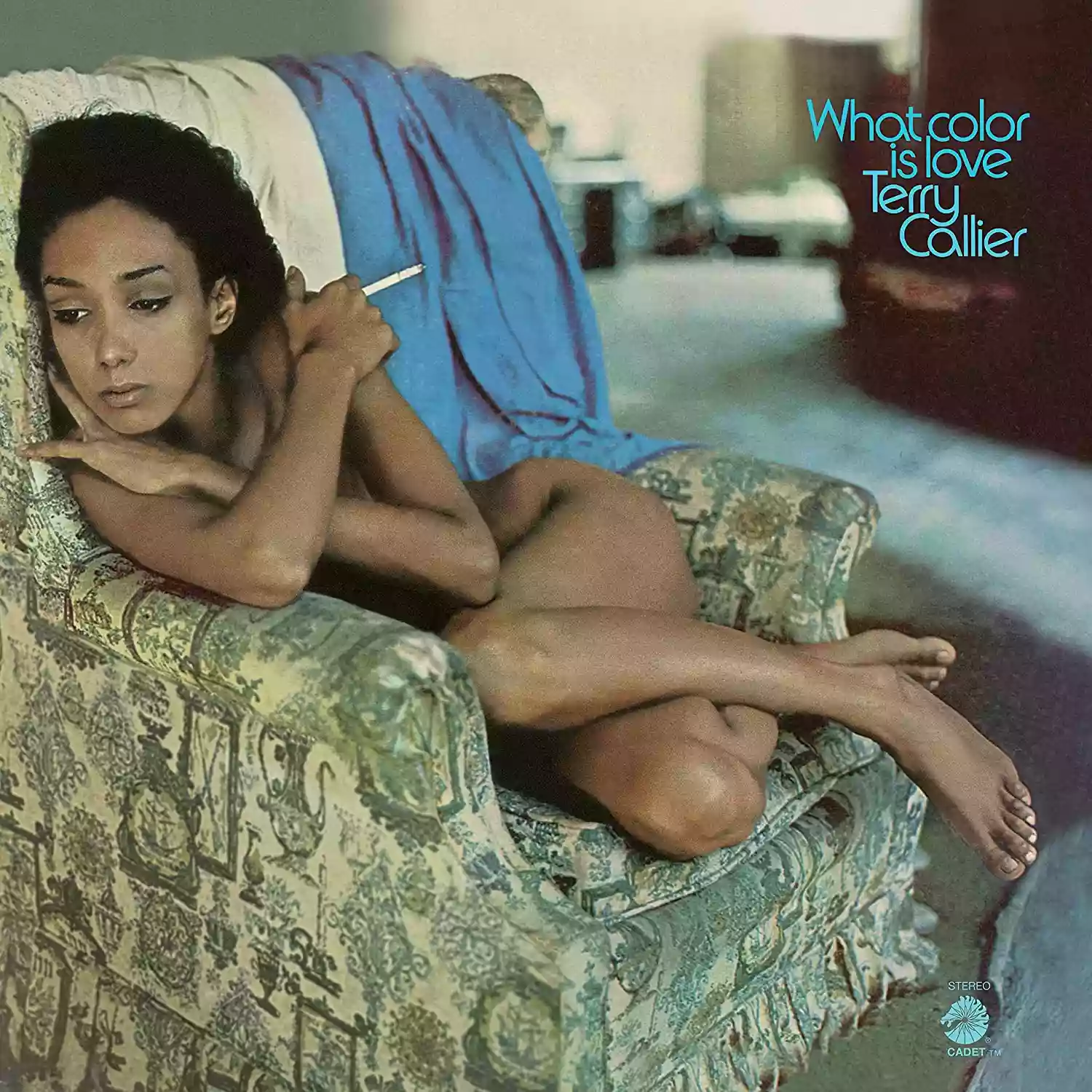
"What Color Is Love" is a goddess as seductive as sin, a sensual silhouette lazily lying on the sofa while the smoke of a cigarette brings back youthful reminiscences: a damp reed gushes passion from Coleman’s sax and, in the distance, puffs the beloved blue train of Coltrane, lost in a thick white cloud.
The sweet and scratchy vocal timbre evokes the specter of solitude, inseparable friend of life.
"Each of us is born alone, welcome to the twilight zone" ("Dancing Girl").
Myrick's alto sax bell adorns Terry's singing, painting cobalt blue tongues in the air, and in the mist, the outlines of Drake and Hayes strolling through the countryside of Tanworth come to life.
"Is it wrong or is it right? Is it black or is it white? What color is love?" ("What Color Is Love").
Love has no colors, only shades, and Callier knows the entire range. "It's as strong as a mountain, " he says, with a sweet and warm voice that would sink an iceberg, supported by Charles Stepney's extraordinary orchestration.
"If I can find myself a good lovin woman, I might not ever come back at all" ("You Goin' Miss Your Candyman").
Existence is founded on choices, but choices made in a moment could weigh on you for a lifetime. Callier knows these truths well and reveals them through clenched teeth in the obsessive guitar arpeggio, while Satterfield's throbbing bass draws around it the ideal passkey. Callier sings of life, fears, and hopes with ancestral spirituality.
"As long as we're in love we'll be fine together, somehow we'll face the challenge of the universe hand in hand" ("Just As Long As We're In Love").
Because there is always a sun, a glimmer of light that eventually shows itself in the pitch-black darkness. It's only a matter of time. That inevitable time that meanwhile consumes the cigarette mercilessly. In the last puffs of smoke, there is room for a symphony crescendo on the theme of war.
"Through a long and sleepless night, can you still say that everything's okay to a mother who's lost her only son?" ("Ho Tsing Mee-A Song Of The Sun")
Love and pain merge in the firm embrace of melancholy. Sincere and passionate Mr. Callier enunciates "I'd Rather Be With You," and the bows of the violins, like sewing needles, chisel a high-fashion cloak. An ocean of passion confined within the boundaries of a title.
"It's your shining sun that has lifted all the shadows from my mind. Yes, your sweet love brought me a brighter day."
"You Don't Care" unfolds for over five minutes in a final embrace, a straightforward and sincere manifesto of the love poured out by Callier's musical airs, with few words, the only title, repeated several times by the angelic voices of the choir. The end credits roll quickly while the guitar and piano chase each other, blending with the choir's last whispers that slowly fade into the grooves of the vinyl, leaving us with a strong sense of loss. Is it enough to replace the needle in the initial groove to renew the magic? Maybe. Or perhaps not. There are things you can always have but never truly possess. "What Color Is Love" is composed of the same substance as emotions. Of everything. Of nothing.
Callier is fully included in the large group of artists to whom life has granted few smiles, always a step behind fortune and one ahead in the unexpected turns of human existence, chasing a success he deserved but only partially achieved.
As is well known, the most beautiful stories are not read in great victories but in sad defeats. Callier remained in a limbo, halfway between the two, between hope and resignation, between Chicago and New York, lost among the most beautiful shades of color the human eye can ever know.
Loading comments slowly
Summary by Bot
Terry Callier's 'What Color Is Love' is a richly orchestrated soul and jazz fusion album that explores love, pain, and hope with deep emotional resonance. Despite career setbacks, Callier’s artistry shines with passionate vocals and sophisticated arrangements. The album is praised as a timeless masterpiece bridging genres and conveying profound spirituality. Its heartfelt tracks combine intimate storytelling with lush instrumentation, making it a standout classic.Tracklist Videos
Terry Callier
Terry Callier (1945–2012) was an American singer‑songwriter and guitarist from Chicago who fused folk, soul and jazz. After early sessions in the mid‑1960s, he issued landmark Cadet albums in 1972 including Occasional Rain and What Color Is Love with producer/arranger Charles Stepney. He stepped away in the 1980s to work as a computer programmer, then returned in the late 1990s, collaborating with 4Hero, Beth Orton, Massive Attack and Paul Weller.04 Reviews
Other reviews
By DottorJazz
A good record always starts with a beautiful cover.
The acoustic guitar arpeggio of 'Dancing Girl' pervades a dreamlike atmosphere enriched with jazz nuances.
