
 •
Rating:
•
Rating:
THE REVIEW
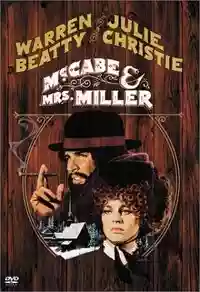
Released in 1971, just a few years after two milestones of the genre (The Wild Bunch and Once Upon a Time in the West), McCabe & Mrs. Miller by Robert Altman is the opposite of the west concept that Leone and Peckinpah were inspired by. Anti-heroic and snowy (nothing to do with The Great Silence, mind you), I Compari, as it was inexplicably translated into Italian, is an anomalous western: awkward shootouts and swaggering; honor and friendship go down the drain; senselessly evil gunmen (nothing to do with the ferocity of spaghetti westerns, spectacular and caricatural); all filtered through the sensitivity of a director always attentive to a representation that is naturalistic, spontaneous, and not just a staging.
Warren Beatty is the nameless stranger of the moment who arrives in a budding mining village to build a saloon and a brothel. He is believed to be a first-rate gunman and is welcomed by the community enthusiastic about his stories and projects. He partners with the mistress Julie Christie/Mrs. Miller, who also came up from the valley to that remote village in the mountains, and who will manage the casino for him, while McCabe/Warren Beatty dedicates himself to the saloon. As the story unfolds, we discover that McCabe is actually "not born a lion's heart" while Mrs. Miller increasingly becomes his point of reference, both from a business and emotional perspective: she is self-confident, positive, shrewd, and experienced. The turning point occurs when it is discovered that the lands on which McCabe has built his small economic empire hide a rich mine, and the owners down in the valley become interested in that small village. John McCabe is offered a considerable sum to sell those lands, but he, hoping to negotiate a higher price, repeatedly refuses despite Mrs. Miller advising him to accept immediately because she knows what "those people" are capable of. When he realizes he has pushed too far, he discovers it is too late: three gunmen have arrived in town, hired by those who want his properties at all costs. The final duel (silent and stealthy) is a masterpiece of cowardice, on both sides.
Beautifully shot by the talented Vilmos Zsigmond ("The Black Dahlia" and "Deliverance"), 'I Compari' is perhaps the hidden masterpiece of Altman's filmography. Julie Christie, one of the most beautiful cinematic appearances ever, was simply exploited in Doctor Zhivago; here she is a joy to look at. Warren Beatty is a perfect bluffer. But the extra touch is the songs by Leonard Cohen chosen by Altman (who loved Lenny) as the only musical commentary: "Winter Lady", "The Stranger Song", and "Sisters Of Mercy". Keith Carradine makes a brief-tragic-cameo, playing the only character still clinging to the myth of the west. The film can also be read as a negative parable of the American dream, but that would be idle chatter.
Do not make other plans if it is screened.
Loading comments slowly
Summary by Bot
McCabe & Mrs. Miller, directed by Robert Altman and released in 1971, presents an anti-heroic and naturalistic take on the western genre. With striking cinematography by Vilmos Zsigmond and a haunting Leonard Cohen soundtrack, the film subverts typical western tropes. Warren Beatty and Julie Christie deliver nuanced performances that anchor the story, which critiques the American Dream. The review praises the film as an underrated Altman masterpiece.
Robert Altman
Robert Altman (1925–2006) was an American director celebrated for ensemble storytelling, overlapping dialogue, and sardonic, humanist portraits of U.S. life. Key films include M*A*S*H, McCabe & Mrs. Miller, Nashville, The Long Goodbye, The Player, and Short Cuts. He won major festival awards at Cannes (Palme d’Or 1970), Berlin (Golden Bear 1976), Venice (Golden Lion 1993) and received an Honorary Academy Award in 2006.10 Reviews
