
 •
Rating:
•
Rating:
THE REVIEW
Thirty-five years of career for a band is a lot, sometimes perhaps too much. It's a utopia to think everything has always gone smoothly. Queensryche are not the exception that proves the rule.
They started from the ground up, producing albums that remained ectoplasms to most people's eyes, but they also found themselves in the right place when melodic heavy metal was in fashion and, despite themselves, were sometimes associated with groups that had few strands of DNA in common with them. They gained fame and musical skills at the sunset of the eighties, standing out with their "artistic" and elegant metal, equipped with ever more pronounced influences that surpassed the boundaries of prog and were soaked with atmospheres akin to Pink Floyd as well as Queen.
They were certainly helped by mother nature and therefore by their musical technique, as well as by the skills of singer Geoff Tate, able to sustain falsettos with the sky as his target and modulate his crystal-clear voice, at times seeming like a woman, or rather a goddess at the microphone. Nevertheless, they were loved or hated by many, as is often the case with difficult-to-own bands, and they experienced a slow decline in popularity starting from the grunge era to the present day. The members also ended up separating at various moments, leading to the very traditional dispute over who should carry on the band's name, with as much as two different records being released simultaneously.
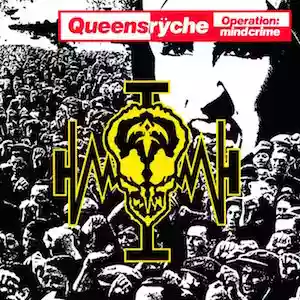
What matters now, however, is to talk about one of their most cherished offspring. That "Operation: Mindcrime" which represents one of their pinnacles. A concept album that set the standard and spawned a less inspired sequel once it reached maturity (eighteen years between the first and the second album).
The story behind the music doesn't matter much to me, but this is a personal limitation of a strange type who prefers to read books or stories told through images. I can say for the sake of accuracy, however, that there are conspiracies, secret cults, assaults against the government, and a wayward protagonist who ends up being involved in these mysterious plans of social rebellion. There's even a love story with Sister Mary, the female archetype of the femme fatale, a central figure in "Suite Sister Mary": eleven minutes placed at the heart of the narrative featuring a cello orchestra conducted by the late "Archduke of Darkness," the renowned composer Michael Kamen.
It is ultimately one of the many gems present throughout a listening experience filled with even better tracks, racing each other for perfection, with only one moment of lesser inspiration ("Speak"). Certainly, "Spreading The Disease" stands out, where martial rhythms, sharp guitars, and hoarseness-proof vocals lead you to a spoken break attacking American political corruption in 1988, where it is easy to recognize the same infamies of too many current governments, globalized under the aegis of the god of money. If you then want to be completely seduced, "The Mission" makes you realize that things are getting serious, with a continuous vocal and musical tension creating a suspended effect, even breath-taking for the more impressionable.
Further on, towards the end, almost as if there was no need for it, the two powerful ballads "Eyes Of A Stranger" and "I Don't Believe In Love" are unleashed, pioneering singles for a well-deserved worldwide success, and the game is complete. The checkmate has happened, and I am left wondering when I lost my bearings and got captured.
Loading comments slowly
Summary by Bot
The review celebrates Queensrÿche's 35-year career and highlights Operation: Mindcrime as a pinnacle of melodic heavy metal and concept albums. It praises the band's musical evolution, Geoff Tate's unique vocals, and standout tracks like "Spreading The Disease" and "Suite Sister Mary." The album's political and social themes enrich its lasting appeal. The reviewer acknowledges the band’s struggles but focuses on the album's artistic achievement and impact.Tracklist Lyrics Videos
Queensrÿche
Queensrÿche are an American heavy metal band from the Seattle/Bellevue area, widely associated with progressive-leaning metal and known for ambitious, concept-driven releases—especially the 1988 concept album Operation: Mindcrime.25 Reviews
Other reviews
By petro
A masterpiece! Actually, A MAS-TER-PIECE! This is THE album of the '80s (and beyond...).
An album that literally set the standard, taking “heavy” rock beyond the usual mental frameworks.
By splinter
"Operation: Mindcrime indeed seems to take metal towards a rather unusual theatricality for the genre."
"What remains from the listening experience is the impression of really having listened to a milestone!"
By Rocky Marciano
This concept album is a diamond that shines with its own light.
Tate’s divine voice branding each track, one of the best voices in the history of metal.
