
 •
Versione 1
Rating:
•
Versione 1
Rating:
THE REVIEW
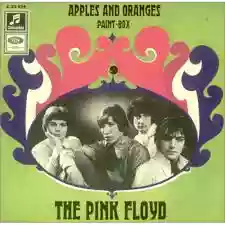
There is a forgotten little gem, and it's a little song about apples and oranges. Those who want to act cool never mention it; it doesn't appear in anthologies, and Floydian sacred texts barely certify its existence. Yet they can't avoid doing so. After all, it is the single following "See Emily Play"...
And "See Emily Play" had been the most perfect example of Albion pop transcendence, something not even strawberry fields and Penny Lane could match.
I know, pop transcendence is a questionable expression. But it summarizes two things well.
One: the ability to bring a sort of bizarre dream into music, without intellectualism, infusing the songs with a light gas capable of making dissonances and oddities fly.
And two: a dowsing-like harmony with the spirit of the times.
And it's the second point that's missing in our apples and oranges.
Sure, Emily and Apple both talk about the appearance of a young girl. Only, the first is a creature of the woods, the other roams the market. You see the difference?
But when I hear that initial tongue-twister, something like "Flip, flop, top, pock, pocket," I no longer think of Emily crying.
Not to mention that psychedelic fair-like gait, the "horticultural mantra" of the off-key choruses, the "she loves me, see you" from a silly love song, the dudududu dududududap finale.
And that guitar then...
Even Rob Chapman, the supreme Barrettologist, agrees with me, and in his splendid book, "A Very Irregular Head," he recounts how in a heated debate with his schoolmates, he was the only one to consider "Apples and Oranges" equal to "See Emily Play." It was a morning of sixty-eight, and the Floyd had performed the night before on British TV.
Then there would also be Fred Frith, who called the use of the wah-wah pedal in this song his all-time favorite. (there, I even slipped in a technical detail).
But apart from the three of us, I don't know of any other admirers.
"Apples and Oranges" is an unlucky song: it follows the myth and precedes the ghosts, categories so absolute that they inevitably make it disappear, crushing it. And the ghosts are not only Barrett's albums but also a fabulous lost single.
Lost because it's too strange. Who knows what the A-side would have been, the vegetal man or that last scream to scream? The caricatured and psychotic garage rock or the vignette a la Captain Beefheart?
Of "Vegetable Man," being pure legend, I think it's almost useless to talk about. I'll just point out when it says "I'm looking for somewhere for me, but it doesn't exist, absolutely doesn't exist."
Of "Scream Thy Last Scream," it makes more sense to say something. Also because it's spoken of very little. However, it's difficult to navigate that chaos of fairy tale figures and nightmare scenarios. To do so, I need an image that functions as an access key and lights up the rooms like a flashlight when the power goes out.
And thanks to Spike Hawkins, the spacey inventor of the intergalactic beetle and a friend of Syd, I have this image, and it's a coat.
Listen: "I saw this coat hanging somewhere and thought: it's such a sinister thing, you can't see the arms!.. so we arranged to move the coat and film it."
And so there exists a little black-and-white film where you see a coat wandering in narrow, dark streets, somewhere between Tottenham Court and New Oxford Street. The soundtrack, of course, is "Scream Thy Last Scream."
That coat seems to me incongruous enough, dark enough to clearly convey the effect this song produces with its mad and frantic horror voices, Mason's muttered and very funny lead voice, Syd's angelic/dull counterpoint, the slyly infernal waltz pace followed by the usual minute of fabulous Floyd sound, then those voices again, again the little waltz... and finally the last dregs, the last debris from the flood... with the water extinguishing its fury, leaving room for the sound of the air... you reach the end a bit shaken.
Then, beyond the ghosts, there is an additional trump card: Jugband Blues with its oscillation between existential tone, acidic sound, and the sardonic clownery of a dull fanfare sound.
"Jugband" then has that almost otherworldly finale, that reach for silence amid shivers.
We are talking about fabulous songs; over the years, almost everyone admits it, even David Gilmour.
But amid all this anguish and paranoia, what is a colorful little song doing? Doesn't it feel out of place like a fifth wheel? A little bit, yes...
The incongruity of "Apples and Oranges" is that it is an out-of-time pop call, by now the musical paths taken by Syd were already winding and dark and no longer envisioned the playful and kaleidoscopic refraction in which Emily was Alice, Ophelia, or the maiden of May games.
However, it remains a great song, very fragrant and twisted, full of things: mad tongue-twisters, the voice of the better youth, underground plots of hyper-acid guitar, chirpy pianola interludes, soft and messed-up Floyd fussing, sometimes pop, sometimes slightly horror choruses.
Yes, a lot of stuff, but it all stands up magically as usual (it's transcendent pop, folks!!!), despite singing a millimeter from chaos and the guitar on the brink of feedback.
It's a fluttering (it's transcendent pop, folks!!!) but like mined... and when the feedback finally arrives, after that famously silly dudududapdapdadadu, and the song ends, you think... you think...
you think that kind of girl from Ipanema for the stoned who roams the market (hence the apples and oranges of the title), well, you think, you can't help but think, that she's a kind of dream in danger... an image destined to fade.
Throughout the song, she is described in haste, almost breathlessly, and when Syd launches into a "I love her, she loves me, let's meet," that "apples and oranges" "apples and oranges" "apples and oranges" of the chorus is sung by rather sinister voices...
or maybe they seem sinister only to me, since Syd said that "Apples and Oranges" was a Christmas song...
and in the end, she, the girl, is alone... and throws breadcrumbs to the ducks on the riverbank... and the song ends with a blow of an axe...
It remains to speak of "Paintbox," the B-side, but we can also say nothing about it.
There's a video on YouTube where Floyd (in '68 or '69) sing "Apples and Oranges" on French TV. Syd, of course, is not there, and it's quite sad.
Loading comments slowly
Summary by Bot
This review celebrates Pink Floyd's underrated single 'Apples and Oranges' as a unique psychedelic pop song that exists out of time. Despite its obscurity and lack of recognition in Floydian lore, the track features inventive, haunting sounds and tongue-twisting lyrics that hold artistic merit. The reviewer draws connections to Syd Barrett's surrounding mythos, contrasting the song's light surrealism with darker contemporaneous works. Ultimately, it highlights the song’s tragic charm and musical complexity.Tracklist Lyrics
Pink Floyd
Pink Floyd formed in London in 1965 and became a defining force in psychedelic and progressive rock. The classic lineage spans Syd Barrett’s founding vision, Roger Waters’ conceptual leadership, Richard Wright’s harmonic textures, Nick Mason’s pulse, and David Gilmour’s arrival in 1968, shaping their signature sound.237 Reviews
