
 •
Rating:
•
Rating:
THE REVIEW
"He died young because he was dear to the Gods"
The name Nicholas Rodney Drake is unknown to most modern music listeners, and even at the time when he was musically flourishing, it lay in the oblivion of some dusty shelf in Great Britain, far outshadowed by far more famous figures like Cat Stevens. The reasons for the few sales of Nick's records while he was still alive have been carefully analyzed by a wide range of scholars who have also written biographies and manuals about this silent figure, who lived between 1948 and 1974. To begin with, Nick Drake had only brief live performances, which, according to "witnesses," were at the same time sublime and embarrassing. Drake, on stage, was the exact opposite of the "bouncing" Chuck Berry: he indeed was careful not to weave any verbal rapport with his audience, limiting himself to a timid performance, not quite suitable for the folk clubs where he played for some time as a support act for Fairport Convention. A Nick Drake concert can be imagined like that of a novice boy in the musical environment, who, extremely embarrassed and agoraphobic, sits on a black stool and arms his Guild guitar, which, customized with the most unthinkable tunings (derived from infinitely long solitary practices), emits paradisiacal and nostalgic sounds.
The shy and aristocratic voice is, along with the incredible guitar style, an element that outlines the basic characteristic of Nick Drake's songs: intimacy. Listening to any of his musical pieces (perhaps excluding some pompous arrangement from "Five Leaves Left", of which even Nick was unsure shortly before the album's release), it almost seems like the artist is in your very room, a few steps away from you, a living and intangible presence at the same time.
I discovered this musician last year through the album "Five Leaves Left", which at the time seemed beautiful and musically pure as a diamond to me. I did not know the acoustic Nick Drake, I knew nothing of his private history, nor that the melodies of "Five Leaves Left" were not entirely genuine. By researching Nick, I first read all his collected lyrics translated into Italian (Nick Drake, All the Lyrics with Translation, Giunti) and then moved on to the official biography (Nick Drake, The Biography, Patrick Humphries).
These two books truly captured me, and revealed much about the life of this boy, whose presence is so evanescent yet simultaneously immortal.
Nick Drake is the almost extinguished ember burning in the coal of a fireplace, but that will never fully go out.
The biography, in particular, was a novel-like experience, where I smiled while reading his joys and cried reading about the pains and ghosts that descended upon him in the last dark days of his life.
After "Five Leaves Lefft", for Nick Drake, comes "Bryter Later", an interesting album that still does not fully reveal his true style, which would later emerge in "Pink Moon", his last acoustic work and last real work.
When it comes to the concept of musical intimacy, even before the enchanting songs of James Taylor, what comes to my mind is the last album that this unfortunate boy produced.
There is a reason why I feel Nick Drake so alive, and it lies precisely in Pink Moon: listening to this album, the intimacy and depth of the song rise to very high levels, and in each track that I enjoy (with eyes closed and lying on the bed is ideal), it seems like I hear my cell phone ringing and see on the display the name of an old friend I haven't seen for years, of whom I had almost forgotten... and so intrigued I answer, and in his tired and dragging voice, in the messages he sends me with his mysterious words, I can tell that something is wrong, and I feel bad for him.
I feel bad for him, yes, because "Pink Moon" is just like a sad phone call that goes deep inside you and injects you with a form of profound melancholy.
This is Drake's alchemy: to be able to transmit his songs into you, elevating you from mere listener to participant and accomplice of his deepest and never explicitly revealed emotions.
The song, the guitar style, the voice, and the feeling are like cancerous diseases that take root inside of you until you experience each song as if you were there watching Nick play it, almost as if the headphones of your Mp3 player were somehow connected to his microphone and his guitar, and he looked at you with his vacant gaze while playing "Things behind the Sun".
Do you know how "Pink Moon" was recorded? The answer is simple: a boy who enters a recording studio for two nights, and on these two sleepless nights commits the final act, turning the stool towards the wall and giving his back to the recording staff. An unrecognizable boy, with long nails, shabby clothes, lost eyes, and a brain torn away by heavy doses of Trypizol (medicine that would kill him shortly thereafter). A boy who can no longer sing and play at the same time, just like a novice musician without a sense of rhythm.
Nick's final work, as per his explicit wish, consists only of an acoustic guitar and his voice.
Now I analyze, song by song, Nick Drake's final album: "Pink Moon".
Pink Moon (Island Records 1972)
1) Pink Moon.
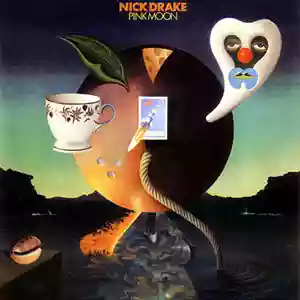
The song that gives the title, not by chance, to the album, from whose deeply allegorical cover the sense of mystery that permeates the entire album already emerges. Pink Moon is a prophetic song, probably inspired by the ancient Asian omen of the Pink Moon, which would bring misfortune to anyone who sees it in the sky. The insubstantial sprinkle of piano (the only appearance of another instrument on the album) reminds us of life, insignificantly short and of an imperceptible touch. What was Nick Drake trying to say with that piece? Did he foresee his death, as, according to legend, Eddie Cochran did?
I believe the most fitting thing was said by Nick's mother, Molly Drake. A simple phrase that needs no further explanation: "Darkness descended upon him".
2) Place To Be.
A raw and realistic song whose message is given bluntly: Drake himself tells us that his happiness has now withered, and he finds himself in a sad world where truth must be faced. Nick becomes as dark as the deep ocean and also blue, like a faint need for help and affection. The guitar part is not one of his best, but, aided by the touchingly real lyrics, it outlines an exceptionally important song within the album.
3) Road
My favorite song on the album. The lyrics are repetitive and redundant (each verse starts either with "I can" or "You can"). However, this repetitiveness is not at all intrusive and gives an atmosphere of
"almost Indian chant", elegantly polished, also thanks to an impeccable deeply rhythmical guitar part.
4) Which Will
An interesting guitar part covers a series of questions in the lyrics, addressed to a mysterious person whom he is asking to choose a love above all else. Drake's vocal accent, usually typically English and meticulously pronounced, acquires a mysterious echo, and the words are pronounced in a melancholically sweet manner.
5) Horn
A minute and twenty-three seconds of heartrending instrumental. In this short, elusive, and incomprehensibly irrelevant melody instead lies all of Nick's feeling, who in the twilight of his life managed to communicate better with the guitar than with words. The strings of the instrument are the vocal cords of the artist, emitting "silent screams" in a piece so poor and bare, yet full of strong meanings. "Horn" is the piece where Nick's sadness is felt the most, although he does not sing but communicates with a guitar, which he turned into magic.
6) Things Behind The Sun
One of Drake's most successful pieces: a symphony of dreamlike images and sounds, an intriguingly successful chord progression. Very beautiful lyrics, especially a part I quote here, translated:
"You'll find recognition as people frown
For the things you say
But say what you must say
About farmers and joy
And the things behind the sun
And the people around your head
Saying: everything's already been said
And the motion in your brain
Sends you out, under the rain".
Maybe it's a personal interpretation, but this "people" are the music critics who received Drake as an artist without any infamy nor praise, and who drove him into a depression that had a heavy toll on him: the gradual physical and intellectual decline until his death at 26.
7) Know
Another strange piece that, outside the context of an album like "Pink Moon", might almost seem unpleasant, but upon delving deeper, one can see in the beautiful lyrics the contradictions of humankind and love:
"Know that I love you
Know that I don't care
Know that I feel you
Know I'm not there".
A simple text, accompanied by a pounding and effective (for the particular context) guitar part and Drake's subdued hums.
8) Parasite.
Although the piece is very beautiful, both instrumentally and lyrically, it is the one I digest with the most difficulty. The reason is simple: the instrumental part is genuinely "Drakian", but the lyrics are an "orgy of images", which refer much (perhaps too much) to Bob Dylan, not coincidentally Nick's youth idol. Maybe Drake wanted to emulate Dylan in a song, hopeful of achieving his same success in an alternative field, but frankly, such an experiment bothers me, because it's not a genuine work.
9) Free Ride
A hammering and effective instrumental part, lyrics that honestly don't drive me crazy, but divinely sung. Another gem of the album precisely for the sublime "vocals".
10) Harvest Breed
An extremely strange effect is what this song gives me. Nick Drake's tunings are known to be strange, but in this piece, they exceed the imaginable. The guitar, at the limit of being out of tune, gives a sense of a gloomily and never-before-heard "acoustic distortion". The only drawback is that the piece lasts really short (like most of the tracks of Pink Moon)
11)
A glimmer of light catches the listener at the end of the album. A glimpse of hopeful tones opens a breach in the foliage of the dark forest of "Pink Moon", erasing the shadows that invade the rest of the album. "From the Morning", besides being a beautiful song (both in lyrics and instrumental part), gives a sense of final rest, of dawn after a storm. Unfortunately, Nick Drake will not find absolute tranquility in a final rest on earth, but in death.
A few months after the release of "Pink Moon", Nick Drake's mother will wake up at three in the night, hearing footsteps descending the stairs. It was Nick's last moments, going down to make himself a bowl of cereal. Once eaten, he will go back upstairs, lie down on the bed, and be found dead the next morning.
Overdose of Trypizol.
The most credited hypothesis is that of suicide, not that of a dosage mistake. I think Nick acted instinctively, unable to fall asleep: "Enough, damn it, I can't sleep, now I'll take some more pills and who cares if I don't wake up".
Drake's death keeps him in a limbo of eternal youth, just like Peter Pan, whose beauty is never destined to end. The contribution this artist could have still given would have been enormous, and it causes impression and disbelief to think that Nick Drake is dead, even if in a sense, he never truly existed.
I thank those who had the patience to read me this far.
Francesco Piccinini
Loading comments slowly
Summary by Bot
This review explores the deep intimacy and melancholy of Nick Drake's final album Pink Moon. It reflects on Drake's unique guitar style, shy stage presence, and haunting vocals. The reviewer dissects each track thoughtfully, highlighting the album's emotional power and subtle production. The tragic context of Drake's life and early death underscores the timeless impact of this acoustic masterpiece.
Nick Drake
Nicholas Rodney "Nick" Drake (19 June 1948 – 25 November 1974) was an English singer-songwriter noted for three studio albums: Five Leaves Left (1969), Bryter Layter (1971) and Pink Moon (1972).36 Reviews
Other reviews
By zaireeka
Listening is not enough.
I listen to Pink Moon and embark on a journey at the end of my little night.
By joe strummer
Nick’s voice penetrated my heart to touch the deepest strings of my soul, it motivated me immensely.
This album has made my life less trivial, less flat and gray.
By maxgit
"'Pink Moon' is the story of a defeat but also represents a victory."
The image is one of free fall, into the void, without a parachute. But there’s no pain, no suffering, you simply let yourself be carried away.
By Louis
I recognize that fantastically acoustic guitar, that familiar and unknown voice, beautiful and dangerous, perhaps the right thing at the wrong time?
Tears are the blood of the soul.
By Hell
That night, that damned night, I wanted everything to end. To never look anyone in the face again, neither pain, nor myself.
The face was pink and round like a moon, a scarred, frightened, and distraught moon, the mouth a river of bright red, the eyes two gray puddles forgotten by God.
