
 •
Rating:
•
Rating:
THE REVIEW
“The black-eyed dog”... Nick's voice, strained and almost extinguished, had never sounded so sinister.
Now it's no longer morning singing the night, and this is truly a blues desperate and full of fatigue. Despite some twists à la “Pink moon” here there’s something like a mute or a gag, a remnant of wind carrying just a fragment of sound.
It's more than sufficient, however, and in fact, it is once again what it takes to convey the idea: we don't care about knowing exactly who that black dog knocking on his door and shouting his name is—whether it's depression or a reference to Robert Johnson or whatever. That voice is enough. And the touching attempt to still be a great guitarist.
And finally, almost in spite of himself, Nick allows himself to step out of grace and restraint, from that kind of clouded intensity he used to reach with a slow layering of small lights.
There is too much truth, too much soul here. There is no poetry, just the essential. "I’m getting old and I want to go home, I’m getting old and I don’t want to know... "
Crazy Giovanna once told me, “I’m never hungry and I’m dying of hunger.” “Black eyed dog” for me is something like that.
But where did that young Keats go, the one who sang "deep down on the depths" and really went deep, no matter if with regurgitated romanticisms about improbable sand princesses? It was about a sand princess that “Strange meeting II” spoke of, right?
And that student who traveled from his room to the mythical realm of folk and already knew that the secret of every blues tune is the first guitar riff and how the voice enters? That “Been smoking too long” is a blues tune, right?
Ah, the dreams of “Strange meeting II” are borrowed, wrapped in some kind of bedroom/beach mist/dust, but you can already hear a little hop of a bird and a wandering beyond space and time.
Dreams borrowed from a million good readings. Or maybe just a few little books of beloved poets.
And borrowed is also the rhetoric of the hero in “Been smoking too long,” that is, that sort of epic dimension of the bard of all misfortunes.
”What have I done wrong?” Nick asks himself. Perhaps someone threw a bit of graveyard soil mixed with dried snake skin dust at him? Or maybe he smoked too many joints? The correct answer is the second, but a blues is only good if it seems like the first. But here, it seems like both; it’s a blues tune, I’ve said it. And it's a cover, the author is in fact his friend Robyn Frederick.
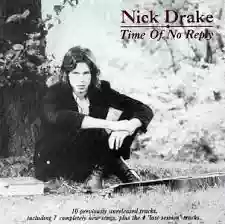
But this is “Time of no reply,” the desperate blues and the blues tune and everything in between: outtakes from “Five leaves left,” scraps from notebooks, alternate versions of tracks from the first two albums, and the handful of post “Pink moon” songs (all except one, “Tow the line,” which will end up in “made to love to magic”). It contains almost only songs for voice and guitar and is a masterpiece equal to the albums published in life.
The outtakes from “Five leaves left” are pure grace, they come from afar but it feels like you can touch them, almost as if they were just two steps away and not lost in their elegant distance. Wrapped in a breath of mysterious folk/blues aristocracy, they still manage to touch deeply.
It seems, yes, to have precise coordinates (that sound, that voice) but again we are out of time and space. It seems, yes, an absolute harmonization of silence, but it’s just a whisper, even if carved in a kind of suspended solemnity.
Let's take “Clothes of sand.” I've always thought of this track as one of perfect measure, where the form reaches the limit of perfection: the voice is almost too distant, the words almost too poetic, the arpeggio almost too mannered, but just almost. The beauty is brought to the brink of being cloying, but it always manages to stay just this side of it. And in this tension between the measure and the powerful feelings lies the secret. That here measure is magic and magic is when there’s a limit and immediately afterward there is no more. Try to keep youthful naivety and soul blues suspended, try to make some stale archetype flutter.
“Joey” is equally beautiful and just a bit more grounded. And it really makes you wonder how it's possible that songs like these were left out of “Five leaves left.”
“Mayfair” is just a little ditty. And it’s also the coolest neighborhood in London, the one, among other things, of rock aristocracy (Beatles, Stones, and so on). There “dark looks are hidden by a mystical power.” and there are only “pretty and icy faces”... “Will we ever see the sun in Mayfair, will we ever see the moon, the rain?” Because Nick can’t resist himself, since the sun or the rain are always there, pretty much in every song, for us to still see them, along with the dark looks, beyond any mystical power of whatever.
Yes, “Mayfair” is just a little ditty. The vampire often whistles it, and it sounds like five drunk birds outside the tavern. And in the “Made to love to magic” version, Nick whistles too.
But perhaps the heart of the album is in the handful of songs recorded shortly before his death, where certainly there's not the warm, full sound of echoes and magic of “Pink moon.” But what is there is really hard to define.
The lyrics are even more sparse, the voice has almost entirely lost that so English, so classic tone, and if I previously spoke of folk blues aristocracy, here let's remove the aristocracy altogether.
Only the folk blues remains. And what a folk blues. Only the shadows on the wall remain, not the candle that projected them.
Do you ever take walks? I mean those fluttering ones, in the kaleidoscope made of images of nothing, like a piece of sky or a little leaf. and where everything is a voice calling you, because that’s what “Voice of the mountain” talks about, a voice calling you and saying you can be free, but you would have to merge with that voice, and you can’t. Here Nick is wonderful and resorts to his elementary and primitive symbols, because that voice is the voice of the sea and of a country path, of a hill and a tree. But then it happens that you know the game, you know the price, you know your name, you know all the social crap, but damn, that voice is more and it’s calling you... and it is precisely this calling that Nick returns to us with a melody of almost otherworldly grace, crystalline like few others.
There’s a truly moving moment in the song, and it’s when “voice” becomes “tune”: “tune from the hillside and tune full of light, a flute in the morning, chime in the night”. Well, if I had to give a snap definition of this song, I would choose precisely these beautiful verses.
With a voice that, even if cracked, is all sweetness and the sound of the guitar naïve and fresh, “Rider on the wheel” is nothing but a folk ditty, but bright, like a colored miniature dissolved in light, or the little bit of sunlight filtering through the shutter of an attic and playing with the dust. It’s a quietly powerful ditty, with a kind of strange warmth that you don’t even notice at first, and when it comes it’s like when you stop for a moment to breathe, and you feel your whole body awakening with stars of energy just under your skin, barely crackling,
According to Nick Kent, “Rider” talks about depression “seeing your psyche overwhelmed by something you can’t control, there’s nothing you can do about it, so you write a song that expresses what you feel”, it may be, especially if you think about the opening words “you know my name, but I’m still not there”, which in reality doesn’t say “I’m not there”, it says “I don’t feel myself”, that is, I don’t perceive myself, more or less like being an abandoned village. “We butterflies are just fine in abandoned villages,” says a line by Franco Arminio...
”Rider” is a sweet lullaby of absence, something happy/unhappy, and perhaps contains a secret. The sound of the guitar has a sparkle that perhaps has something to do with those little stars I was telling you about. The voice I won’t even try to define. (“Yes,” a little voice tells me, “don’t even try”).
“Hanging on a star” is a stunning piece, a delicate blues scream, a desperate plea for help, "why do you leave me hanging on a star, why do you leave me in the deep sea?" The acoustic guitar I believe is precisely the whirl of that sea, the desperate distance of that star, the voice tries to free itself, actually no!! it says it can’t break free and pleads with someone who might do it, knowing full well they won’t.
Who, tell me who, who has ever managed to sing songs of four lines, who? Perhaps only that old busker the vampire knew somewhere and sometimes talks about in our boozy evenings, one who made old blues and who, if he started improvising, shouted or whispered only some keywords like sun or rain. And certainly, that busker wasn’t Nick who had fooled everyone, no, but the vampire cried that time. And it’s very beautiful a vampire crying.
We’ve already talked about “Black eyed dog.”
Among the alternate takes, I would note “Fly,” the masterpiece of “Bryter later,” here in a more intimate and moving version.
Stop...
Loading comments slowly
Summary by Bot
This review praises Nick Drake's 'Time of No Reply' as a deeply emotional folk blues album. It highlights the raw and haunting vocals, sparse yet powerful instrumentation, and themes of despair and introspection. The collection of outtakes offers intimate glimpses into Drake's artistry, matching the quality of his official releases. Songs like 'Black Eyed Dog' and 'Rider on the Wheel' are noted for their melancholic beauty and subtle complexity.Tracklist Lyrics
Nick Drake
Nicholas Rodney "Nick" Drake (19 June 1948 – 25 November 1974) was an English singer-songwriter noted for three studio albums: Five Leaves Left (1969), Bryter Layter (1971) and Pink Moon (1972).36 Reviews
