
 •
Rating:
•
Rating:
THE REVIEW
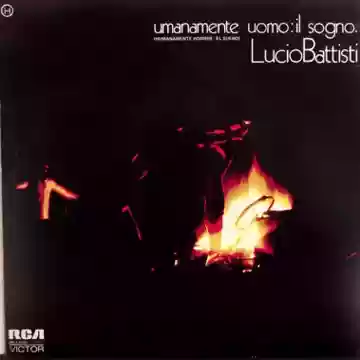
After the enormous success of "Emozioni" (1970) - and after the half misstep of "Amore e non amore" (1971) - Battisti decides to declare himself independent. Together with Mogol, he founds the production company "Numero Uno" and releases, after almost a year of work, what is probably his masterpiece: "Umanamente uomo: il sogno".
It is a mature, solid, and effectively robust album. The melodies, strong and vibrant, seem to completely distance themselves from the playful and vaguely hippie sounds of "Balla Linda" or "Per una lira"; Battisti's voice, always perfect and ingeniously ungraceful, seems to blend wonderfully with Mogol's words, sophisticated and at times even philosophical (remember the chorus of "I giardini di marzo"? "The universe finds space within me, but the courage to live it is still not there").
"Umanamente uomo: il sogno" is a fundamental album (I would say essential) to understand and analyze the Battisti phenomenon. That Lucio was a great composer of music is undeniable (can someone refute me?) and it's also fair to remember, repetita juvant, that no one today would be able to write music as beautiful. In Italy, musical culture is limited to considering artists as riffraff like Luca Dirisio or Dolcenera (both present, incidentally, at the Sanremo Festival 2006) and we don't realize, or perhaps pretend not to realize, that not even the great oldies of music (De Gregori, Conte, Bennato) know how to write a decent musical score anymore. And abroad it's not much better: not even the Rolling Stones seem to be much in the mood anymore! Battisti is therefore the only life raft. Let's be clear: even Lucio made some small missteps, but, in truth, they are laughable and forgettable peccadilloes. With "Umanamente uomo: il sogno" Battisti goes beyond his own ideas and convictions: he invents sweet and rarefied melodies (unforgettable the long final coda of "E penso a te") and sends half a decade (the '60s) to the scrap heap in one fell swoop, makes Edoardo Vianello and Wilma Goich forgotten, and breaks the chains of monotony: the music is no longer just a confused set of more or less catchy notes, it is a real complete and perfect musical score. The melodies, although very catchy, are constructed in a syncopated manner and, most of the time, even against the grain: have you ever tried listening closely to "Comunque bella"? Doesn't it seem like a kind of soundtrack in the style of silent movies of the '20s?
The album is an exciting collection of tracks swinging between the brilliant and the legendary: "I giardini di marzo", an unforgettable hit that Battisti will define, despite an evident commercial exploitation, a real miracle (perhaps the highest point ever reached by the Mogol-Battisti duo); "Innocenti evasioni", an irresistible tease of the ancient Italian sport of cheating ("What a sensation of light madness, is coloring my soul"), lively and sustained music, and curious vocal winks that Battisti imparts almost to every verse; "E penso a te" a skilful mixture of widespread romance and simple and reassuring philosophy (but so, so beautiful); "Umanamente uomo: il sogno", a long musical interlude where Battisti can vent all his restless and rebellious soul (memorable musical intuitions between guitar and piano); "Anche per te", a beautiful musical track strangely written by an inspired Mogol who, for once, seems to want to approach social issues and therefore society ("For you who put money next to him who sleeps, and who still offers a little love to those who do not know what to do with it"); "Comunque bella", very beautiful music, a bit sillier the lyrics, but "Comunque bella"; "Il leone e la gallina" a little-known Battisti fable that Lucio sings, and narrates, as if he were telling a Grimm brothers' story (to be rediscovered soon); "Sognando e risognando" is a successful hymn to love and the power of dreams; "Il fuoco" is the right finale (romantic and very Italian) that closes, in great beauty, a stunning album without concessions or falls.
A small curiosity: in the modern CD version "Umanamente uomo: il sogno" contains nine songs, in the old cassette version the songs are ten. Do you know what makes the difference? "La canzone del sole"... not trifles.
Loading comments slowly
Summary by Bot
The review praises 'Umanamente uomo: il sogno' as Lucio Battisti's masterpiece, marking his artistic independence with compelling melodies and profound lyrics. It emphasizes the album's mature and innovative musical style, its importance in Italian music history, and highlights standout tracks. The review also contrasts it with other contemporary Italian and international artists, underlining Battisti’s lasting legacy.Tracklist Lyrics Videos
Lucio Battisti
Lucio Battisti (1943–1998) was an Italian singer, composer and producer from Poggio Bustone. He rose to prominence in the late 1960s and 1970s with lyricist Mogol, crafting many of Italy’s most beloved songs, and later pursued a radical electronic and linguistic shift with Pasquale Panella (1986–1994). From 1980 onward he withdrew from concerts, TV and interviews, insisting the art should speak for the artist.104 Reviews
Other reviews
By the clash
A man, indeed, melancholic, nostalgic, naive, and defeated.
The dream has turned into a nightmare.
By 123asterisco
Not that I understood much, in fact. I would say I didn’t understand a thing. I simply liked drawing with The one with the fire.
Objectivity, in this case, is mute in the face of the unpredictability of a choice.
