
 •
Rating:
•
Rating:
THE REVIEW
Much has been said about the last period of activity (and even life) of Battisti, who mysteriously stepped away from strobe lights, TV events, and public appearances, self-isolating in a corner of darkness and solitude. His decision to divorce from Mogol, dissolving a legendary decade-long partnership of melodies and poetry among the most famous of the early light music era in Italy, and to immerse himself in an artistic and creative journey of broad international scope, caused quite a stir.
The album E già, released in 1982, was just the first episode of the experimental revolution undertaken by Battisti, a revolution that included in its package a collaboration with philosopher Pasquale Panella, sparse promotion of his works, almost no singles released, a total absence from stages and tours, and above all, a striking embrace of electronic-artificial sounds that had already invaded the mainstream panorama not only in the Anglo-American scene (just think of the New Wave movement, post-punk, and the emerging synth-pop of collectives like Depeche Mode, Erasure, Eurythmics, and the mixtures between these and the already fading star of disco) but which, however, struggled to be accepted in a country still loyal to the pompous classicism of singer-songwriter music. Sales suffered, and the glories of the '70s declined inexorably in the charts with Battisti's postmodern creations struggling to establish themselves in modest positions in the year-end rankings. But, setting aside any commercial counting for a moment, it was the pedantic critics who were the first to slam the enigmatic and rapid artistic evolution (or involution) of Battisti, compromising any post-Mogol recovery capable of holding up to the peaks of the fantastic idyll and turning up their snooty noses at the philosophical-hermetic incomprehensibility of Panella's proposal.
Following E già in the '80s were Don Giovanni and L'Apparenza, and the last decade began with La Sposa Occidentale, all works that - apart from a very modest "recovery" - represented only the perfect continuation of Battisti's desire to detach from the annoying aura of Italy's minstrel by embracing a musical and literary manipulation totally opposed to the ideals of society and the tricolor cultural proposal.
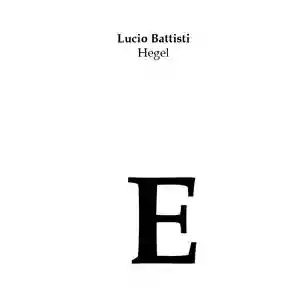
Hegel, 1994, was the last roar of a man who preferred the semi-anonymity, isolation, press silence, sequence of white covers, low chart achievements, and the bloody crusade of infuriated critics and early pro-Battistians who were disappointed: probably the pinnacle of the exasperated investigation filtered through Panella's most skillful pen, the album marries surreal, hermetic, extremely complex texts with diverse and composite sounds, not simply reducible to a vacuous and sterile digression of europop and synth-pop as claimed by many exegetes. The eight tracks offered, a sort of "free fall" into the work and thought of the German idealist not particularly loved by high school students forced to study his doctrine and repeat it orally during final exams, can be seen as the conclusive and perfect litmus test of the last Battisti—an artist tired of the saccharine melodrama à la italienne wanting to embrace novelty without falling into cliché and the frantic adaptation of a specific global trend (in this case, synthesizer sounds) to the Italian context. While maintaining the bleak hermeticism of his isolation intact, Battisti dares to experiment even more and tries to fuse in a precise unicuum the almost impossible comprehension and interpretation of the lyrics with sounds that seem to be lost in a strange frivolity, not assimilable to euphoria or contentment. The tracks on Hegel are thus an attempt to empathize, reveal, "humanize" a highly complex philosophical poem (devoid of verses, choruses, bridges, interludes, repetitions, and even almost "rapped" albeit without the vigor and emphasis of the leading exponents) bound to a nineteenth-century intellectual figure adapting it to the post-modern context of the late millennium, metaphorically representable with the sudden and abrupt sinusoids of electronic music. Among the best proposals of the last Battisti, not as contrived and computerized as narrated by many, Almeno l'Inizio, built on a euro-pop base with techno-funky motifs, the static and almost robotic La Voce del Viso, as well as the trip-hop investigation of La Bellezza Riunita and Hegel, cannot be missed.
Hegel could only definitively conclude a successful artistic and creative experimentation; however semi-unsuccessful when compared to the lucrative receptions of the idyll with Mogol. Even if snubbed, Battisti's production in the '90s was always awaited with trepidation, and the lack of an announcement of a successor to Hegel spawned a mountain of lies, April Fools', and inconsistent rumors, first and foremost the colossal hoax of a potential new work titled L'Asola (which in reality was meant to be read as "La Sola", or "scam" in Roman dialect). The mysterious demise of the minstrel, which occurred in 1998, definitively ended one of the happiest chapters of our musical panorama, a panorama for which today there is a dire need for a second Battisti capable of going beyond conventions, rejecting the hypocritical visibility of televisions and scandalous magazines, looking beyond the Alps and establishing a real and effective bridge over the Strait of Messina between us and others.
Lucio Battisti, Hegel
Almeno l'Inizio - Hegel - Tubinga - La Bellezza Riunita - La Moda nel Respiro - Stanze come questa - Estetica - La Voce del Viso
Loading comments slowly
Summary by Bot
Lucio Battisti's 'Hegel' marks his final artistic phase, characterized by a profound departure from traditional Italian pop into experimental and electronic domains. Partnering with philosopher Pasquale Panella, Battisti embraced complex, hermetic lyrics and synth-driven sounds. Despite mixed critical and commercial reactions, 'Hegel' stands as a bold, avant-garde statement that blends philosophy with music. The album reflects Battisti's isolation from mainstream visibility and his quest for creative innovation.Tracklist Lyrics Videos
Lucio Battisti
Lucio Battisti (1943–1998) was an Italian singer, composer and producer from Poggio Bustone. He rose to prominence in the late 1960s and 1970s with lyricist Mogol, crafting many of Italy’s most beloved songs, and later pursued a radical electronic and linguistic shift with Pasquale Panella (1986–1994). From 1980 onward he withdrew from concerts, TV and interviews, insisting the art should speak for the artist.104 Reviews
Other reviews
By voiceface
Hegel is not Battisti's masterpiece and not even a masterpiece in Italian music.
If you love music, by the twenty-first listen, you will love this album as well.
By GianlucaGT
Lucio Battisti and Pasquale Panella indulge in conjectural reasonings that arbitrarily wander in the fragility of the human psyche.
Everything is enclosed within the soul: emotion, suffering, joy. Everything sealed hermetically.
By Abraham
"'Hegel' is the simple combination of the monstrosity of words borne aloft without rest but with enormous grace by Pasquale Panella and Battisti’s appropriate melodies, never so appropriate indeed."
"'Hegel' is a magnificent mockery, the ultimate mockery, the disinterested farewell of Battisti. Electronics, heart, mind, and Panella."
By Battisti
Panella himself said in an interview that only those who have been to high school can understand Hegel, while if someone listening to the album is an idiot, they will admit that whoever wrote the lyrics wrote nonsense.
"Hegel" is, therefore, Battisti's testament... a last attempt at musical freedom by the artist.
