
 •
Rating:
•
Rating:
THE REVIEW
I admit that it's a difficult CD to review, but I'll give it a try anyway, even if I won't be too exhaustive.
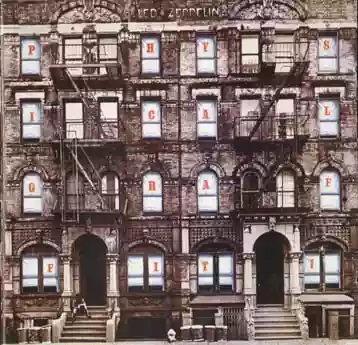
The album in question is "Physical Graffiti" by Led Zeppelin, released in 1975, about two years after the previous "Houses of the Holy". This album sits between the band's flourishing peak and its decline (which began with "Presence"). And it's completely different from what a listener might expect from the Zepp.
The first disc consists of 6 tracks, all with terrifyingly catchy rhythms that instantly get stuck in your head (the first is Custard Pie, where the riff hardly ever changes, but immediately sets an active tone for the work). Second track: The rover: another great song of pure rock (there was also a cover made - unfortunately - by Dream Theater, a band known for overdoing it with covers - see "Master of Puppets" and "The Dark Side Of The Moon").
The third track can be considered the expressive peak of this first disc: In my time of dying, which is divided into two parts. The first is relaxed, introducing a mortuary atmosphere, as the title suggests. The second part is an explosion of life, one of the group's most powerful songs: the guitar feels insane, the voice is strained, and the old "Bonzo" Bonham delivers one of the most significant performances of his career. The track brims with energy, and is hard to forget (especially for its well-deserved duration of 11 minutes).
The fourth track is Houses of the holy, which, in my opinion, contains a wonderful phrase: "Let the music be your master". Fourth track: Trampled Under Foot, another strongly energetic song, repetitively chanting "Let's talk about love. . .". Last track of the first disc: Kashmir, another peak of the album, with the presence of various strings and clearly eastern music (also lasting more than 8 minutes). By this point, at least 90% of you will be eager to hear the continuation of such a rock masterpiece. And rightfully so!
Because the second part starts with one of Zepp's most controversial tracks: In the light, a track closest to progressive, of considerable beauty. It continues with a great solo: Bron-Yr-Aur (not to be confused with Bron-Yr-Aur STOMP, from the third album - also because I prefer the former! But that's just personal taste). Third and fourth tracks of the second part: Down by the seaside and Ten years gone, one of the most beautiful songs on the entire Physical Graffiti. From here on, after these great tracks, the album takes the liberty to slightly fall off, with somewhat weaker, yet still valid tracks. They follow with Night Flight, The Wanton Song, Boogie With Stu (primarily written by Bonham), Black Country Woman, and Sick Again.
Thus we reach the end of a rather comprehensive work, but unfortunately, it marks the end of the era of great creativity that characterized the Zepp until this point. It's worth mentioning, though, that they couldn't have concluded it better than this, with 5 more than excellent albums already behind them. Some might say: "Yes, but the Pink Floyd, after 5 albums, created their most committed and significant albums!!!". Yes, but here we're talking about the Zeppelin, if that's not enough for you, it's your loss. : )
Note on the rating: 4 and a half stars (maybe not five, but what an album, folks!)
PS: a small appeal - I highly recommend listening to all the previous albums, each more beautiful than the last, even if this comment might seem obvious and unnecessary to some. But it's always better to clarify. . .
Loading comments slowly
Summary by Bot
Physical Graffiti by Led Zeppelin is a challenging yet rewarding album showcasing the band's transition between their peak and gradual decline. The review highlights its standout tracks like 'In My Time of Dying' and 'Kashmir,' praising energetic rhythms and powerful performances. While the latter half dips slightly, the album remains a rock masterpiece with diverse sounds and influences. Highly recommended for fans of classic rock.Tracklist Lyrics Videos
Led Zeppelin
Led Zeppelin were an English rock band formed in 1968 by Jimmy Page with Robert Plant, John Paul Jones and John Bonham. They became one of the most influential rock groups of the late 1960s and 1970s; the band disbanded after John Bonham's death in 1980.109 Reviews
Other reviews
By Antonino91
"Despite having some lazy and unremarkable moments, 'Physical Graffiti' is a very enjoyable album."
"Kashmir, where stunning hard sounds are intertwined with sounds with a decidedly Indian flavor, 8 minutes and 30 of great spectacle."
By Miki Page
"Physical Graffiti captures Led Zeppelin at the height of their career, in the prime of their strength."
"Kashmir is a mystical journey through oriental sounds, giving it a high level of expression and emotion."
By claudio carpentieri
"With the listening of ‘In My Time Of Dying’ one can say it’s witnessing one of the band’s absolute masterpieces!"
"A double release that once again confirms the graceful state of the four members of the dirigible, always capable of creating music worthy of the noblest meaning of this term."
By Rax
"Double albums are always bad records and Physical Graffiti is no exception."
"'Kashmir' is a real work of art with its memorable riff and oriental atmospheres."
