
 •
Rating:
•
Rating:
THE REVIEW
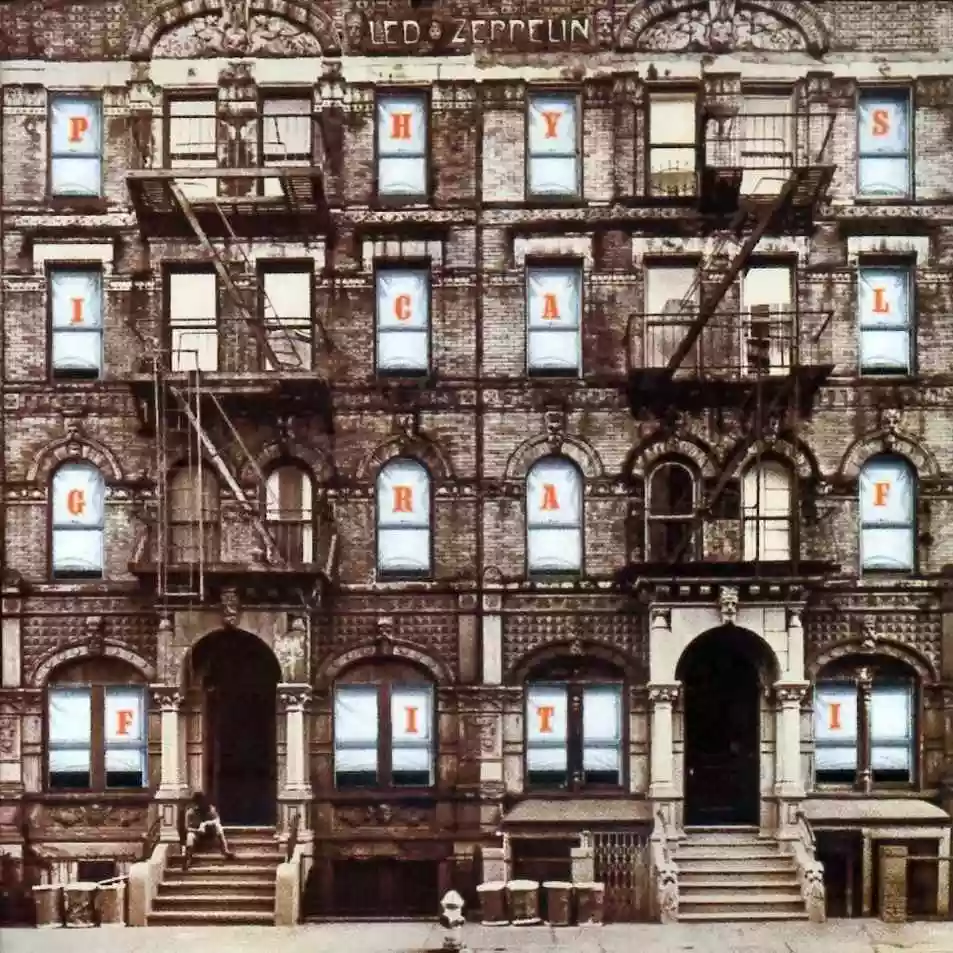
"Physical Graffiti" more than the successor of "Houses Of The Holy" is the direct result of the five preceding chapters. The work on this album began in November 1973 in intermittent phases, definitively resuming between January and February of the following year, also going through internal crises (...including the one where Jones took a break to reflect on his departure from the group!), which resolved positively.
Noteworthy is the handling of the hostile attitude held by the press, to which the band can only respond with facts. When the Melody Maker proclaims the Led Zeppelin as the best group after eight years during which this recognition was given to the Beatles, who in turn will be surpassed by the Zeps breaking the record for the number of paying attendees at a concert (the 55,000 souls in delirium at Shea Stadium in New York in 1965), with a fiery show at Tampa Stadium (Florida) where the paying attendees reached 56,800. This work (this time a double album) is enthusiastically received, grossing almost 15 million dollars in pre-sales alone, and also includes a supporting tour, with a team of 44 roadies necessary to keep everything running smoothly.
The arduous task of introducing us to the first record is left to "Custard Pie", whose impetuous start warms up the atmosphere well to develop an energetic musical ensemble, where Jones's clavinet and Plant’s accordion find a perfect placement. "The Rover" opens with Bonham's drum beats that engage in continuous crescendo dialogue with Page's "brawny" guitar, eventually generating a riff in pure ZZTop-style, with a fervent vocal interpretation where Plant passionately sets one of his most philosophical lyrics ("And our time is flyin', See the candle burnin' low. Is the new world risin' From the shambles of the old? If we could just join hands, If we could just join hands: E il nostro tempo stà volando, Guarda la candela che brucia lentamente, che un nuovo mondo stia sorgendo, Dalle rovine del vecchio? Se stingessimo le mani, se stingessimo le mani"). With the listening of "In My Time Of Dying" one can say it's witnessing one of the band's absolute masterpieces! It’s a track composed in eight hands by the four members, where the vocal charge well binds with the strident yet harmonic bottleneck, just as the anxious bass becomes one with the imposing drumming, delivering eleven minutes of pure auditory orgasm to the listener.
If "Houses Of The Holy" (as "The Rover" comes from the "Houses Of The Holy" sessions) is a flirtatious track that reflects carefreeness and bliss, "Trampled Under Foot" (with openly Wonderian inspiration) moves on enjoyably funky rhythms, where the guitar/keyboard pair are the guiding instruments for one of the tracks with the boldest lyrics ("Check that heavy hetal underneath the hood Baby, I can roll all night Believe, I got the proper tools, talkin' about love Talkin' about love, talkin' about...= Controlla questa belva sotto il cofano Bella, posso rullare tutta la notte Credimi, ho gli attrezzi giusti, parliamo d'amore Parliamo d'amore, parliamo"). The intricate "Kashmir" is the meeting point between two strongly different musical cultures, such as the western and eastern ones, where the typical elements of the band's music are condensed, from the leading guitar to the full rhythmic parts, this time further enhanced by a string section capable of delivering exemplary majesty.
The second record is ideally connected to the closure of the first one, with a composition like "In The Light", where the surreal and metaphysical climate is mixed with a more subdued vigor, also due to the more solemn role played by Plant. Following this, the calmness of the acoustic instrumental "Bron-Yr-Aur" and the composed "Down By The Seaside" (both resurrected from the Led Zeppelin III recording sessions) further temper the moderately lively atmosphere appreciated so far. Undoubtedly one of the best episodes goes by the name of "Ten Years Gone", not so much for the pleasant melodic interplay crafted or the distinguishable overdubs, but for that professionalism publicly displayed in alternately transitioning between acoustic and electric contexts. "Night Flight" is pure and transparent rock that goes straight to the heart, while "The Wanton Song" is a clear example of adrenaline in its raw state, reproducing some of the album's most solid minutes, robustly hard at least as much as the accompanying text ("With blazin' eyes I see my tremblin' hands, When we know the time has come. Lose many senses, lose command. Feel your healin' rivers run = Con occhi scintillanti guardo la mia mano tremante, Quando sappiamo che il momento stà arrivando. Perdo molti sensi, perdo il controllo. Sento scorrere i tuoi fiumi benevoli").
The cheerful atmosphere of "Boogie With Stu", reveals that even those who have created tracks that increased the artistic value of rock music need moments like these, to vent that capacity for even disorderly improvisation in which the company of the straightforward Ian Stewart (piano/keyboarder man, the sixth member of the Stones, so to speak!) can only help to manifest itself in its best form. Another quick foray into the acoustic field is provided by "Black Country Woman", which more scantily re-proposes the origins of blues, further highlighted by Plant's accordion. The definitive conclusion to this additional album effort is entrusted to "Sick Again" (blatantly dedicated to the L.A. Queens who followed them almost everywhere in the U.S.), a virile and dynamic track, which can only represent the perfect conclusion, almost like a signature at the bottom of an irrevocable pact.
A double release that once again confirms the graceful state of the four members of the dirigible, always capable of creating music worthy of the noblest meaning of this term, almost as if by enchantment, they had been consciously delegated by a Higher Entity to carry out a mission that few would have completed:....... Perhaps that of making everything they would render sonically audible shine......
Loading comments slowly
Summary by Bot
This review celebrates Led Zeppelin’s Physical Graffiti as a pivotal double album that builds on the band's previous work. It highlights the band's ability to overcome internal struggles and press hostility, producing a diverse mix of hard rock, funk, and Eastern-inspired tracks. Key songs like "Custard Pie," "In My Time Of Dying," and "Kashmir" showcase their musical mastery. The album’s commercial success and extensive tour emphasize its legendary status. Ultimately, it affirms the band’s unique artistic vision and timeless appeal.Tracklist Lyrics Videos
Led Zeppelin
Led Zeppelin were an English rock band formed in 1968 by Jimmy Page with Robert Plant, John Paul Jones and John Bonham. They became one of the most influential rock groups of the late 1960s and 1970s; the band disbanded after John Bonham's death in 1980.109 Reviews
Other reviews
By Antonino91
"Despite having some lazy and unremarkable moments, 'Physical Graffiti' is a very enjoyable album."
"Kashmir, where stunning hard sounds are intertwined with sounds with a decidedly Indian flavor, 8 minutes and 30 of great spectacle."
By Miki Page
"Physical Graffiti captures Led Zeppelin at the height of their career, in the prime of their strength."
"Kashmir is a mystical journey through oriental sounds, giving it a high level of expression and emotion."
By paloz
The first disc consists of 6 tracks, all with terrifyingly catchy rhythms that instantly get stuck in your head.
'In my time of dying' brims with energy, and is hard to forget... delivering one of Bonham's most significant performances.
By Rax
"Double albums are always bad records and Physical Graffiti is no exception."
"'Kashmir' is a real work of art with its memorable riff and oriental atmospheres."
