
 •
Rating:
•
Rating:
THE REVIEW
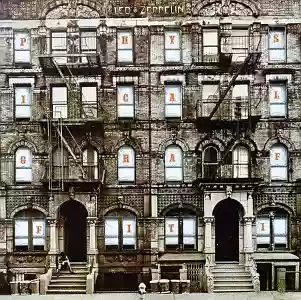
"Physical Graffiti", that is Led Zeppelin at the pinnacle of their career and creativity. With this masterpiece, the Led achieve the artistic maturation started with "III" and continued with "Houses of the Holy", creating the only double album in their discography where various musical genres are skillfully blended, from hard rock to funky, passing through blues and oriental sounds, with peaks of expression and intensity truly at the highest levels.
The album opens with "Custard Pie", a hard-rock piece with rough sounds, followed by the more "clear" rock of "The Rover", a song from '70, where Page places one of his riffs and one of his most perfectly constructed solos. It follows with "In My Time Of Dying", a blues standard, to which Bonham's scorching drums, Plant's dramatic singing, and Page's sadistic guitar give a frightening emotional intensity, making it a Led cornerstone. It continues with the impish "Houses Of The Holy", dating from '73, with a heavy funky track, "Trampled Under Foot", where Jones stands out on the keyboard and Plant sings the analogies between car mechanics and the sexual act, reaching the apotheosis of "Physical Graffiti": "Kashmir". Bonzo's imposing drums, Page and Jones' slow and majestic riff, with Jones still on the keyboard, and the epic journey narrated by a Plant in great shape make this track a mystical journey through oriental sounds, giving it a high level of expression and emotion.
The second disc opens with "In The Light", a genuine masterpiece that picks up the oriental sounds of "Kashmir" but, unlike it, is not imposing but more subtle and sinuous; while "Bron-Yr-Aur" is a splendid acoustic instrumental by Page. It continues with the lazy and unjustly underestimated "Down By The Seaside", from '70; then comes "Ten Years Gone", a romantic ballad built on the carpet of Page's perfectly harmonized 14 guitar overdubs, where Plant softly sings the story of his lost love. The next track is "Night Flight", a sunny rock from '71, with Page and Bonham at their best form, Plant's passionate singing, and Jones on the organ. The hard sound that has always distinguished the Led returns: "The Wanton Song" is a hard-rock about sex, with raw sounds, based on Page's crushing and obsessive riff; the atmosphere then relaxes with two amusing acoustic tracks: "Boogie With Stu", a negligible jam with Ian Stewart from '71, and "Black Country Woman", a good piece with a carefree atmosphere from '73. Finally, we return to unbridled sex: "Sick Again" is another fantastic hard-rock, with Page in the lead, but the other three also deliver a superb performance, making this track one of the best Led performances.
When the album was released on February 24, 1975, it received critical acclaim and was an enormous success worldwide: in one week, it climbed to the top of the US and UK charts, and just on pre-orders, it grossed 15 million dollars. "Physical Graffiti" is for the Led a sort of return to the origins: the sound is hard, dirty, raw, far from the crystalline sounds of "Houses Of The Holy", and it is their perfect album: the most complete, the most refined, and the most ambitious: a monument of hard-rock, containing the best music of all the '70s, as well as all the features that made the Zeppelin sound. Many consider it the beginning of the Zep’s artistic decline, but it is exactly the opposite: "Physical Graffiti" captures the Led at the height of their career, in the prime of their strength. Their decline would instead begin with Plant's car accident in August 1975: from then on, a series of unfortunate events would befall the group, affecting their artistic performances: nothing would ever be the same again.
Loading comments slowly
Summary by Bot
Physical Graffiti represents Led Zeppelin at the peak of their creativity, skillfully blending multiple genres in a groundbreaking double album. Highlights include powerful performances on tracks like "Kashmir" and "In My Time Of Dying." The album's raw, hard rock sound is a return to origins and a monumental achievement. Despite views of decline, the band was at their prime during its release. The album achieved massive commercial and critical success worldwide.Tracklist Lyrics Videos
Led Zeppelin
Led Zeppelin were an English rock band formed in 1968 by Jimmy Page with Robert Plant, John Paul Jones and John Bonham. They became one of the most influential rock groups of the late 1960s and 1970s; the band disbanded after John Bonham's death in 1980.109 Reviews
Other reviews
By Antonino91
"Despite having some lazy and unremarkable moments, 'Physical Graffiti' is a very enjoyable album."
"Kashmir, where stunning hard sounds are intertwined with sounds with a decidedly Indian flavor, 8 minutes and 30 of great spectacle."
By paloz
The first disc consists of 6 tracks, all with terrifyingly catchy rhythms that instantly get stuck in your head.
'In my time of dying' brims with energy, and is hard to forget... delivering one of Bonham's most significant performances.
By claudio carpentieri
"With the listening of ‘In My Time Of Dying’ one can say it’s witnessing one of the band’s absolute masterpieces!"
"A double release that once again confirms the graceful state of the four members of the dirigible, always capable of creating music worthy of the noblest meaning of this term."
By Rax
"Double albums are always bad records and Physical Graffiti is no exception."
"'Kashmir' is a real work of art with its memorable riff and oriental atmospheres."
