
 •
Rating:
•
Rating:
THE REVIEW
Can guys who go around dressed like hippies conceive a work that condenses in about forty minutes everything that in the realm of “metal” would be developed years later and in a stylistic and cultural evolution lasting at least a decade?
It's one of the oddities, the most glaring paradox, if you will, of this genre, which has established itself in the musical world for its visual, content, and verbal harshness, but if you look closely, it originates from primordial elements quite distant from what would emerge: the horns of Ronnie James Dio, which became the universal greeting of metalheads around the world, are nothing but the "sciò sciò" that the (Italian) grandmother would do to ward off the evil eye. The studs and leather clothes "invented" by a homosexual and former hippie, flying in the face of the masculinity and machismo preached by metal philosophy. The mascot of the Iron, which gave rise to hundreds of increasingly grim and gory imitations, sees one of its inspirers in a (at least visually) punkish singer.
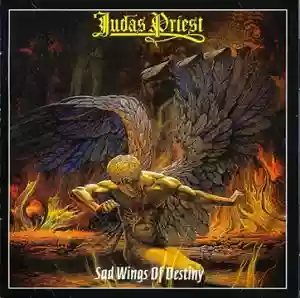
In 1976, these Birmingham gentlemen, whose homosexual singer I just mentioned, have an enlightenment, a revelation, but I would more likely call it an unintentional slip: what else can you call "Sad Wings of Destiny" if not something you absolutely did not plan to do? If your first album is called "Rocka Rolla" and it's perfect hard rock, and those to come will all be hard rock, at least until "Screaming for Vengeance" (but even here, I think it's hard rock made as heavy as possible), and then even fall into the gay metal of "Turbo" (I shudder to remember the lyrics...), what could have spawned a concept—because that's what it is—where everything exudes “metal”? Away with the little songs, but a perfect synthesis of story-songs, built on texts that are at times bitter (the victim of changes, the deceiver of dreamers), at times resigned (the epitaph), at times violent and grim (the tyrant and Jack the Ripper), leaving only the burden of the world's gloom in your heart.
The guitar does not only produce riffs and solos, but it is a second voice, a lament, a call to look and seek a horizon in the darkness: when "Victim of Changes" stops halfway and you follow with your ear, eyes, and heart that echo that fades into the distance, punctuated only by a metallic sound that seems to scatter tears in the wind, well, damn, what's left to say: this is METAL.
So, the question: who was in the recording studio with Tipton and company? Who inspired them for the epic "Victim of Changes"? Who for the primordial speed metal of "Tyrant" and "The Ripper"? Who yet for the amazing, moving, and absolutely innovative "Dreamer Deceiver", a slow track that doesn't talk about love and sex but instead opens up beneath you an abyss of loneliness where only the seed of slowed-down thrash could bloom?
I still don't know the answer.
Loading comments slowly
Summary by Bot
Judas Priest's 1976 album Sad Wings Of Destiny is praised as a foundational metal work that blends bitter, resigned, and grim themes across epic, innovative songs. The band transcended their hard rock beginnings to create a powerful, stylistically rich metal concept album. The guitar work adds emotional depth, and the album’s influence resonates across metal’s evolution. A paradoxical mix of visual and sonic contrasts highlights its originality and lasting impact.Tracklist Lyrics Videos
Judas Priest
Formed in Birmingham in 1969, Judas Priest are among the pioneers of heavy metal, known for twin-guitar attack and Rob Halford's high vocals. Their career spans classic studio albums and acclaimed live records.49 Reviews
Other reviews
By Revolver
"The album immediately starts with a myth, the Judas Priest pearl, the indestructible and unbeatable 'Victim Of Changes.'"
"Sad Wings of Destiny... its merit lies solely in one feature: the music. Let's give thanks to the Gods of Metal."
