
 •
Rating:
•
Rating:
THE REVIEW
It always seems strange when your idols venture into unexplored territories (for them). Even stranger when it's done by people so attached to history as they are responsible for history itself.
They don’t do it for success or money, but simply because they find themselves in a position to do so... Let's say they can afford it (or at least they believe they can)... Let's also say that, due to internal upheavals, some historic bands are prompted to change and conduct experiments they have long considered.
However, this change is not always welcomed by everyone as a positive upheaval... Many find themselves having to contend with angry and disappointed fans who bring the band back down to earth to reconsider their choices. Let's be honest: Regardless of how much positive history one might have, no one can afford to consider themselves untouchable and believe that anything can be received as manna from heaven (who said Metallica?).
A striking example of this in the Heavy Metal universe was, around the turn of the new millennium, the Judas Priest.
A fundamental band for the birth and development of Metal itself, founded 35 years ago when Metal was still an undefined and unexplored project, hinted at in part by a few pioneers and brave innovators (I won’t name names, everyone knows them). The Judas Priest have contributed from the beginning (though influenced by Rock’n’Blues in their early musical steps) to create and define the world of Metal as we know it now (“Sad Wings Of Destiny” 1976, is considered by many the first true Metal album in history).
It's pointless to reiterate the historical importance of albums and songs from which all subsequent bands would draw names and inspiration for their music... Let's just say that the greatest merit of Judas Priest has been to never retrace their steps, to never staticize on a well-defined musical choice, always evolving the sound they proposed, while remaining always anchored to a certain style (created by themselves), trying to expand and vary their proposal, as if they wanted to meticulously define the entire universe of classic Heavy Metal where all other bands would move... In short... Like a “God” (Metal God) who created the realm for their “children”. In essence, it seems that Judas Priest created Heavy Metal and have (in part) developed (almost) all possible variants within the (“classic”) Heavy Metal itself. In their career, they have thus modified their music while remaining always attached to a musical proposal they helped to shape... This until 1997.
In 1997, indeed, after years of silence, due to the loss (for personal disagreements) of their most identifying element (the legendary singer Rob “The Metal God” Halford), they do something unexpected... They enlist a young talent with iron lungs (Tim “Ripper” Owens), who previously played in a Judas Priest cover band (British Steel), and they create what is considered the “album of discord” with their fans: “Jugulator”.
Critics are divided: some (few) see it as a masterpiece giving new life and setting new horizons for the Priest's music, while others (many) dismiss it as a complete misstep begging for the return of the great Rob and accusing them of selling out and losing their way.
But how does this “Jugulator” sound? Well, let's say it sounds “strange”... Especially when compared to what the band had done previously.
Indeed, it must be pointed out right away: this work does not belong (as we were always accustomed by the Priest) to the “classic” Heavy Metal universe.
It is more of a strange (courageous) experimentation-contamination of various aspects (Metal) that have little to do with classic Metal: electro-industrial parts, references to evolved Thrash Metal with excursions into a kind of hyper-aggressive and sharp Nu-Metal... Gone are the metallic gallops, gone are the frantic chases of the two guitars in whirlwind solos, gone is the genuine and pulsating rhythmic section in favor of a more “modern” sound and, in a certain sense, much nastier, more violent, and “sharp” (with tight tempo changes and an incredible and emphasized drum work by the granite Scott Travis)... An incredibly compact, powerful, and solid sound where melody is used more sparingly than in the past... A sound that, I must say, at times (few) closely resembles that of the massive “Demanufacture” by the great Fear Factory.
This was the album that the good Glenn Tipton (guitarist and leader after Rob’s departure) had in mind for a long time and that the line-up change (and his incredible Super-Ego) allowed him to put into action.
At the beginning, back in 1997, I must say that I really liked the album... I had never heard the Priest so fierce and technical, and I was quite fond of the new singer... But then, as time went on, my enthusiasm waned more and more... Let's say I understood the true value of this record.
By this, I don't mean that it’s a bad record, and I absolutely distance myself from those who claim that it’s merely “authentic garbage”, I’m simply saying that, in my view, this is a “disposable” record.
Let me explain... A “disposable” record is one that uses immediacy and frontal impact as its best weapon, and then fails to maintain the exciting expectations generated by early listens, resulting in becoming more and more predictable (many Power Metal records, for example, suffer from the “disposable” complex).
That doesn’t mean the album is sterile and insipid, on the contrary... Inside we can find very successful and decidedly catchy tracks, such as the devastating title track (which seemed to me, however, since the beginning an attempt, not completely successful, to reproduce the winning formula of “Painkiller”) or the (very long) concluding piece with an almost “evocative-spiritual” flavor “Cathedral Spires”; but also pieces like “Death Row” (with the memorable initial phone call), “Burn In Hell” (with its overwhelming crescendo), “Blood Stained” and “Bullet Train” (which distantly recall the old “Priest Style”) manage to be appreciated for their dynamism and destructive charge...
It's a pity that all of this is inextricably linked to a significant tendency to flirt with modern-metal sounds that have little to do with the group's twenty-year history and that even less suit the (limited in this realm) capabilities of our dear ones... Not to mention much less successful pieces where repetition reigns supreme along with a good dose of boredom (“Dead Meat”, “Decapitate”, “Brain Dead”, “Abductors”)... Plus, even within the more successful moments, there is the impression that something is off and that much more attention was paid to the form (stratospheric production) than to the substance. Tim's voice is indeed powerful and endowed with great extension (probably even better than Rob’s in the lower and darker parts), but it cannot be compared to Halford's for interpretation and pathos.
It almost seems that the late millennium Judas Priest, after looking around for years and listening with eager interest to the new and innovative metal proposals from post-thrash bands like the (already mentioned) Fear Factory, Machine Head, Grip-Inc et cetera, wanted to show that they too were capable of re-proposing themselves and reaffirming their diva role within Metal. It's just a shame they didn't succeed, partly due to incapacity (in that field) and partly due to unsuitability.
All this brings us to the crucial point: why does this album ultimately result in being a (very) mediocre work?
Contrary to what many think, I believe the problem does not lie in the fact that Judas Priest changed style and sound with this “Jugulator” (I am convinced that ranks of fans would have cried scandal even if they managed to produce a magnificent album but not pure Heavy Metal)... The problem is that this “Jugulator” is, very simply, an uninspired and tragically inconclusive album, that offers no new insights and isn't even a summary of what Metal could be at the end of the (last) millennium... This regardless of the musical territory (Post-Heavy-Thrash) in which this work moves (I would have been the first to appreciate a successful genre change).
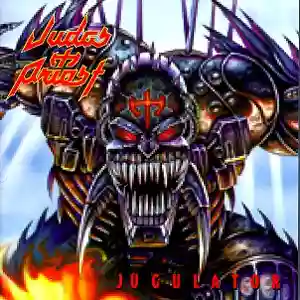
Finally a warning about the cover: is it possible that in seven years of inactivity and time, and with all the work for the production, they couldn't manage to create a cover that doesn’t look like it was drawn by my (possessed) cousin??? There is probably a reason... But we are not given to know.
Loading comments slowly
Summary by Bot
Judas Priest's 1997 album Jugulator marked a drastic shift from their classic heavy metal roots, introducing a harsher, modern metal sound. The change was divisive among fans and critics, with some appreciating the bold experimentation and others viewing it as uninspired and inconclusive. While the album features powerful performances and some standout tracks, it lacks the enduring impact and emotional depth of earlier works. Ultimately, Jugulator stands as a controversial and disposable record within Judas Priest's catalog.
Judas Priest
Formed in Birmingham in 1969, Judas Priest are among the pioneers of heavy metal, known for twin-guitar attack and Rob Halford's high vocals. Their career spans classic studio albums and acclaimed live records.49 Reviews
Other reviews
By Starblazer
Steel. Heavy metal in its purest form forged in the furnace of hell by Master Glenn Tipton.
It is truly a mission impossible to resist the irresistible perverse crescendo of 'Burn In Hell'.
By Rainbow Rising
Jugulator is the bastard child of Painkiller, a big, muscular guy with a Slayer t-shirt and a Pantera tattoo.
Owens doles out plenty of high notes on a nice wall of guitars and helicopter double kick.
